Overweening Generalist

Showing posts with label human brain. Show all posts

Friday, October 11, 2013

Euclidean Quotidian: 90 Degree Angles and the Semantic Unconscious

Ten Scattershot Ideas, One For Each Finger and Two Thumbs

1.) Supposedly the medieval Europeans thought Euclid's works were the same as the one we know as Eucleides of Megara, so olde books about geometry in Europe were by "Megarensis." They weren't the same dude: "Megarensis" was a contemporary of Plato; the great Euclid of high school geometry was closer to being contemporary with some of Plato's early students.

The Arabs got hold of Euclid and thought the name was made of ucli (the key) and dis (measure). At any rate, his Elements was the model of rationality ne plus ultra, and I'm writing this piece after pondering Euclid's influence on two philosophers, Vico and Spinoza, who were not the first to mimic the potent rhetorical form and structure of Euclid.

2.) In Peter Thonemann's review of three books for the TLS, note the story of the Malawi girl, who charged with learning how to set a dinner table English-style, experienced a steep learning curve, because the world she grew up in was curvilinear; there were no right angles. We had to learn the "order of things" we take for granted as "the way things are done."  I also thought it interesting that  with the Romans rolling through the peoples of Europe, they brought right angles and rectangles and ideas about straight lines and order with them, the Irish being the last to "convert," and it went along with Christianity.

There's a question of the "reading" of artefacts from the long-dead: if they built with right angles, was their social structure more authoritarian? Some think so. Others think what matters is the initial posit and then iterated forms that grew from there. Mikhail Okhitovich, Soviet sociological thinker of the 1930s, asserted that right angles originated with private land ownership, then extended to architectural forms, and represent a non-communistic mode of thought; because of this curvilinear forms in architecture were the best and most egalitarian form.


Before rigid hierarchical forms of State, what was often found were circular forms, which have a center but seem to resist hierarchy...on some level. Do Euclidean forms give rise to a form of thought that permeates a culture, and if so, is this idea mostly unconscious, part of the paideuma?

Many non-communist Left-ish thinkers have assumed that dwellings based on rectangles and 90 degree angles were somehow metaphors for artificiality, non-organicism, or simply convention, and living in "boxes" tended to encourage conformist social ideas and a stifling of creativity. Look at any fat book on great 20th century architects and buildings. Look at Buckminster Fuller.

3.) A pop kulch example of a leftist strain in American thought is found in this folk song: "Little Boxes." Boxes and conformity. Boxes and restraint. Boxes and the suburbs, Levittowns.

4.) The distaste for "boxes" runs in countless intellectual and aesthetic fields. While Nietzsche lays out with this probe: "Mathematics would certainly not have come into existence if one had known from the beginning that there was no exactly straight line, no actual circle, no absolute magnitude," and we are left to wonder, our contemporary Nassim Nicholas Taleb writes in his Bed of Procrustes, "They are born, then put in a box; they go home to live in a box; they study by ticking boxes; the go to what is called 'work' in a box, where they sit in their cubicle box; they drive to the grocery store in a box to buy food in a box; they go to the gym in a box to sit in a box; they talk about thinking 'outside the box'; and when they die they are put in a box. All boxes, Euclidean, smooth boxes." (p.31)

5.) Art critic Jed Perl wonders about the state of painting and painters in today's art world. At one time the rectangle frame of the painting was a given. The artist played an outre role in society. But now practically all competing media are either rectangle shaped (iPod/iPad/iPhone?), or text is read within a rectangular-ish frame (the screen you're using now?); further: images in the most popular media are dynamic inside a rectangular frame: TV, films, the camera frame. Could it be that the "degree of stabilizing supremacy of that rectangle has been undermined by the technology that surrounds us?," Perl asks. He knowns painters. It's his milieu. And Perl asserts that today's painter, because of the static image inside a rectangle, has been forced to go on the defensive or offensive, which presents a new hindrance. At the same time, Perl asserts that painting is not dead.

6.) In what appears to be an untitled poem, Tony Quagliano:

I read this poem about geometry
or shadows
or was it poetics, or
some analogy among the three---
that sounds right
a poem about science and art
itself some artful connection
opting for the poem of course (being a poem) slyly
saying math's impure
or at least not pure enough
for one geometer not impressed by Euclid
or more impressed by non-Euclid
or some such twist
and what gets me, why I mention this at all, is
that the poem was good

though no one bled directly in it
words were clean, scientific
stitched in artful lines for the anthologist
and while a slashed wrist would have to wait
this poem of shadows, or math
or some connection in the courtyard of art
this fragile suture, poet to geometer, takes life
over your dead body
and mine

and it was good
which is why I mention this at all.
-p.65, Language Matters: Selected Poetry

7.) I remember reading about some hotshot engineering students - probably at CalTech? - and the problem of stacking oranges at the grocery store. Because of their roundness, there's far more non-used-up space (AKA "air") between oranges. How to maximize the number the oranges stackable? Well, you obviously make square oranges, using the Lego-mind. Easier said than done.


I hadn't thought much about shipping containers and how they have made the world seem far smaller and distance irrelevant until I read Andrew Curry's fine piece in Nautilus not long ago. "Invisible to most people, (shipping containers) are fundamental to how practically everything in our consumer-driven lives works." As for packing as much stuff into a space as efficiently as possible, it doesn't get much better than shipping containers. ("Invisible to most people...")

Score one for rectilinearity.

8.) One of the Prophets of Euclidean space and modern consciousness, Marshall McLuhan, in 1968:

The visual sense, alone of our senses, creates the forms of space and time that are uniform, continuous and connected. Euclidean space is the prerogative of visual and literate man. With the advent of electric circuitry and the instant movement of information, Euclidean space recedes, and the non-Euclidean geometries emerge. Lewis Carroll, the Oxford mathematician, was perfectly aware of this change in our world when he took Alice through the looking-glass into the world where each object creates its own space and conditions. To the visual or Euclidean man, objects do not create time and space. They are merely fitted into time and space. The idea of the world as an environment that is more or less fixed is very much the product of literacy and visual assumptions. In his book The Philosophical Impact of Contemporary Physics Milic Capek explains some of the strange confusions in the scientific mind that result from the encounter of the old non-Euclidean spaces of preliterate man with the Euclidean and Newtonian spaces of literate man. The scientists of our time are just as confused as the philosophers, or the teachers, and it is for the reason that Whitehead assigned: they still have the illusion that the new developments are to be fitted into the old space or environment.
-p. 347, Essential McLuhan, from an essay, "The Emperor's New Clothes," originally in Through the Vanishing Point: Space in Poetry and Painting, co-written with Harley Parker. McLuhan asserted in 1968 that "the artist is a person who is especially aware of the challenge and dangers of new environments presented to human sensibility." McLuhan thought artists were subversive because society expected the replication of existing orders and forms, but artists violated these expectations.

Three thoughts:
a.) In 1968 McLuhan may have been far more prophetic than he thought: not only are scientists still trying to come to terms with non-Euclidean findings in astrophysics, materials science, microbiology, subatomic physics (but I do see some inroads), but going back to Jed Perl's essay on the "state of the art" in painting 45 years later, McLuhan's "with the advent of electric circuitry"...and I think maybe painting, contra Perl, may be, if not dead, in the ICU, condition: critical.

b.) When I do that mental yoga which allows me into McLuhan's thought-space, I realize how intensely Euclidean my assumptions seem, as based on the idea of Gutenberg Man and the space of the literate reader of texts, for hours every day, decades on end, eyes decoding 26 symbols with punctuation, left to right, linear left to right, left to right (THIS), left to right, punctuation. In my conditioned assumptions of quotidian reality, objects "really do" fit inside of space and time. I want them to create space and time themselves, by power of their sheer Being, capital be. But most of the time: no. I have to work on it. How do I get out of Gutenberg Euclidean head space? Cannabis, film, walks in nature, animation, humor and surrealism, reading Joyce or Pound, get into the Korzybski-Zen level of the phenomenal event-level, pre-language, observing without hypnotizing and misleading "woids," and then careful consciousness of abstracting, watching myself abstract until It all melts, or something strange in science. You have your ways.

c.) For such a overwhelmingly "straight" Euclidean man, Prof. McLuhan's (whose personal politics were a sort of conservative Catholic with tinges of anarchy?) mind was, to me, reliably non-Euclidean and psychedelic. His deep immersion in James Joyce and Ezra Pound was probably a significant influence here, but there was so so so so much more. He was an absolute virtuoso with playing with metaphors and combining those ideas with others, if only just to see if they were thrilling and made anyone else want to think about some idea in some new way. I find this an anarchist strain in McLuhan's thought. (How about I take catholic idea about the senses and think about the new electronic media, like radio of TV? I can add ideas I copped from Thomas Nashe, Wyndham Lewis, Ezra Pound, Harold Innes, and anthropologists. And Finnegans Wake! And mythology, Poe, Einstein,  and painting's figure/ground and the rise of the Renaissance's vanishing point? And then: Vico! And commercials and comic strips!? And Walter J. Ong...and and and...)


9.) Robert Anton Wilson's extensions of Timothy Leary's ideas of the evolution of "circuits" in the human mind drew heavily on Euclid for the first three "domesticated primate" aspects of all of us: the oral/biosurvival circuit is about approach/avoidance and is represented in Euclidean metaphor as "forward-back." The second circuit stage of development (according to the theory, we "imprint" all of these circuits), the anal/territorial circuit, is about up/down, and represents the deeper levels of any thinking about politics, whether within the family, local city, national, or international. Notice up/down fits well in Euclidean space-thought.

The third circuit is about right/left and for mammals like us, based on the bilateral symmetry of the body and the nervous system, which nature has seen fit to encourage a dominance of one side over the other, most people's left hemisphere's motor cortex encouraging right-handedness. Conceptual thought and left-right equations (think: algebra!) and logic all fall under the third circuit.

Although neuroscientific ideas about hemisphericalization in evolution and discrete modules of each of the brain's two hemispheres has moved away from a once-popular notion of the "holistic" right hemisphere and the "linear" left, these metaphors still seem to resonate. For Wilson, right-handedness and math and literacy in symbolic humans indicate a left-hemisphere domination (the left hemisphere controls the right side of the body) which has unconsciously biased "linear" and hierarchical forms in human history, which begins with writing. The right hemisphere, relatively "silent" and seemingly subdued by assumptions about "reality" made by the left hemisphere (especially in industrialized Western humans), has yet to harness the intuitive genius housed in the right hemisphere.

So much ink has been spilled over these ideas, once extremely popular but now seemingly in a slow descent. Nevertheless, these ideas live, as you may have noticed from a conversation within the past few months. Why?

Well, I think it's because there's still some truth to the right/left brain modularity-of-function idea, although it's not as simple as those who popularized the findings of the Sperry and Gazzaniga "split brain" experiments. Also: I think Wilson was on to something: "Right-hand dominance, and associated preferences for the linear left-lobe functions of the brain, determine our normal modes of artifact-manufacture and conceptual thought, i.e., third circuit 'mind.' It is no accident, then, that our logic (and our computer-design) follows the either-or, binary structure of these circuits. Nor is it an accident that our geometry, until the last century, has been Euclidean. Euclid's geometry, Aristotle's logic, and Newton's physics are meta-programs synthesizing and generalizing first brain forward-back, second brain up-down and third brain right-left programs." - Cosmic Trigger vol 1, pp.199-200

For Wilson (and Leary) there were relatively "new" circuits that have appeared in human evolution over the last 11,000 years or so. And they seem non-Euclidean, more organic, curvilinear, and more inclusive of a holistic, total-floating body sense, as if we were meant to move through space/time.

To be clear: Euclid and his forebears the Pythagoreans wormed their way into our paideuma due to the natural evolution of mammals on a rocky watery planet with an atmosphere conducive to carbon-based replicative life forms under the purview of a energy-source star at a Goldilocks distance. We got Euclidean forms because that's the way we evolve. Which may Beg the Q, but it's one of my favored narratives, and my entire brain, both hemispheres, seem to harmonically resonate with it.

[Further extrapolations from Wilson on this complex of ideas: see Illuminatus! Trilogy, pp.793-795; Prometheus Rising, pp.97-100; Schrodinger's Cat Trilogy, pp.342-347.]

10.) I grew up in boxy architecture, and when I first encountered this idea - about rectangles and 90 degree angles and conformity - I also found out we forgot how we did it, but at some point we had to learn to see in 3-D spatial terms. Supposedly some cultural anthropologists had gone into deepest darkest rain forest Africa and lived with and studied pygmies, whose complete environment was always giant trees and vines and moving through those living breathing green spaces, always canopied by jungle thickness as "ceiling."And when they were taken to a clearing at the edge of the forest and the anthropologists pointed to a man and a jeep far off in the distance, the natives thought they were seeing a tiny man. They had not learned to see over vistas of "open space."

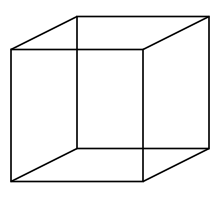
So, I lay in bed and looked at the point where the ceiling meets the walls. Two walls meet at the "point" of the ceiling. And I tried to remember what it was like to not see that as a point in space. It's akin to many visual illusions or the Necker Cube you've all seen. It was fruitless. Until, one day...O! Such little things that thrill me. Aye: the corner was on a flat plane. And then it pointed out toward me...

I attest, I assert that when I enter buildings of a non-Euclidean build, my consciousness is altered. An inventory of memories and anecdotes would bore you and me, but I wonder if you have felt the same? I love round rooms. A spiral staircase can really get me going. On and on. But here's the thing: if I grew up in a non-Euclidean house, I strongly suspect that entering a Euclidean "tiny box" house would alter my conscious also. Because I think these represent the unfamiliar structure of space...

I hope I didn't come off like some un-hep "square" in this blogspew.


Wednesday, October 2, 2013

The Drug Report: Crisis In Psychopharmacology

It's been at least 30 years since a truly new drug has hit the market that addresses the needs of patients suffering from depression, anxiety, manic depression (now rather bloodlessly called "bipolar disorder"), and schizophrenia. Any "new" drugs in the last 30 years have been basically some variation on an older, established drug (called "Me Too" drugs), in an effort of competing drug companies to keep up with the competition. These non-new "new" drugs are almost always marketed as "blockbuster" or "revolutionary" therapeutics, touting less side effects than older, competing drugs. They are not new and the side effects are just different, not less. 50 or so psychiatric drugs bring in $25 billion a year in Unistat alone. And they're pretty lousy.

(I know, I know: you'd be far worse off without the one that worked for you. Hey: they do some good. For some people. I want better drugs for you, is all. And we were promised them with the 2000 mapping of the human genome. So...where are they? Later.)

                                                        serotonin

The drugs people use - by every estimate I've seen between 20% to 25% of the Unistat population takes  at least one of these - were discovered by accident. By serendipity. In the 15 years after 1945. In 1952 a tuberculosis drug didn't work for TB, but iproniozid sure elicited euphoria when tested! Bingo: the first antidepressant. The drug that became Tofranil was supposed to work for schizophrenics, but it didn't help them, only make them run naked into town, laughing. Another antidepressant. In 1949 lithium was discovered, by accident, to treat manic depression. In 1957 Leo Sternbach was about ready to give up his research into a class of antihistamines, things were looking like a dead-end, when he stumbled onto the benzodiazepines: your Valium, Xanax, Lorazepam, Klonopin, etc: an empire of anti-anxiety drugs, and a huge influence on the tonality of culture in the West in the latter half of the 20th century.

With better technics, we learned much more about neurons and neurotransmitters. The SSRIs seemed to treat depression and anxiety. They were really the last big breakthrough. Ever since then, clinical trials that have made it to Stage III have been nothing but huge, sad, very expensive wastes. And so Novartis, Glaxo-Smith-Kline, Astra Zeneca, Pfizer, Sanofri and Merck have by and large quit trying. They've halted clinical trials, moved onto research that shows more promise. The pipeline for new psychopharmacological drugs is dry.

                                    psilocybin, very much like serotonin in structure

Wait a minute: with more neuroscientists than ever before, far better imaging devices, a tremendous acceleration of knowledge about the human brain over the past 30 years...why? And mental health takes an increasing toll on us. If not you, someone you know. Why is this so difficult? Is it because what R.D. Laing called "the medical model" finally showed its hand? (A pair of nines?)

Again: our technology to map with ever finer-grains our cells, genes, and organs is greater than ever. We now have a deeper understanding of the human genome, an explosive discovery of the complexity of the epigenome, increasing understanding of how our environment and microbes interact with us...why don't we have a drug that will cure depression by now? Are we simply too complex to understand? Were we destined to be granted a brief window of time in which a few "happy accidents" would yield up as good as it gets, and it all ended 30 years ago? What about our computing power and pharmacological knowledge? Isn't it also subject to Moore's Law: a doubling roughly every 18 months? Shouldn't we have had a bevy of breakthroughs by now?

What are we doing wrong?

In 2011 Eli Lilly thought they had a breakthrough for schizophrenia. They'd given PCP to mice, then their new drug and...the mice calmed down! Everything went well. They got to Stage III clinical trials (humans) and 18 months later the drug was dead. Placebos worked just as well. Lilly is another company that has all but given up now too.

                                    LSD: like psilocybin and serotonin, structurally

Some New Ways of Thinking and Genuine Promise 
Steven Hyman of Harvard and M.I.T. knows this field well. He was quoted in an article I read as admitting of his colleagues, "People are tired of curing mice."

Let's go back to the last breakthough: Prozac and all its cousins.

It had been assumed that, when those happy accidents occurred, there must be a theoretical basis. Pharmacologists have always acted like they were on top of what was going on, but the trade secret was they were faking it: when a drug worked, it went on the market, people used it and they "worked" well enough, but at first the chemists and psychiatrists had no idea why. With better understanding of the brain, they found the ancient model of the imbalance of humors as an explanatory scheme. Only they juiced it up: they found  these drugs altered neurotransmitters. Therefore, the lack of the neurotransmitter caused the disease! It seemed quite plausible, and very much like the hardcore finding that insulin works for diabetics.


Nassim Nicholas Taleb says this is a classic case of the "reverse-engineering problem": drop an ice cube on the floor and then go play cards with your friends in the other room. Can you visualize the cube breaking down into a tiny pool of water? Of course you can. You walk back into the kitchen and see a tiny pool of water where you had dropped the cube. It's pretty straight-forward. Now: imagine walking down the street and coming upon a tiny pool of water. A little spot of wet. How many ways can you dream up the cause of this spot?

A cop comes upon a drunken man looking for his keys, at night, under a streetlight. The cop asks the drunk why he keeps looking under the streetlight, and the drunk says it's because the light is so much better there.

Obviously, even our best researchers have been looking where the light was bright. And the reverse-engineered explanation of our not-all-that-great/we-can-do-better psychopharmacological drugs? Human. All-too human.


The neurotransmitters are not the cause of the mental illness. They merely point at the underlying cause; neurotransmitters (dopamine, serotonin, norepinephrine, etc) are tangential and partial. Reverse-engineering to allow more serotonin to remain in the synaptic gap between neurons was a genius move; too bad there are a handful of studies that show SSRIs work little better than placebos. (For some people they have worked well enough; I don't want to slight this!) All in all, there's a "truthiness" about depression drugs.

We treat everyone the same in studies, while knowing they have variable epigenomes. This is receiving some major research and seems quite promising, to my eyes. We have a semantic problem with experts dealing with a patient, making observations and tests, then naming the disease they "have," which is a major problem: people and diseases do not fall into our socially-constructed and convenient categories as well as we'd like. This problem is now far more acknowledged than ever, which seems promising to me. One example is the Research Domain criteria: we map behavioral abnormalities and symptoms and link them to specific causes in the brain, without the label of "schizophrenia" or "panic disorder." Why is this approach better? Because it's more targeted. Instead of looking at one or two neurotransmitters that "cause" schizophrenia, we try to find out specifically what causes people to hear voices, or become catatonic.

The idea that we must take 18 years from conception through clinical trials is being re-thought. Even more crucially for mental disease: non-human animal studies long ago reached diminished returns. Now the idea is small-scale, carefully controlled studies on humans will speed up the process and may yield breakthroughs in shorter periods.

Another area of promise: when a drug failed, it often worked for a few people. But our gold standard of drug testing: double-blind and placebo-controlled? The rules were that if the placebo worked as well as the drug, throw out the drug. But the people who were helped probably should have told us something.

Along those lines, there is a strong call to restore abandoned or "invisible" clinical trials to correct the scientific record. We may learn some very interesting things from "failed" trials.

The techniques surrounding stem cells have accelerated at an incredibly dizzying pace upward and for the better: now researchers can test cells and drugs in a a dish and make very good guesses as to whether a compound would have some efficacy.

With the mapping of human genome in 2000, hundreds of utopian promises were made that now seem embarrassing or outright quackery. But there was reason to be optimistic. We thought because we were very complex, we'd have the most genes, but instead of 100,000 we only had about 21,000. Grapes have more genes than us: this was nothing like what we'd expected. Worse: 13 years later we now know that a "bigger" system - in terms of complexity - governs the genome: the epigenome. It turns out that RNA plays a far, far bigger part than we'd thought. The complexity can seem overwhelming.

In 2002 researcher Andrew Hopkins came up with an eye-opening paper, the "druggable genome": Okay: we'd thought we had 100,000 genes. We have closer to 21,000. He estimated that only about 10% of those genes coded for proteins that could bind to small molecules, which is how drugs work, basically. So: about 2,100 genes. But he estimated that, of those, only about 20% would be likely to involve diseases. So now we're down to about 420 possibilities for targets. And then he guessed we'd already discovered 50% of those (probably accidentally?). We only had 210 targets left? For all diseases, not just mental illnesses? Not exactly a rosy scenario. But...

Cheminformatics! This is a burgeoning discipline using the aforementioned computational doubling: there are tens of thousands of compounds in digitized libraries. Do you test them all? Two guys wrote  an algorithm to teach a computer to sift through a welter of data on TB, which is becoming antibiotic-resistant. A Big Deal, quite threatening to all of us, potentially. Their algorithm said: find all compounds that are like the drugs that used to work on tuberculosis. So you get that data set. Then the algorithm says, throw out every compound known to be toxic to mammalian cells. You have a smaller set, but a safer one to work with. The algorithm discovered a 40-year old drug that was shown to have anti-TB properties but had been forgotten.


Even more interesting and promising: researchers in Cambridge, MA have taken messenger RNA (mRNA), an ultra fragile molecule which, when injected activates the body's immune response, tweaked a couple of "letters" in its nucleotide sequence, and made a non-fragile mRNA that does not turn on the immune system. What this could do is take the information from the DNA in a gene and make it "fix" missing or broken proteins in another cell, in effect causing a patient with a (probably inherited?) protein abnormality to make a drug inside their own cells!

Nessa Carey, a gifted explainer of how epigenetics works in our bodies, has urged us to be cautious about getting too excited over drugs based on DNA-RNA, because so far, "One of the major problems with this kind of approach therapeutically may sound rather mundane. Nucleic acids, such as RNA-DNA, are just difficult to turn into good drugs. Most good existing drugs - ibuprofen, Viagra, antihistamines - have certain characteristics in common. You can swallow them, they get across your gut wall, they get distributed around your body, they don't get destroyed too quickly by your liver, they get taken in by cells, and they work their effects on the molecules in or on the cells. Those all sound like really simple things, but they're often the most difficult things to get right when developing a new drug."

Finally, there is a very real call to combine all our new technologies with an active looking for happy accidents, like in the 1945-60 period. We find as many compounds that could possibly have efficacy, get people willing to be guinea pigs to try them (we have far better ways to guess at what's likely to have horrendous side effects or death-dealing qualities, but we're by no means "covered" here), and see what happens! Yes, the dark side is that the poor will probably be the ones to sign up...How do we find new things to try? "Scientists Map All Possible Drug-Like Chemical Compounds." It turns out the drunk looking for his keys was far more accurate an analogy than we might've guessed. Or wanted to guess. Check out all the unexplored chemical "space" yet to be charted! It reminds me of the incredible number of phenethylamines and tryptamines that Alexander Shulgin mapped: but a drop in the ocean? (Shulgin deserved the Nobel Prize for Chemistry: just read-up on his career! It's almost criminal he didn't get the Prize.) It's like looking for signs of life in the Milky Way! Or more prosaically: like geologists learning how to more profitably drill for oil. It's also about algorithms and possibilities and adventure and hellacious mistakes yet to be made.

To all of us looking for better living through chemistry: Bon appetite! I do think we may make it through this bottleneck to a whole new world of more sophisticated drugs that will make all the ones we've had since 1945 look primitive. Maybe?

Some Of The Works Consulted:
The Epigenetics Revolution by Nessa Carey
"No New Meds," by Laura Sanders:
http://www.sciencenews.org/view/feature/id/348115/description/No_New_Meds
Happy Accidents: Serendipity In Modern Medical Breakthroughs, by Morton A. Meyers
"The Psychiatric Drug Crisis" by Gary Greenberg:
http://www.newyorker.com/online/blogs/elements/2013/09/psychiatry-prozac-ssri-mental-health-theory-discredited.html
PIHKAL: A Chemical Love Story, by Alexander and Ann Shulgin
"Where Are All The Miracle Drugs?" by Brian Palmer:
http://www.slate.com/articles/health_and_science/human_genome/2013/09/human_genome_drugs_where_are_the_miracle_cures_from_genomics_did_the_genome.single.html
"Messenger RNAs Could Create a New Class of Drugs," by Susan Young:
http://www.technologyreview.com/news/512926/messenger-rnas-could-create-a-new-class-of-drugs/
"Faster, Smarter and Cheaper Drug Discovery":
http://www.sciencedaily.com/releases/2013/03/130321131920.htm
Serendipity: Accidental Discoveries In Science, by Royston Roberts
Hope or Hype: The Obsession With Medical Advances and the High Cost of False Promises, by Richard A. Deyo and Donald L. Patrick
"Experts Propose Restoring Invisible and Abandoned Trials to 'Correct the Scientific Record'":
http://www.sciencecodex.com/experts_propose_restoring_invisible_and_abandoned_trials_to_correct_the_scientific_record-114055
The Black Swan: The Impact of the Highly Improbable, by Nassim Nicholas Taleb

Saturday, November 3, 2012

Human Brains: Enchanted Looms, Electro-Colloidal Computers, Flying Lasagna, and Other Grey Matters

A Generalist trying to study and write about the human brain seems bound to tax attention: there's simply so much there to get all worked up over, especially since the 1990s "Decade of the Brain" and the resultant supernovae of imaging machines, knowledge of genes and epigenetics, experimental psychologies, and an ungainly amount of scientific data. No PhD in Neuroscience can keep up with all of it; one must specialize. We now have Neuroeconomics. Finally!

But the Generalist is at free play in the dense, massive fields.

I had wanted to do an entire blogspew on the materiality of the human brain, simply because I find descriptions of it so trippy. Full Disclosure: I have never held a human brain in my hands. But I've read and seen enough from people who have, or surgeons who have performed brain surgery, to palpably - in my imagination - "feel" the majesty of it all. But first: the human brain from another level: how we perceive or make "reality," and how tenuous it all seems.


Two Quotes From Disparate Recent Readings
We've learned a lot about how memory works in the last 20 years, but there's a lot left to learn. Just about any textbook minted in the last ten years will discuss how different declarative memory ("knowing that") works versus procedural memory ("knowing how"...like navigating a stairwell, riding a bike, or tying your shoes).

Discussing recent findings using imaging machines, Amiri, Lannon and Lewis write, "While explicit memory (basically: declarative- OG) is swift and capacious, a fallacious sense of accuracy attends its frequently erroneous returns. New scanning technologies show that perception activates the same brain area as imagination. Perhaps for this reason, the brain cannot reliably distinguish between recorded experience and internal fantasy." - A General Theory of Love, p.104

Before you go thinking about you and your friends and everyone you love here - not to mention how this might impact "personal responsibility" and the Law! - dig this quote from Douglas Rushkoff's Program Or Be Programmed: Ten Commands For The Digital Age:

"But the latest research into virtual worlds might suggests the lines between the two (digital models of reality and our own being-in-the-world models - OG) may be blurring. A Stanford scientist testing kids' memories of virtual reality experiences found that at least half the children cannot distinguish between what they really did and what they did in the computer simulation. Two weeks after donning headsets and swimming with virtual whales, half of the participants interviewed believed they had actually had the real world experience. Likewise, Philip Rosedale - the quite sane founder of the virtual reality community Second Life - told me he believes that by 2020, his online world will be indistinguishable from real life." - p.69

[Note: This all may dovetail mindblowingly with Nick Bostrom's ideas about humans being a computer simulation, which I touched on HERE, and this recent article, "Physicists May Have Evidence Universe Is A Computer Simulation". Caution: If you you're not familiar with these ideas yet and have wanted to do a psychedelic drug such as psilocybin mushrooms but can't find any, these ideas may prove an adequate substitute.]


Three Pound Universe: Dissection Witness
I liked Zoe Williams's brief article on her experience in the room with a neuropathologist and his "special chopping board and really sharp knife." I'll watch anything on the science channels on TV that are about the materiality of the brain, and I can't get enough of reading about the sacred object you're using now to decode what I'm trying to say. For us, it seems plausible that the brain is the most complex object in the universe. And when Williams describes it as "jaundiced pallor and pronounced bulge, like pickled eggs," it activates those circuits in my own brain that have to do with...surrealism.

Maybe that's just me.

Dr. Gentleman, who seems to love his job of slicing and dicing recently deceased brains, works for a UK brain bank devoted to researching Parkinson's, Alzheimer's, and Multiple Sclerosis, roughly in that order. He can use the naked eye to read the sorts of suffering the human underwent. It's always interesting to hear about something like, for example, strokes.

"'It's pot luck with strokes,' he explains at one point - you can have a stroke and not notice. Or you can have a stroke that leaves you with a cystic cavity, or what a layperson might call, a big hole in your head."

Gentleman cuts away in front of the journalist, pointing out, "that's the main event; personality, executive function, reason." I find the high number of errors interesting: people while living had been diagnosed with some brain disease - they and their loved ones were at least given a name for their malady - and far more often than I would've thought, it was wrong, judging by the visual evidence of the physical insults of the person's actual brain. Clearly, we have a long road to hoe here.

All this stuff not only puts me in the mood of surrealism, but concomitant to this, in encountering the actual material brain, a combination of dreamlike wonder juxtaposed with ghastly existential terror, back to dreamlike wonder. And quite often a dark humor suffuses the scene.

If you're still interested in this stuff, HERE's another: cutting through the deeply-buried pineal gland. You can thank me later.

                                                            Richard Brautigan

Richard Brautigan's Brains, "Literally"
You can make this stuff up, but you must have an eldritch, poetic mind. But this story is true: poet J.J. Phillips wanted to do research on the counterculture novelist/poet Richard Brautigan (have you read Trout Fishing in America?). Stephen Gerz tells the story in his edifying book blog Booktryst in a post "Novelist Richard Brautigan's Brains At Bancroft Library: A Grand Guignol Adventure," which you must read; I can't do it justice.

Maybe I should've posted this on Halloween.

I take some odd and demented delight in knowing most of the action here took place in my neighborhood. The owner of Serendipity Books, Peter Howard? His legend grows by the year. Did he know for sure that's why some of Brautigan's papers were so messy? Phillips had to call in a coroner to confirm. And what of the librarians at the UC Berkeley Bancroft Library? Phillips thought they were acting "squirrelly and obfuscatory." And I think Phillips has a point: what if Brautigan had had Mad Cow disease?

Being a fan of Codrescu, I can only imagine his reaction upon hearing the story. Wow.

Another Poet
I'd like to leave you with a link to "Brain," by C.K. Williams. Here the brain is traversed by the poet, a cavern, a maze of corridors...and where is a comforting soul?

Who knows what's real? All "I" - this is my brain speaking here - know is, I'm hungry and it's time for dinner, so I bid this spew adieu.