Overweening Generalist

Showing posts with label Thomas Kuhn. Show all posts

Friday, May 25, 2012

Imre Lakatos: Another Favored Hungarian

How does science work? In the long history of physics, from Aristotle to the string theorists of today, what precisely went on to bring about the change from one model or theory or mode of working to a newer way? How did similar things happen in math, chemistry, or other areas of knowledge that humans have sought to inquire into, to probe the inner workings of "reality"?

Perhaps the most influential High Culture text of the second part of the roaring 20th century was Thomas Kuhn's The Structure of Scientific Revolutions. Kuhn's creativity and rhetoric has proven very powerful. When your friends drop the word "paradigm," they may not know it, but they're probably borrowing from Kuhn at an nth removal. Kuhn said - of course this is far more complex than befits a single blog-post - but after a bunch of stabs in the dark, a new science gets going because some thinkers used metaphors that turned out to yield more satisfying corollaries. Eventually specialists working under the sway of a theory that seems to have won out cannot see any alternatives, or have been inculcated by their mentors in this theory that any rival theory or new idea must be wrong, or mistaken, or fraudulent. This is when a science is in its "normal" stage: scientists are working under such a powerful theory that it provides plenty of good problems to solve, and workers under this paradigm, while acknowledging that certain phenomena keep appearing that can't be accounted for in the theory, figure it's only a matter of time before someone working under this Great Theory will come along and figure it out. Meanwhile, anomalies keep piling up, and scientists keep putting them on the To Be Solved Later shelf. (Philosopher Ian Hacking's recent Q&A on the 50th anniversary of Kuhn's famous book, and how it's holding up.)

Eventually, a different way of thinking comes along. It is attacked by the dominant paradigm-workers; they have their whole lives invested in the reigning order. But the new paradigm starts to show that it can not only account for the older paradigm, but it starts to account satisfactorily for many of the anomalies the older paradigm couldn't solve; the older order and its adherents eventually die off, and the younger people with their new paradigm carry on, in their version of "normal science." A revolution has occurred.

Prior to Kuhn, possibly the most influential thinker in the philosophy of science was Karl Raimund Popper, who - and I'm leaving a woeful amount out here - said that a good theory must be "falsifiable" to be taken seriously. When tested, if falsified, great doubt is shed on the theory. If the theory is subjected to a thoroughgoing round of conjectures and is still found to fail, it should be abandoned for something better. (Popper's "Three Worlds" of knowledge idea.)

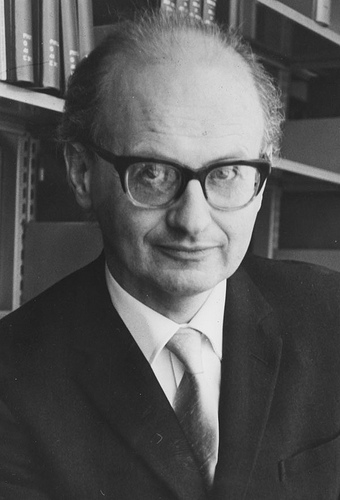
                                                    Imre Lakatos: One wily, funny,
                                                    rational cat!

Enter Imre Lakatos (say "EE moo ray LAK uh tosh"), who was born Imre Lipschitz, changed it to Imre Molnar to avoid Nazi persecution when they rolled into Hungary, then he later changed it to Lakatos (which means "locksmith" in Hungarian), possibly in honor of a Hungarian General who fought against Nazi rule in Hungary, but also maybe because his old shirts had "I.L." on them, so why not save money when it's scarce after WWII?

During WWII, Imre became a communist. He also attended the private seminars of Georgy Lukacs, the prime mover of the Frankfurt School. But eventually he had a difficult time dogmatically toeing the Communist party line (It's Imre Lakatos! Of course he couldn't help but question the Authorities!), and they threw him in prison for the crime of "revisionism." Imre spent 1950-53 in prison, then went back to academic life, radicalized and allied with at least one group that furthered the march toward the disastrous 1956 Hungarian Revolution.

And here we have that same old story, of political strife in Hungary driving its geniuses out of the country, where they usually flourished in England or especially Unistat. Imre found his home at the London School of Economics (LSE), where he met Karl Popper and a host of high-powered thinkers, became a very popular professor until Imre's untimely death in 1974, his lectures crowded with excited young intellectuals. Imre was never boring and told many jokes. As the philosopher Ernest Gellner said of Imre's talks: "He lectured on a difficult, abstract subject riddled with technicalities: the philosophy of mathematics and science; but he did so in a way that made it intelligible, fascinating, dramatic, and above all, conspicuously amusing even for the non-specialists."


He developed his method of doing the philosophy of science by first developing a method of dialogue surrounding a theorem in mathematics, showing that, if one questioned every attempted conjecture, a counterexample was almost always found. How did conjectures and counterexamples arise in the first place? One might be tempted to say they were arrived by well-educated thinkers using creativity on the problem, or even by something like Charles Saunders Peirce's "abduction" in logic.

Lakatos said a form of "thought experiment" was used, and, being the Hungarian sort of mathematical mind and seeming to fetishize "rationality" above all (more on this below), he admitted that thought experiments that led to tests of a theorem qualified as "quasi-empiricism." This mode of thought was very important and indeed, heuristic: it helped to generate auxiliary hypotheses, kernels of thought that, Hegelian-like (Lakatos was heavily influenced by Hegel) and with refutations and counterexamples...led to to the growth of knowledge. Moving on...

Lakatos wanted to find a middle way between Popper and Kuhn. At the LSE he became heavily influenced by Popper, but Kuhn's book (first edition published in 1962) had to be criticized and accounted for, and justified with Popper's falsifiability idea. Over the years, Lakatos often spoke of Popper1 and Popper2. The former was the Popper that is misread by his readers, or the Popper represented by bad readings of Popper; the latter represents the close, insightful readings of Popper, but many critics have said that Popper2 is really Lakatos himself.

Popper had said something along the lines that, scientists propose hypotheses, and these are tested. If the tests show the hypotheses did not work as thought, then this was Nature saying "No!" Think of something better. Here's Imre's rejoinder to that: "It is not that we propose a theory and Nature may shout 'No!'; rather we propose a maze of theories and nature may shout 'Inconsistent!'" - p.130, Criticism and the Growth of Knowledge. There's something telling here: in Imre's very complex epistemic formulations, we do not criticize individuals, we criticize the methodology being done within a certain research program. As his pioneering work in mathematics - in which he argued via imaginative reconstructions of actual different mathematicians' attempts to prove a conjecture, arriving at the idea that no theorem in informal math is "true" and "final," only that no counterexample had arrived yet - this was also how scientific knowledge should be worked upon. Highly mathematized, too rationalistic, too Idealistic? Maybe...

Imre thought that, because Kuhn rejected Popper's falsification and justification ideas, he'd fallen back on "mysticism" and, because Kuhn had not demonstrated a logic of scientific discovery other than something resembling a political revolution - or even plate tectonics - that his ideas were tantamount to irrationality and "mob rule." (See Imre in this passage from 1970's Criticism and the Growth of Knowledge) Speaking from my current state of confusion and ignorance, I think Imre wanted people to be as Hungarianly rationalistic as he was; however, they are not. I'm not sure they ever were. Rarely have groups of humans - even scientists! - behaved rationally in the way that Imre idealized. Scientists are humans too, with emotional stakes, cutthroat competitiveness, and adhering to party-line dogmas like Churchmen.

But now we're getting to why I think Imre Lakatos is such a fascinating thinker on the human stage. (He died of a brain hemorrhage suddenly at the age of 51.)

Eventually, Lakatos struck up a friendship with the anarchist-epistemologist and philosopher of science, Paul Feyerabend. Feyerabend, an Austrian, had fought for the Nazis, as he details in his wonderfully readable autobiography, Killing Time, eventually ending up with a professorship in Berkeley. Imre's mother and grandmother had died in Auschwitz. But Imre's and Paul's intense intellectual interests led to very heated and civil exchanges, and very many letters, all of Imre's to Paul lost, because of Feyerabend's carelessness. He said he tacked some to his walls in Berkeley to keep the rain out, if memory serves. Imre, meanwhile, dutifully filed every letter from Paul, and you can read Paul's letters to Imre in the delightful For and Against Method: Imre Lakatos/Paul Feyerabend, edited magnificently by Matteo Motterlini.

(John Kadvany's photos of Imre, Popper, Feyerabend, and Imre's Hungarian milieux.)

Despite Imre's intensely rationalistic mind, and his deep desire to take Popper's thought further, Feyerabend, a very close reader of Imre, Popper, Kuhn, and many others, repeatedly failed to see a difference between Imre's implied historical "logic" used in scientific discovery, and Feyerabend's own, "anything goes," best seen in the third edition of Feyerabend's, in my view vastly underrated Against Method. Throughout their correspondence, Feyerabend, playing Socrates tinged with Pyrrho, points up again and again that, when followed to its conclusion, Lakatos's "method" is virtually the same as his: anarchistic!

How could two seemingly polar temperaments be friends at all? First, both were deeply in love with intellectual thought, and especially dialogue. It was Imre who cornered Feyerabend at a party in 1970 and said, "Paul, you have such strange ideas. Why don't you write them down? I shall write a reply, we publish the whole thing, and I promise you - we shall have lots of fun." Paul's Against Method was his side; Imre died too soon to write his reply. Nevertheless, we can read the book of letters, and Imre's books and come to our own conjectures.

The second reason these two men were such good friends was humor. Imre's students knew that, no matter how difficult the subject of a lecture, some jokes would be forthcoming to retain levity. Feyerabend, a fascinating, irascible, complex character who I think qualifies as one of the great guerrilla ontologists of the 20th century, wrote in a letter to Imre dated 16 April, 1971:

"Criterion for being a lefty: you lose your sense of humour and become a self-righteous bastard (or bitch, as the case may be). In this, of course, you do homage to an age old American tradition: Puritanism. Now, I am un-American to the extent that I despise Puritanism, whether it comes from the right, left, or centre. 'But what about the truth?,' people ask. The truth, whatever it is, be damned. What we need is laughter. You have got the gift for laughter, even where your own position is concerned, so, as far as I am concerned, you are a good guy (and you are 'good' even theoretically, for your theory is equivalent to mine, as I have said above and in chapter 25 of my magnificent AM."

There is very much more to be said of Imre Lakatos, thinker extraordinaire, but I have gone on too long once again. I will leave by exhorting readers of Robert Anton Wilson, who are interested in his epistemology and his ontology, to maybe check out Lakatos and Feyerabend. Popper and Kuhn are far more well-known, but Imre and Paul should go a long way toward further mindcopulae, and I'm thinking especially of readers of RAW's The New Inquisition: Irrational Rationalism and the Citadel of Science. Also, as per Imre's inner working from within the logic of scientific discovery: when an idea within a research program is being tested via creative criticism and the dialectical sparks that occur therein, a progressive program will yield startling innovations. Nick Herbert talks about a couple instances of conjecture and refutation that led to innovation or new ideas that he was involved with, in quantum theory, here.

Wednesday, September 14, 2011

There Is No "Scientific Method"

Or at least that's what the anarchist academic epistemologist/ontologist Paul Feyerabend argued, in his classic Against Method, which first arrived in 1975 and was amended significantly over the next two editions, the third coming out in 1993, a year before Feyerabend died of a brain tumor at age 68. There exists a 4th edition as of 2010, but I have not perused it yet and so will stifle the urge to comment on it.
                                  The pugnacious Feyerabend, ready to spar intellectually with all-comers.

He was officially a Professor at Berkeley from 1958 to 1989, when he left Unistat with a woman who'd seen him give a talk; both had been rattled by the 1989 San Francisco earthquake and it was time to leave.

A brief bracketed tangent on sources and "facts":
[The seemingly requisite Wiki article (I include links to Wikipedia because, while hit and miss, the entries are sometimes detailed and quite fine, and, if not, they at least give a few stats and links.) is here.]

[The always top-notch Stanford Encyclopedia of Philosophy entry, should you choose to accept reading it, is here. If you happen to read Wiki and/or Stanford or some other linked source and something is at odds with what I say in the blog, so much the better, as one of my aims is to impart some learned cognitive dissonance and spur you to your own exertions. That's what I want from my reading; I will assume my Ideal Reader as being somewhat akin to myself. - the OG]

Among a handful of books (less than 15 but more than 7) that I regularly delve into that are about the sociology of knowledge, Feyerabend's Against Method is one. What a bold and entertaining intellectual!

                            Imre Lakatos, Hungarian Popperian whose sense of humor Feyerabend greatly appreciated

It was supposed to be called For and Against Method, a collaborative work with his equally brilliant and dear friend Imre Lakatos (say "LAK-uh-tosh"), who was a disciple of Sir Karl Raimund Popper, and had developed Popper's ideas about rationality in science in novel ways. Feyerabend says that Lakatos told him, "You have such strange ideas. Why don't you write them down?," and Feyerabend suggested they pit each other's ideas about the scientific method (which Paul thought was a fiction) against one another in a book, possibly as an exchange of letters. But Imre died in 1974, shortly before the first edition of Paul's writings on the topic came out.

Basically: Feyerabend said that, contrary to secondary school stories, in fact scientists have tinkered and bumbled and stumbled and used innumerable quirky methods in order to make their breakthroughs. And after tinkering enough, happy accidents occur. The Francis Bacon story about empiricism just doesn't really fly. Science as an endeavor is far messier than the textbooks make it out. Are there many scientists who themselves buy into the mythos of "the scientific method" and try to work along those lines? Yes, there are: but the results seem pretty sketchy. At best the narrative of "the" method cashes out at a lot less than you'd think. And different sciences have different approaches. And it's far, far, far more of a social endeavor than ever. And the sophisticated gadgetry and measuring devices increasingly lead to computer modeling and statistical analysis. And...well, you get the picture.

For enthusiasts of the sociology of knowledge, the sociology of science, and maverick anarchistic ideas in philosophy, I consider Against Method a must-read, and I'll try to highlight a few reasons why...

Oh, but first: I wrote on David Kaiser's recent book How The Hippies Saved Physics here. And Kaiser's cogent ideas about the structural reasons for physicists' unemployment in the 1970s should hold sway, but I would like to point out that Feyerabend was one powerful thinker around Berkeley throughout this period, and he had some ideas that may have gotten into the air and then the minds of the Berkeley hippie physicists. In his 1987 preface to the 3rd edition of Against Method, he says:

"None of the ideas that underlie my argument is new. My interpretation of scientific knowledge, for example, was a triviality for physicists like Mach, Boltzmann, Einstein and Bohr. But the ideas of these great thinkers were distorted beyond recognition by the rodents of neopositivism and the competing rodents of the church of critical rationalism. Lakatos was, after Kuhn, one of the few thinkers who noticed the discrepancy and tried to eliminate it by means of a complex and very interesting theory of rationality. I don't think he has succeeded in this. But the attempt was worth the effort; it has led to interesting results in the history of science and to new insights into the limits of reason."

Feyerabend was always against the "shut up and do your math" mantra with which physicists were inculcated during and after WWII in Unistat. (He also became friends with David Bohm, who influenced his thinking on quantum mechanics. Bohm also influenced the Berkeley hippie physicists.)
-----------------------------------------
Feyerabend noted that Thomas Kuhn had become duly famous and influential, but was preceded by John Stuart Mill and Niels Bohr in his line of thought. For Mill, see the passage on p.31 of the 3rd ed; Feyerabend quotes from Mill's Autobiography and it reads like proto-Kuhn...from a book published in 1873!
----------------------------------------
He does something I like a lot, a throwback: he includes an "Analytical Index" at he beginning of his book, which summarizes the basic argument in every chapter. I've seen this in many olde pre-20th century books and always found this rhetorical flourish charming. For Chapter 3, we read this statement, which is one the first hooks he got into me:

"There is no idea, however ancient and absurd, that is not capable of improving our knowledge. The whole history of thought is absorbed into science and is used for improving every single theory. Nor is political interference rejected. It may be needed to overcome the chauvinism of science that resists alternatives to the status quo." And then he elaborates in the chapter. This seems like a world turned upside down to many of us in Unistat in 2011: we would rather political ideas stay out of science, as the State-Military-Industrial-Corporate-Entertainment Complex seems to be doing us in, slowly.

But Feyerabend has, ultimately, a longue duree in mind. He agrees in the separation of Church (in this he considers not only the Churches, but rationalists, secular humanists and Marxist ideologies as "religious" and interfering!) and State, but he also - and this blew me away when I first encountered it - thinks "democratic societies must be protected from science." Dig this epistemological wildness and weirdness:

"This does not mean scientists cannot profit from a philosophical education and that humanity has not and never will profit from the sciences. However, the profits should not be imposed; they should be examined and freely accepted by the parties of the exchange. In a democracy scientific institutions, research programmes, and suggestions must therefore be subject to public control [NB: recent concerns over nanoparticles, not to mention animal testing and those little things called "nuclear weapons" - the OG], there must be a separation between state and science just as there is a separation between state and religious institutions, and science should be taught as one view among many and not the one and only road to truth and reality. There is nothing in the nature of science that excludes such institutional arrangements or shows that they are liable to lead to disaster."

Oh wow! I've already gone on too long, but you must read him to understand where he's coming from here, especially with that bombshell of a statement of "one view among many." To quote Mr. X from the movie JFK, "You may think you know what's going on..." (Oh wait: wasn't that Noah Cross in Chinatown?)
---------------------------------------------------------
Feyerabend, who grew up in Nazi-controlled Vienna and fought for the Germans in WWII, wrote a surpassingly readable autobiography just before he died. Even though it's written by a philosopher of science, it's the sort of under-300 page book that any intelligent person can read for fun, and contains frank passages on his very active sex life (even though he was shot during the war, the bullet lodging near his spine, leaving him impotent for the rest of his life...he married four times and had many affairs!) and lurid anecdotes about Popper, Lakatos, and even the eminent philosophy professor John Searle, a longtime colleague at Berkeley. It's title is Killing Time, and is a play on Feyerabend's name, which in German means "work-free time" or "after work."
---------------------------------------------------------
Finally, Paul was much-misunderstood - after reading his autobiography I'm not sure if he understood himself, emotionally, all that well - and he fed into this by his frequent changes of mind (any intelligent being "flip-flops" when they encounter new knowledge; it's part of a survival mechanism, something the Republican Party in Unistat seems to know NOTHING about), and Paul liked to say provocative things. But some seem to deliberately misread him. Here's an article from the National Catholic Register that seeks to defend Pope "Rats" Ratzinger in his "science ain't everything" screed of not long ago. Yes, "Rats" and Paul were both concerned about science run amok, but Feyerabend would vehemently distance himself from such an Authoritarian schmuck as the mitered infallible Pope-man, He who wears a dress and speaks on behalf of Gee Oh Dee. Oh, well...
---------------------------------------------------
While I don't agree with Feyerabend on everything - far from it - he was, to me, an overwhelmingly interesting thinker and personality. Sombunall readers of Robert Anton Wilson's book The New Inquisition: Irrational Rationalism and the Citadel of Science might find they generate an abundance of dialectical sparks when they rub that book against Against Method. Just sayin'.

Saturday, August 6, 2011

Weirdness Around Thomas Kuhn

One of the big revelations for me in reading David Kaiser's How The Hippies Saved Physics was the stories about Ira Einhorn's chummy relationship with Thomas Kuhn, which, in hindsight seems totally bizarre to me. And therefore wonderful. All I had known about Einhorn came after he was charged with the grisly murder of his girlfriend, how he fled to France, how it eventually played out. I knew Einhorn ("The Unicorn") was a big player in the first Earth Day, and was a Allen Ginsberg-ish ambassador between the worlds of New Age ideas and the Establishment. Einhorn was seen as legit by hippies and Bell Telephone executives alike. I followed the story of Einhorn being suspected of murder, and traced some of his story backwards. I had no idea he had as much influence as he apparently did getting the wild New Physics books of the 1970s published. I certainly had no idea he was close pals with Kuhn, who in my readings by and about him outside his landmark The Structure of Scientific Revolutions, seemed to me the kind of tweedy academic who would not have anything to do an intelligent hippie like Einhorn, but Kaiser shows me I was wrong, and I love that bit in the book. It's like finding out Darwin was pals with Bakunin or something. (As far as I know Chuck and Mike never met, just for the contingent record.)


I consider Kuhn's book the most influential High Culture book of the second half of the roaring 20th century, and if you haven't read it, think about doing so. It's readable and totally fascinating, and gives you a strong purchase on the philosophy of science, and it will always speak to your readings of Michael Polanyi, Sir Karl Raimund Popper, Jean-Francois Lyotard, Imre Lakatos, and my favorite, the anarchist Paul Feyerabend.

You'll also be able to see why his Strong Poetry of "paradigm" became such a powerful meme in non-high culture books and discourse.

Another passing strange story involving Kuhn only came into my ambit in the last two months: one of my two or three favorite living film documentarians - indeed, one of my favorite living artists - Errol Morris, was once a student of Kuhn's, and asked him so many questions that aggravated Kuhn that eventually Kuhn threw an ashtray at Morris's head. And missed. Morris calls this rhetoric "Argument by Ashtray." I loved how Morris relates this time with Kuhn in a recent series in the NYT. The ashtray missed him, and he thought, suddenly, "Einstein's office is just around the corner. I'm at Princeton!" (I paraphrase, probably.) He says the Ashtray Incident changed his life, and eventually will probably do something on film about it. (Maybe?)

(Note: Herbert Butterfield's "The Whig Interpretation of History" that influenced Kuhn seems related at least tangentially to the thrust of my blogpost here.)

Again: my preconceived notions about Kuhn the man were wonderfully violated. Here's a guy who went from Harvard to Berkeley (where he wrote Structure), to Princeton, and finally to M.I.T., where his office was not far from Noam Chomsky's. (Noam disagreed with his esteemed colleague about the philosophy of science; Chomsky thinks there was one revolution, and it was Galileo's and it's still being played out.)

Kuhn interviewed Niels Bohr the day before Bohr died. I am still working on integrating Kuhn's model of the sociology of science with Bohr's model agnosticism. If anyone wants to recommend a book here, please do...

Two items of interest before I let you go: Kuhn took classes given by the great sociologist of knowledge and science, Michael Polanyi. Polanyi emphasized the subjective nature of the scientist's experience, and how that meant that there must be a relativism built into the search for scientific knowledge. When Kuhn's first version of Structure came out, he used that idea but did not credit Polanyi, which raised cries of plagiarism. In his second edition, Polanyi received credit.

Finally, a basic take-away vis a vis Popper's notion of "falsifiability" and Kuhn: Popper seemed to want to argue that when a scientist (or a series of them) falsified some aspect of what Kuhn considered within the current purview of "normal science," that it made a significant impact on that discipline. Kuhn thought that was mostly wrong: when an idea within the reigning paradigm is subjected to test and it seems to have been "falsified," the community usually attributes this as a mistake by the scientists! I think, given my outsider's readings in the history of science, that Kuhn should be heeded more by Popperians.

Here's an interview former Scientific American editor John Horgan did with Kuhn.

Tuesday, August 2, 2011

A Periodic Problem in the History of Science

I think this problem can be properly placed within Thomas Kuhn's overall conceptual scheme about revolutions in science. I will attempt to discuss two recent instances that seem isomorphic, but the details of each story are more interesting. To add: I will try to make this brief.

Both instances - or scientific narratives - were ones I encountered recently in my reading; it seems there are numerous similar examples. But I want to address two of my favorite ideas - ideas any Generalist probably finds of exceeding interest: 1.) the evolution of language, and 2.) the philosophical meanings of the quantum theory.

I was re-reading a tremendously well-done work in the popularization of recent linguistics, Christine Kenneally's The First Word: The Search for the Origins of Language (2007), and I can't recommend it highly enough if you have even a passing interest in the subject. There were many "theories" (loosest sense of the term) about the origin of human language, but things began to heat up in European universities around the 1770s, especially with philosophers like Rousseau. When Darwin enters the scene, the biologists get white-hot about language. Of course, in 1870, one can only speculate enough on the topic before one has concocted something of a Just-So story. As Keanneally writes:

"Biological evolution proved to be an excellent analogy for language change, and linguists took up the evolutionary analogy with such enthusiasm that they began to treat natural selection as a literal account of language change rather than a helpful analogy, applying the idea of survival of the fittest  to such phenomena as the way speech sounds change over long periods of time (how, for example, a distinct sound like f might become s). Ironically, linguists still regarded speculating on the origins of language to be an unscientific problem, and it remained controversial to adopt Darwin's theory for that purpose. So while Darwin himself freely considered the origins of language, linguists did anything but."

Indeed, the Societe de Linguistique of Paris banned talking about the subject in the nineteenth century. I guess it seemed too distracting. Their official statement read:"The Society will accept no communication concerning either the origin of language or the creation of a universal language." What a bunch of killjoys! In 1872, Kenneally tells us, the London Philological Society also closed off the Question.

                          Christine Kenneally, Linguistics PhD from Cambridge,
                            author of The First Word: The Search for the Origins 
                          of Language

For 100 years, linguists who were interested in the question were marginalized. It was a disreputable thing to let on that it was one of your bailiwicks. If you wanted to discuss the topic, you'd better do it in secret, or the guardians of the discipline might hear about it and prevent you from getting a decent job. Nevertheless there were always little groundswells of interest.

For about 45 years of Noam Chomsky's career as a linguist he pretty much dodged questions of language evolution. One can find him saying we can't know such things, so why even try. It left many of us to ponder, "Does Chomsky think his Cartesian perfect system of syntax just appeared suddenly one day, like fundamentalist Christians think God made the world in seven days, then rested? Human language is a miracle!" (<---I said something like this to a friend not long ago, when we were talking about Chomsky.) Chomsky went on and on about the innateness of language, which would seem to suggest an inquiry into genetics and evolution, but Noam apparently had his reasons? (Some other blogpost...or have I already covered this? I write too much, too quickly and haphazardly, and forget!)

Quick side-trip regarding Chomsky: when he first began teaching linguistics at M.I.T.  (around 1959 or so, I'm too lazy to look it up, frankly), he had an Engineering student named Philip Lieberman in his class. Lieberman loved Chomsky's ideas and decided to pursue linguistics himself. But in a recurring story with Chomsky and brilliant ex-students, Kenneally writes, "There is no interaction between them now. Both men are famously combative, and they have taken opposite positions on the subject of the evolution of language." Lieberman went on to do fantastic work on Parkinson's patients, which strongly suggested that syntax was intimately related to the basal ganglia and motor cortex. He examined skulls, listened to apes, tested brains, did all sorts of creative lab research. (The idea of doing linguistics in this way seems to literally disgust Chomsky.) In 1984, Lieberman produced The Biology and Evolution of Language, a Darwinian view. He thought Chomsky had the wrong metaphor: a computer. Rather, it's evolution, which has a logic all its own, a logic we don't really understand. For Lieberman, it seems we must start with this knowledge. For Noam Chomsky, it's absurd: we already have the innate capacity for Cartesian common sense, endowed by...uhh...never mind.

Kenneally: "According to Lieberman, the analogy between the computer and the brain prevents a true understanding of language. Even though formulas can describe a set of sentences, they don't have much to do with how language is produced by the brain or how the brain and language evolved. 'Syntax is not the touchstone of human language, and evolution is not logical,' declared Lieberman. 'Evolution doesn't give a damn about formal elegance.'"

I guess Chomsky saw his version was ridiculous, so in 2002 his name appeared on a paper with Marc Hauser (recently resigned from Harvard for faking research), and Tecumseh Fitch, called "The Faculty of Language: What Is It, Who Has It, and How Did It Evolve?" But I will leave it to readers of linguistics or of Kenneally's book just how much we think Chomsky was interested in the question.

Anyway, the topic is hot again, and there are all kinds of research projects that are leading us towards an understanding, not only of the origin of language in humans, but animal communication systems, the relation of music to language, and the deep levels of our mathematical faculty.

**********************************************************************************

In a deliriously spellbinding recent book (for my nervous system, at least), How the Hippies Saved Physics: Science, Counterculture, and the Quantum Revival, by M.I.T. professor David Kaiser, he tells the story of Einstein, Schrodinger, Born, Bohr, Pauli, Heisenberg, et.al and their development of the quantum theory between 1900 and 1926...and then how Einstein thought the theory must be wrong, because it suggested a philosophically messy picture of Nature, and that God didn't play dice with the universe, etc. (Niels Bohr didn't have a problem with the oddities of the theory.) Einstein's and Bohr's colleagues were all deeply fascinated or appalled or in some way philosophically fixated on what this very successful theory meant about how nature works. They discussed it for days on end with each other. Then the second half of the Hot War between the years 1914-1945 flared again, and then most of them fled to the US.

In the Manhattan Project and after the war, the US government hothoused enormous numbers of physics students in order to "win" the physics war with the USSR. Kaiser is very engaging as he describes the radical shift to "just shut up and calculate" from "what do the equations mean?" Any physics student in the US (and most of Europe, although it wasn't nearly as pronounced there) were considered flaky if they asked their professor what the equations meant about how strange nature seems at subatomic levels. Like the origin of language question for 100 years, here was a fascinating question that had been deemed as frivolous by the leaders of physics, from roughly 1941 to around 1975-80, when suddenly, the US government became somewhat paranoid that the USSR might be ahead of the US in telepathy, or other outre ideas.

Funding for physicists had been cut drastically by the early 1970s, so many PhDs had no jobs. But all along there were physicists who had been fascinated by Einstein's thought experiments that might show that the quantum theory was flawed, and there was a Deeper Reality. In 1964, one of those physicists, John S. Bell, devised a theorem that, if it were to be tested - and it seemed more testable than the Einstein, Rosen, and Podolsky thought experiment - it might show that Einstein was right: there were hidden variables, or...something that could show the quantum theory was incomplete.

      Left to right: Jack Sarfatti, Saul-Paul Sirag*, Nick Herbert, and in the right corner, Fred Alan Wolf, all PhDs in physics, all fascinated by the implications of Bell's Theorem, all stoners and scientific revolutionaries.


I don't want to ruin a good read, but the Berkeley-based hippie physicists played a huge role in getting physics back to its philosophical roots. And it led to a revolution in quantum information science, quantum computing, and quantum encryption techniques. One of the developers of quantum encryption, Stephen Wiesner, is quoted by Kaiser as saying this in 2009: "We need some periods of anarchy when new or irreverent thoughts and changes can come forward."

Whether we're discussing the ban on openly talking about the origin of language or of the philosophical roots of the quantum theory, in both historical stories we see very intricate reasons why perennial questions get dampened, and also institutional reasons why they come back. The foremost "experts" during the times of the bans thought they were "correct:" that such questions were frivolous; we've moved beyond that; these are not the kinds of questions "serious scientists" ask. And how utterly wrong they were!

Hoo-kay! Sorry I was so brief!

*- I have awarded Saul-Paul Sirag the PhD but he doesn't have one; he has been published on quantum theory in the world-leading journal Nature twice. As David Kaiser writes, "Most PhD physicists who pursue ordinary academic careers never manage to get even one of their research articles through the rigorous peer-review at Nature."-p.243