Ironist-Ethologist John B. Calhoun: Some Background
Have you ever read science fiction writer John Brunner's Stand On Zanzibar? What about Tom Wolfe's non-fiction "New Journalism" book, The Pump House Gang? Ever seen a film called Soylent Green? (Of course you have! Enjoy your next meal...) Did you ever read (or read about) Dr. Paul Ehrlich's The Population Bomb? He appeared on The Tonight Show With Johnny Carson in the 1960s, with his grim neo-Malthusian message about how overpopulation will cause famine, deplete our water resources, and we'd all die, doomed and sick, panicky and screamy and just tremendously bothered, sorta like a horror film. Sorta like Soylent Green. Ehrlich's appearance on the TV, with dire fnord messages made his book an instant best-seller.
(Hint to writers prospecting for writing gold: write a book on how we're all gonna die monstrously horrible deaths because we're not paying attention to something. Use a modicum of statistics, but use imagery like a novelist. You may be livin' on Easy Street before you know it! Then you and I and everyone we love will die in some catastrophe that had nothing to do with the one you warned about in your book. Your Thing was Bird Flu; what really wiped the humans out was an errant asteroid. It's a Win-Win for you [selling a lot of books] and the asteroid [gets to annihilate an advanced civilization, or pull off a "Milky Way Hit Job," as they say at Galactic Central]. You heard it here first!)
So yea: there was this ethologist named John B. Calhoun. Some of you Unistatian history buffs will know about John C. Calhoun. This middle initial B dude was quite different. He built what he called "utopias" for rodent populations, then sat back and watched them reproduce, interact, raise their young, etc, took feverish notes, tabulated his data, did it again and again. His work influenced all the books and the film (and many others, no doubt) I mentioned above. Some sources say Calhoun's term "behavioral sink" - which I think qualifies for what literary critic Harold Bloom called "strong poetry" - has become widely known, although in my experience with highly educated people, 2011-2012, few have heard the term. So I'll put some flesh on it for you, if you don't mind.
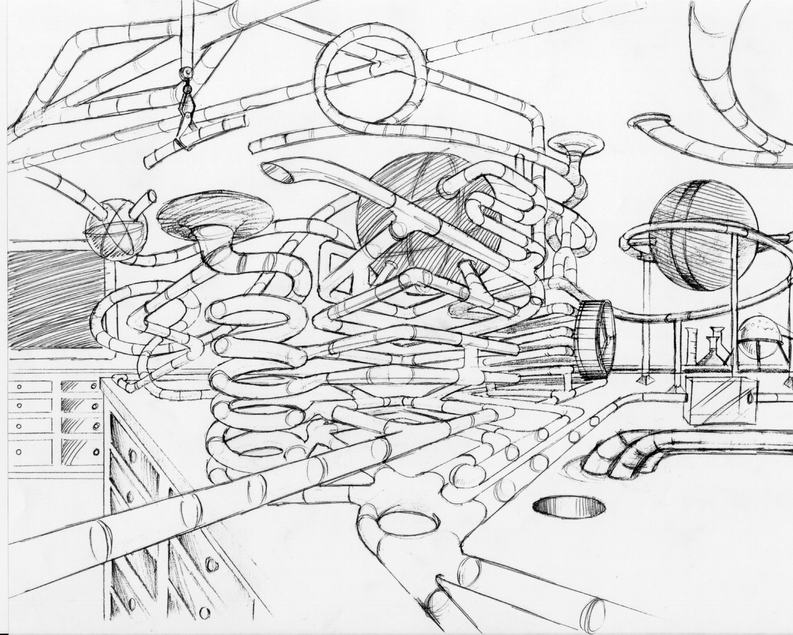
habit-trail for rodents: sorta between our City and a rabbit's warren?
The people most likely to know "behavioral sink" would be urban sociologists. What Calhoun found was that, when a utopian spatial set-up for rodents - everything they need to be "happy" and which he actually, with a wry smile, labeled as "heaven" - reaches a population density of X, things start to go rapidly downhill toward dystopia. Social norms break down, rodents get aggressive, narcissistic, they die earlier, they fail to pass their genes on, and when they do pass their genes on, they're bad parents. They also have weird sex and abuse drugs and eat too much. Some theorists have said that it's not so much the geometrical space - now cramped to the Xth point - which is bringing on this behavior, but it's the overabundance of social interactions that drives them nuts.
(Remember: we ARE talking about rodents, as studied in a non-Skinnerian way: a set-up that initially, rodents would prefer, in an environment as close to what they'd make themselves, in as natural a setting as possible. And FULL DISCLOSURE: I happen to enjoy some drugs and alcohol and weird sex, and again, I'm not even on Facebook or Twitter and I'm not a rodent to boot. I DO see short attention spans and very deep shallows in more places now, tons of stupidity among people with historically unparalleled access to Information, and lots of indifference to suffering, but am still not totally sold on Calhoun's rodents-to-humans idea. However, he did think that too many/a high frequency of bad social interactions drive things down the Sink, whereas his more famous followers - like Ehrlich - thought population density depleted water and food, and that will do us in. Calhoun thought the social stuff was enough to send us over. I worry that he's more accurate than I'd thought. Moreover, subsequent urban theorists have had some problems with Calhoun's findings, while still thinking he was on to something. Let this all-too-typical parenthetical by the OG constitute an "interlude"? Very well then. Let's move on.)
(Remember: we ARE talking about rodents, as studied in a non-Skinnerian way: a set-up that initially, rodents would prefer, in an environment as close to what they'd make themselves, in as natural a setting as possible. And FULL DISCLOSURE: I happen to enjoy some drugs and alcohol and weird sex, and again, I'm not even on Facebook or Twitter and I'm not a rodent to boot. I DO see short attention spans and very deep shallows in more places now, tons of stupidity among people with historically unparalleled access to Information, and lots of indifference to suffering, but am still not totally sold on Calhoun's rodents-to-humans idea. However, he did think that too many/a high frequency of bad social interactions drive things down the Sink, whereas his more famous followers - like Ehrlich - thought population density depleted water and food, and that will do us in. Calhoun thought the social stuff was enough to send us over. I worry that he's more accurate than I'd thought. Moreover, subsequent urban theorists have had some problems with Calhoun's findings, while still thinking he was on to something. Let this all-too-typical parenthetical by the OG constitute an "interlude"? Very well then. Let's move on.)
Try and tell me you weren't thinking of humans there. No big deal: that's what we do. We try to relate almost everything to how it might bear on our lives. Any questions so far?
Yea, the list of items Calhoun saw among rodents when "utopia" devolved into a "behavioral sink" seems a might close to home, eh? I forgot to mention the rodents, when socially crowded beyond equilibrium, got stressed-out physical illnesses, developed psychosomatic symptoms, and mental illness.
John B. Calhoun was once a big deal, but the vagaries of time and the hyper-mega-turbulent acceleration of ideas, knowledge, and media noise seems to have crowded him out since his heyday: circa 1948-72. Those dystopian books and movies neglected to emphasize an aspect of Calhoun's thought: he was an Ironist among social scientists. He was dismayed that those who were influenced by him were so starkly pessimistic. Because Calhoun wasn't. He believed in the creative ability of humans (let's face it: you study rodents like crazy to learn about humans) to solve their Big Problems. And he thought we needed to seek out what he called "creative deviants" in order to, among other solution-oriented ideas, COLONIZE SPACE!
Gadget Addiction and Social Interaction Quality
We live in a world in which some people have the job description of "Information Management Expert." Increasingly, in meeting harried and frazzled clients, they caution that drinking digital information from a fire hydrant is bound to cause the sanest, best-grounded of us to make our brains feel like expired tapioca, our bodies like losing fighters in a Bruce Lee flick, our affects and outlooks on the world like someone being told their dog just died. Must it be like this? Apparently, yes.
Now: I know YOU have kept things in balance. You are "on the ball," but you know others who fit the description. And most importantly: you care. That's why you're here, reading this. It's just the Big-Hearted Person you are. You can't help it. Born that way. It's simply the way you roll. Ya gotsa do what ya gotsa do. Hey, I hear ya. How does anyone ever get by without Us around? Am I right? <cough>
In earlier blogspewage I'd written about the obesity epidemic. Part of the deeply structured reason we have the Problem is because, historically, sugar and fat are cheap and bountiful, whereas for 99% of our time as hominids, that stuff - which we need to stay sharp - was a total SCORE, and everyone in the wandering extended-family band society rejoiced: a bit of honey! Some meat from a large mammal! Now you drive thru Burger King. Same with information. Access to social Others is a bit complex.
In this article about whether Internet Compulsion Disorder should be included in the upcoming DSM-V, we see the classic instant gratification via dopamine-circuit-buzz dealio described.
Here's an article that compares the Roman writer Petronius (he of the incredible "Dinner With Trimalchio") and surfeit of food, to our surfeit of information. Note the grad student who talks about life online as feeling less like a thinking, feeling human and more like a rat who must press the button for another pellet, forgetting why...Gluttony Going Viral indeed.
Oh, my. It would be easy to link another 400 articles here, related to digital media and addiction. Hey, I'm not immune. Maybe it's the deeper reason why - other than the surface reasons I tell myself - that I'm not on Facebook or Twitter? A social connection, however mediated, and depending on the individual's eccentric nervous system and his/her - to borrow from William S. Burroughs - algebra of need - gives a dopamine reward nod. And for very many of us, this is enough. But then look at how Calhoun's rodents reacted when their social space was crowded. This brings me to a related idea, Neophilia and Neophobia.

Winifred Gallagher, behavioral science writer
Leary and Calhoun
Before personal computers and cell phones - much less Facebook, Twitter, iPads, Siri, X-Box, et.al - Timothy Leary was a technophilic neophile, who saw the pending Internet as a boon (and...it has been, right?) and would be the new LSD. I think he turned out to be basically right. We would live in a "virtual reality" and it would be so interesting that we wouldn't need psychedelic drugs: the new media would be psychedelic itself. And Jaron Lanier - for my money, one of the most interesting geniuses on the planet - pioneered virtual reality. And a young person very much influenced by Leary, Douglas Rushkoff, declared that the counterculture had "won;" the ideas ushered in by Baby Boomers had become mainstream.
And yet, in Winifred Gallagher's terrific 2011 book on neophilia and its discontents, New: Understanding Our Need For Novelty and Change, she cites the other side of Leary's neophilic enthusiasm by invoking...John B. Calhoun, citing his idea of the "behavioral sink" and that, yes, we have increased creativity, communication, ideas and access to information, but what has/will also accelerate is the number of social roles we'll be forced to play, and that things are moving too fast for us to learn how to get a handle. We'll have more competition, negative encounters, and a general dissatisfaction with daily life. Gallagher quotes Calhoun, "Everything is coming at us fast and faster, yet we can't even learn from our experiences unless we have refractory periods to digest them in." (p.169)
This "refractory period" is part of the OG's raison d'etre. I baldly state: we need more quiet, non-electronically-mediated face-to-face communication/interaction with others and we need more time alone in our interiorities, reading stimulating and challenging books. So by my own logic, stop reading my blog! (Waitaminnit: that can't be right...) All the gadgets are fine, but many of us are getting carried away. (Hey you! Are you reading this on a tablet computer while texting someone on the subway? Pay attention! You don't want to miss your stop like you did that one time.) I also think Douglas Rushkoff is right: just as in the Axial Age the very few rabbis or monks read the books to the rest of us, and a very few wrote the books while the rest of us read them post-Gutenberg, we need to learn to program like the programmers and not just consume their programmed gadgets, which have inherent biases in them. I have not taken up programming. The weak version of Rushkoff's advocation of being a "programmer" is to actively seek out and expose the biases of our gadgets. This I enjoy doing.
I am NOT against all our wonderful gadgets. I am for much more thinking about what makes us happy, though. I despise the Bewildered Herd. Making the decision to question how we're being programmed may be a crucial one. Things seem to be accelerating logarithmically, and no one is in control; it cannot be stopped. But we can modify our choices. Am I preaching to the choir here? I suspect so...
This "refractory period" is part of the OG's raison d'etre. I baldly state: we need more quiet, non-electronically-mediated face-to-face communication/interaction with others and we need more time alone in our interiorities, reading stimulating and challenging books. So by my own logic, stop reading my blog! (Waitaminnit: that can't be right...) All the gadgets are fine, but many of us are getting carried away. (Hey you! Are you reading this on a tablet computer while texting someone on the subway? Pay attention! You don't want to miss your stop like you did that one time.) I also think Douglas Rushkoff is right: just as in the Axial Age the very few rabbis or monks read the books to the rest of us, and a very few wrote the books while the rest of us read them post-Gutenberg, we need to learn to program like the programmers and not just consume their programmed gadgets, which have inherent biases in them. I have not taken up programming. The weak version of Rushkoff's advocation of being a "programmer" is to actively seek out and expose the biases of our gadgets. This I enjoy doing.
I am NOT against all our wonderful gadgets. I am for much more thinking about what makes us happy, though. I despise the Bewildered Herd. Making the decision to question how we're being programmed may be a crucial one. Things seem to be accelerating logarithmically, and no one is in control; it cannot be stopped. But we can modify our choices. Am I preaching to the choir here? I suspect so...
M.I.T. scholar of social media and technology in general and internet in particular and how it affects us, Sherry Turkle, wrote books on the exciting possibilities for individuality and the play with identity. That was ten years ago. Now, her latest book is Alone Together: Why We Expect More From Technology and Less From Each Other. The title gives the gist.
Jaron Lanier's 2009 book You Are Not A Gadget: A Manifesto, is cited as "essential reading" in Douglas Rushkoff's 2010 book Program Or Be Programmed: Ten Commands For A Digital Age. I consider Rushkoff's to be THE manifesto for those of you worried about our digital algorithms increasingly programming us, and how to wrest something human back for ourselves, for our sanity. Then read Lanier. Then read their influences and the books in their bibliographies.
I wonder where Uncle Tim would be on this issue if he were here today?
Or: just say fuck it, and go write on your Facebook wall about LAME blogging jeremiahs and how BORING they are.
My adrenal glands are faxing to my liver and heart, my hypothalamus-pituitary-adrenal axis has gone into fight/flight/feed/fuck mode, so I will bid my Dear Readers adieu for today.
Here's Sherry Turkle for 6 minutes and 17 seconds (not that you "have" that much time!), on Facebook and privacy and cell phones at the dinner table and other things:

