Yes, we're talking about baseball cards.
Here's my story about cards. As a boy, I was crazy about the things, and a few of my friends were too. I mowed neighbors' lawns and washed their cars to make extra money to try to complete that year's set. I'd buy, for 15 cents, packs of 10 that had one very sharp-edged slab of hard, thin, pink bubble gum in them. We'd buy eight or twelve packs at a time, walk a few feet outside the store onto the sidewalk, rip open the packs and quickly rifle through the ten cards, noting with the dexterity of a Las Vegas croupier which ones were duplicates - which we could potentially trade with a friend who might have one we in turn didn't have - and which ones were new to us. There'd be about 600 unique cards per baseball season, and broken into series of around 110, released at different times during the season. You'd get a call on some July morning: "The third series is out!," and feel your pulse quicken. The wrappers (and often the lousy gum) would go into the trash bin on the sidewalk, and we'd walk home talking about who we had, who we still needed to get. Boys as totally irrational collectors of images of romantic men we might be one day ourselves, if only we could hit the ball out of the infield. Our own little low-stakes micro-world version of Tulip-mania. Our entrance into the world of commodity fetishism. We would have no Critical Theory for another 15 years.
Often we'd noticed some barely noteworthy player - a backup shortstop for the Brewers or some reliever with a high ERA - was the one card we couldn't find. When one of us found it, envy ensued. This may have been our first taste of a corporate conspiracy theory: to get us to waste as much of our allowances on cards as possible. Every kid I ever knew kept all his duplicates separate; they were little stacks of waste. They represented pitches swung at and missed. They were ordered pollution. May as well throw 'em away...but some other kid might actually "need" one of your banjo-hitting shortstops. You had five of that guy, or four more than you needed. It was stuff like this that was bothersome in our lives. (Did I really live that life?)
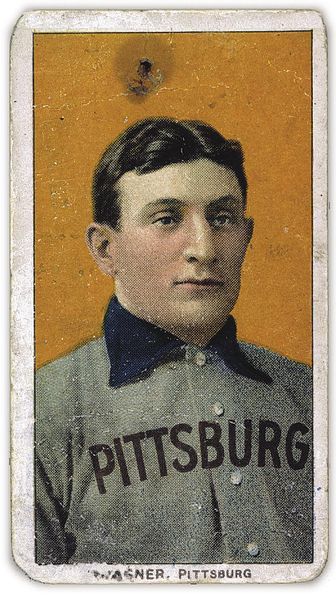
At some point, I think it was my dad who found an article in the Los Angeles Times about a very rare baseball card that might be worth $250. It was the Honus Wagner. Jeez, you'd think it would be Lou Gehrig, or Ty Cobb, or Babe Ruth. I knew Wagner was in the Hall of Fame. He was from the Dead Ball Era. He was so deep in ancient history it was freakish stuff. Who could afford to spend that much on a baseball card? I read the article with the same sense of irreality that attended an article about the history of the Hope Diamond, or how Champollion deciphered the Rosetta Stone: marvelous, uncanny, hard to believe.
One day, while reading the ads in the back of a comic book, I noticed some place on the other side of the country sold cards on demand - for five or ten cents each! I'd write them for a FREE catalog, and then send them cash in an envelope, noting exactly which cards I wanted. It took all the romance - and waste - out of buying packs of bubblegum, but I was able to collect complete sets, almost all in perfect condition, of the cards issued by Topps from 1969 through 1975, when I got tired of "all that" and moved onto other things. In the collecting years, I'd stumbled onto ways to obtain much older cards for relatively cheap prices, and I had all of those neatly bundled, by number in their own special shoe boxes I inherited from my mom. I had a few cards from the 1950s. I had a Mickey Mantle. I had...oh, nevermind.

This was three years before he broke Babe Ruth's
all-time home run record. I remember the day he broke
the record. I was glad for him. Hammerin' Hank is a
Good Guy. Always was.
I had complete, mint collections of basketball, football, and hockey cards too. They eventually were stored in my closet, in the dark. If there were any shops that dealt in sports memorabilia, I had never heard of them. Sports cards were strictly kid's stuff, although over the years I had heard stories of some classmate's father who owned...everything. I assumed they were stories.
Around the age of 17, I realized if I wanted to have any realistic hope of getting laid, I'd require my own car, and therefore needed money fast. One way: I saw an ad in a local newspaper. Some guy would buy my sportscards. I remember he came out to the house and looked at them, and offered me $50, and I said okay. I don't remember haggling. I had ceased even thinking about those cards for a few years.
It only took about another three or four years before sports cards became a big deal. I thought, "Well, I was into that before anyone else was!" Then, closer scrutiny brought the devastating revelation that my collection I'd sold a few years ago would have probably been worth at least $5000 if I still had it. I saw a catalog of special cards that sold for $25 or $50 each. I had owned most of those. I told the truth to anyone who'd listen. I felt like a fool, but how could I have known that stuff would all the sudden become a Big Deal? The more I told my story, the more therapeutic it was, for some reason. Oh well: sometimes kids do hasty, stupid things, and how many people thought the earliest Apple stock was probably overpriced and passed?
There were storefront memorabilia shops all over the place now, and they sold cards, and I studiously avoided going in there to look, although I remember telling one guy who seemed to know the card market like a stock broker can talk stocks, and he thought I'd probably had a collection worth $8000. Which was not pleasant to hear.
Anyway: I was soon playing guitar in rock bands, enjoying college, smoking pot, having sex, teaching private music lessons to people aged 6 to 60, but mostly 16.

One night I got stoned and read the essay again and it made sense. These things happen.
"To perceive the aura of an object we look at means to invest it with the ability to look at us in return." - Walter Benjamin
I didn't know it until a few years later: Benjamin, an intellectual of astonishing depth and breadth, had been heavily influenced by Charles Baudelaire's writings on drugs, especially hashish. Benjamin has undergone a systematic program of using drugs and writing while stoned, or recollecting the stoned state, in order to build up a body of work - along with other painters, poets, and intellectuals - that would catalog the temporary moments of internal freedom from Ordinary Reality. It was theorized that, for humans to carry out a successful revolution away from the types of "mind" that led to World War I, the various fascisms in Europe, and the deadening of the senses that life under industrial capitalism brought, systematic inquiry into stoned (and other non-ordinary states) would lead to a jumping off point for true Revolution.
And Benjamin's idea of "aura" was arrived at during an investigation of hashish.
I thought about my relationship to the mass-produced cards I had been obsessed with as a kid. I still remember time alone, looking at the cards, studying the data of the player's career. Bats left, throws right. Hit .382 one year in the minor leagues! I think I perceived an aura with some of those cards. I think some of them "spoke" to me. To this day I vividly remember a handful of cards, for some odd reason. Why? Why should I have cared? What did it mean? These were not one-offs, invested with - and this is what Benjamin thought an aura was - a quality that was apart from its material signifier in the world. Like an afterimage, but more ethereal. He thought mass production of the same old cookie-cutter item washed out the aura of the Original. I like the idea. It's a great "stoned" idea, and indeed: Benjamin, a mystical quasi-secular Jewish intellectual, was one of the great stoner-artists of all time. (See Benjamin on Hashish. This is intellectual stonerism at its "highest" high...) A work of Art could, when the perceiver focuses upon it, return its own feelings of profound wonder of existence, beauty, truth. Let me be clear: you the viewer can perceive these things AND the Work Itself can permeate some level of existence with its own feelings about the Profound.
Benjamin's idea of "aura" - the now-famous essay was first published around 1935 - turned out to have a strong influence on Critical Theory and postmodernism. So when your professor had you read Frederic Jameson and you thought to yourself, "Maybe if I was stoned I could make sense of this stuff," you probably weren't far off.
Now rare baseball cards are bought by wealthy investors as if they were paintings by minor Expressionist masters. The idea of value in Art will never cease to be a wonder to me.
But I still think I had that experience of "aura" with a few mass-produced baseball cards when I was 12. I can't explain it. I remember feeling it. I think it best not to try to explain it. I remember that time as golden.
There is this French word flaneur. An idler, a lounger. It's often been used in the sense of...well, myself as the sort of blogger-writer the Overweening Generalist represents: the sort of bookish person you see in a cafe, writing poetry or some essay on the meaning of History. Benjamin thought the flaneur turned his back on history, all the while being swept up by it. The flaneur reads and ponders the endless expanse of ruins in history and is blown forward by history, into the future, a supermassive vortex of Progress carrying everything within its forces...
I must leave you with the supreme intellectually stoned feel of Benjamin. Here's the first paragraph of his essay, "Theses on the Philosophy of History," translated from German by Harry Zohn:
The story is told of an automaton constructed in such a way that it could play a winning game of chess, answering each move of an opponent with a countermove. A puppet in Turkish attire and with a hookah in its mouth sat before a chessboard placed on a large table. A system of mirrors created the illusion that this table was transparent from all sides. Actually, a little hunchback who was an expert chess player sat inside and guided the puppet's hand by means of strings. One can imagine a philosophical counterpart to this device. The puppet called "historical materialism" is to win all the time. It can easily be a match for anyone if it enlists the services of theology, which today, as we know, is wizened and has to keep out of sight. - p. 253, from a collection of Benjamin essays called Illuminations: Essays and Reflections
The Wiki for the Honus Wagner card, with hints and outlines as to its history and intrigues.

