Overweening Generalist

Showing posts with label Walter Benjamin. Show all posts

Saturday, February 9, 2013

Disparate Remarks on Writers and Other Artists and Their Audience(s)

Walter Benjamin
While recently re-reading Walter Benjamin's essay "The Task of the Translator" ("An Introduction to the Translation of Baudelaire's Tableaux Parisiens") - I was reminded of Benjamin's counterintuitive idea that Art only confirms our spiritual and physical existence, but doesn't care about its audience. "Even the concept of an 'ideal' receiver is detrimental to the theoretical consideration of art..." This seems to fly in the face of an age-old discourse about writers assuming certain types of readers, and at least two main types: 1.) The "average" reader, who the author can't expect to really get through to; and 2.) The "ideal" reader, who, it has often been expressed, the writer has most in mind when she writes.

But I think here Benjamin is thinking of a third type of mind: the translator, who ought to try to communicate the essence of the piece in a new language, to a new audience. "Any translation which attempts to perform a transmitting function cannot transmit anything but information - hence, something inessential." Such an odd idea of the role of the translator! And odd ideas about information, essences, and audiences. I find Benjamin wrong here, but he's one of a small handful of writers who are more interesting to me even when I find them wrong. I am part of Benjamin's audience; when he wrote the aforementioned essay he supposedly did not have me in mind. I think that's about correct.

There are those writers - usually my kind - who develop their private vocabularies, which can scare off ordinary readers, but if the vocabularies contain metaphors poetic and potent enough, they spill out of the private life of the writer and into his more-or-less "ideal" readers' minds...and then they infiltrate the larger society. And change it. 

                                                      Tom Robbins

In Conversations With Tom Robbins he said he can't think of his audience when he writes, that he needs to concentrate, "like a Wallenda."

Glenn Gould, Roman Polanski, Orson Welles
Gould stopped performing live concerts at age 32, saying, "I detest audiences...they are a force of evil." This always has me wondering: how can a nervous system perform so transcendently well, all the while detesting its audience? Clearly, Gould was wired differently than most of us. For every Gould there are a hundred musicians who remark how difficult it is to record in the studio: there is no audience, no mass of Dionysian energy reflecting back from the crowd. No love-radiation from the adoring audience. I wonder how many solo performers have an active dislike for those paying, braying idiots who peer out there beyond the stage lights? Perhaps it's not as rare as I thought; I have heard of some performers who say they get an edge by working up a distaste for those who deign to sit in judgment of their performance, simply because they managed to scrape up the price of a ticket. But few dare to state their feelings so baldly as Gould did.

                                                      Glenn Gould, an enigma

I caught this line from Roman Polanski, one of my favorite directors: "I aim for the public at large, including children, and I'll target the children inside us until the day I die."

Wait, wait, wait: I know what you're thinking, and for today I'll pass on the easy jokes here; that underaged gal has said publicly she didn't want Polanski persecuted by the system as he had been. 

Now, a good lot of Polanski's films are pretty bleak. I just watched Cul de Sac. It's absurd, dark, violent, and oddly funny. But for children? Double that for Knife In The Water, which, like Cul de Sac, presents humans as predatory upon each other, which we as a species seem in active denial about; Polanski's pointing to the primate status-seeking and one-upping that seems built into our characters, unless we try to actively root most of it out. Both of those films present male outsiders competing in some primal way for the attention of a woman. For children, Roman? Maybe Polanski was being sardonic in that quote; I have it in my notes and didn't note the context. But I don't think he meant it sardonically. The quote was made before he did his take on Oliver Twist. It certainly can't have anything to do with Chinatown, can it? 

It's an odd quote, taken from p.123 of Roman Polanski: Interviews. I can't see how Rosemary's Baby, Tess, The Ghostwriter, and especially Repulsion have anything to say to the "children inside us," unless it's that the world can be a terrible and brutal place to be a child. But I can see this quote relating very strongly to The Pianist, because it has so much to do with Polanski's hellish childhood...which seems a terrible and brutish place to be a child. Maybe Roman was high at the moment he uttered that statement, who knows. Still, this is an enigmatic quote for me, and I often think of it. 

In Orson Welles: Interviews there is the idea from Welles that, when he made a film he had no audience in mind (similar to Benjamin's idea?), but when he put on a play the audience was in the forefront of his mind. Orson conceptualized the person watching action on the screen as in a different semiotic world than those watching live humans, without all the tricks that filmmakers have at their disposal. This seems at least part of what he meant.

Gurus and Cult Leaders and Their Audiences
I do not see these cases - gurus and cult leaders and their followers - as all that different from, say, the artists/performers Taylor Swift, Rush Limbaugh, Jon Stewart, Lebron James, and the magician David Copperfield and their relationships to their fan(atic)s. The small difference seems to make enough of a difference though: all of them can go "on" do their Thing, and then be done with their act and move on, as some sort of "entertainer"or gadfly, whathaveyou. Their public acts have a long-time legacy of social authorization and have been thoroughly legitimated by enough of the population that they are taken-for-granted "reality."

In Price and Stevens's provocative book Prophets, Cults and Madness, they take a page from Anthony Storr's 1996 Feet of Clay regarding "gurus," who are "people who believe they have been granted some sort of special life-transforming insight, which typically follows a period of mental or physical illness (which has variously been described as a 'mid-life crisis,' a 'creative illness' or a 'dark night of the soul'). This eureka experience may emerge gradually or come like a thunderbolt out of the sky, in the manner of religious conversion, a scientific discovery, or an intact delusional system of the type that occurs in schizophrenia. As a result, the guru becomes convinced that he has discovered 'the truth,' and his conviction, as well as the passion which he proclaims, gives him the charisma which marks him attractive to potential followers." 

This reminds me of Robert Anton Wilson's take on Timothy Leary's "metaprogramming circuit." Historically, certain odd types have accidentally activated this metaphorical neurological circuit, and fell so in love with the "new" program, new way of looking at the world, that their charisma, infectious enthusiasm, or whatever we wish to label this phenomena as: it becomes a cult, then maybe a religion, with official dogma and official enemies. The same old story from here to eternity, as Burroughs said. Wilson saw the main problem with these types as not noticing that it was their own nervous system that "selected" this vision of the world; they mistook it for a message from "out there," when it was actually from within. And there being a Seeker born every minute, they will have followers. Let's just hope it doesn't get out of hand and that someone develops a healthy sense of humor around this "special" vision of "reality." Wilson says gurus and cult leaders get "stuck" here: too much power too soon, and they don't seem to notice that, if they did it once, they can do it again: some other visions of "reality."That first one was just too awesome, too vivid and such a blast. 

On that note, from Plato's (supposedly he wrote it): Seventh Letter: "For this knowledge is not something that can be put into words like other sciences; but after long-continued intercourse between teacher and pupil, in joint pursuit of the subject, suddenly, like lightning flashing forth when a fire is kindled, it is born in the soul and straightaway nourishes itself." 

Now: Plato is saying this happens in a dialectic; it is not Saul's falling off his ass. But it does make me wonder regarding the sulfurous proselytizers. 

                                                    Fran Lebowitz

When Your Audience Dies
Martin Scorsese made a documentary a couple years ago about the hilarious, strident lesbian humorist Fran Lebowitz, and there was a section in which she talked about the cultural aristocracy and connoisseurship of gay men who were her biggest fans in the mid-late 1970s and early 1980s. And then they started dying overnight and it harmed her art, her will to produce sank, her audience dead, and all sorts of 3rd, 4th and 5th raters rose to prominence. While she said all this with a straight face, I do believe she was in earnest...and at the same time the audacity was epic. She'd had a long writer's block. What a grandiose way to explain it! And I still felt very sympathetic to her. I also thought she was basically right: AIDS did take a major toll on the Arts. And I also felt sort of oddly honored: as a hetero male, I loved her two books, Social Studies and Metropolitan Life, as soon as they came out. I knew no other person who even liked her, in suburban Los Angeles. My ego mentally lumped myself in with the gays who survived.


Lebowitz often made me think of her as a reincarnation of Oscar Wilde, who once said that the opening night for his new play didn't go so well because "the audience flopped."

                                                              Wilde

Poetry
I can't escape the idea that "meaning" in Modern poetry derives in a considerable part from good will on the part of the Readers.

The Audience for Robert Heinlein's Stranger In A Strange Land
I've been reading on "reception theory" and wondering about this book, which has captured the imagination of Heinlein's readers in a way that baffled him. His readers "made" their meanings and often the writer was aghast. This fascinates me. I got hold of a bunch of books from the library to try to flesh this out, and stumbled onto Carole Cusack's Invented Religions. Cusack says some critics were "disturbed" that The Church of All Worlds and the Fosterites were meant to symbolize the Dionysian and Apollonian in the public mind, but that "the two churches are almost indistinguishable."

"Critics are also uncertain as to whether Heinlein's positive portrayal of Mike and the CAW is parodic; another possibility is that the novel's elusive genre (variously described as novel, satire, anatomy, myth and parable) means that the meaning of the CAW has to be decided by readers, depending on their assessment of the genre of Stranger." -p.59 

I have only read this book once, but have delved into bits of it at other times. When I read it cover-to-cover I thought it a quasi-Ayn Randian book, but better written. This was at least twenty years ago. I had known that some feminists had applauded Heinlein's depiction of strong, rational, independent  women, but I also thought Jubal was a bit of a blowhard; he just wasn't someone I admired, although clearly I was supposed to. My politics were different then, and I want to re-read the book again this year, if only to notice more clearly this problem of "genre," which fascinates me. Cusack compares Heinlein to Robert Anton Wilson: "Heinlein, like Robert Anton Wilson, was a lifelong agnostic, believing that to affirm that there is no God was a silly and unsupported as to affirm that there was a God." 

This notion of not being able to place a book in a genre immediately draws me to the book. It's one of the main reasons why I became such a devoted reader of Robert Anton Wilson. The mercurial, trans-generic, one-off-ness of his books - as I saw them - was an inherent value to me. 

Speaking of Cusack, who seems to be doing sociology of religion in Sydney, her first chapter in the book is on Discordianism, and her citations include not only Principia Discordia and Thornley's Zenarchy, but Conspiracy Theories in American History (2 vols, I hadn't seen these until today); Adam Gorightly's book on Thornley, The Prankster and the Conspiracy; Alan Watts's Beat Zen, Square Zen and Zen; Adler's famous Drawing Down the Moon; and my friend Eric Wagner's An Insider's Guide to Robert Anton Wilson, which she cites five times.

Fran Lebowitz on homosexuality:

Monday, September 3, 2012

Hoarders: Glad It Ain't Me! (or...is it?)

Ever see the TV show Hoarders? I've seen a couple episodes, which were enough for me. I'm told there is at least one copycat show on cable TV on roughly the same subject. What made me wonder: is this a serotonin imbalance? Is it related to OCD? What? Some researchers at the National Institute for Mental Health are making some inroads using fMRI machines and things like junk mail, but I'll get to that later.

I previously wrote about my baseball card collecting as a youth, and tried to link it to Walter Benjamin's idea about the essence of the Original, which, in my research on Benjamin, I linked to a hashish-inspired idea that has influenced the postmodernists.

Lately - in addition to Hoarders - I've gotten into conversations with friends over their collections, their prized possessions that seemingly would have no value to anyone but themselves, and experiences being in others' dwellings that were...how do I put this delicately? Cluttered badly.

                            I've never been in a house that was this hoarded-up. Click on
                            the pic for a more in-your-face view. You thought You had 
                            problems? 

Robert Sapolsky and Rice Krispie Treats
And I've been thinking of one of my intellectual gurus, Robert Sapolsky, who emphasizes the metaphor of the Continuum when we think of diseases, and it's really easy to see it when we think of things like, say, Obsessive-Compulsive Disorder. Sapolsky would hold a little end-of-the-semester party for students at Stanford, and make sure Rice Krispie Treats would be part of the celebration. The picture I linked to there, notice, has all the little treats cut from the pan in idealized rectangles or squares. At some point, during every party, Sapolsky would sneak back into the room where the cookies and cakes were, and notice that people who had used a knife to cut their own treats would always cut at nice 90 degree angles. Sapolsky would quickly and surreptitiously make some odd, uneven, symmetry-ruining cut in the Treats, eat his confection, then rejoin the party. After a short period when others had gone into the food room for Treats and other goodies, he'd go back in, and sure enough: someone had "fixed" the irregular angle he'd cut and recouped the 90 degree angle. His point? We all have a bit of this OCD-ishness in us, even the best and brightest Neuroscience students at Stanford.

When you drop mail in a public post office box on a street corner, do you ever check again to make sure your mail actually fell into the box and didn't get "stuck" inside the lid? If you do, don't feel bad: more people than you'd think also do this.

If you want to read a really mindblowing essay on how this might relate evolutionarily to the rise of religious ritual and dogma, read "Circling The Blankets For God," from Sapolsky's book The Trouble With Testosterone. Or: HERE 'tis from Scribd.

Ahh...but what does this have to do with hoarding? I'm not sure. Let's delve a bit deeper.

My Own Magical Thinking
When I met my future wife's parents I quickly took a strong liking to her father, who had been born in North Carolina in 1919, with four brothers, and they did subsistence farming near Chapel Hill. During the Great Depression they had nothing except what they grew for themselves. When what we call "World War Two" came around, he enlisted, but his eyes had been crossed since he was born, so the Army fixed his eyesight and he learned radio repair instead of having to fight Germans or Japanese. He caught tuberculosis during the war, and was in a TB ward for five years, until they were sure they had one of a new class of miracle drugs called "antibiotics" that could fix him up without harm. While in the ward he taught himself advanced mathematics, relativity, and the basics of quantum mechanics from books brought around in a bookmobile. After the war he owned the first TV repair shop in Los Angeles - he had no formal college! - and then spent the rest of his life working in aviation and on NASA-related projects as an engineer. This guy was amazing. He was wry, very funny, relentlessly logical, and had a thick North Carolina accent until death. What's my point?

One day my wife, after visiting him, brought me a bunch of his old cardigan sweaters and asked me if I wanted any of them. I said Hell Yes! I had never been a cardigan-wearer, but just wearing her Old Man's old sweaters would be cool. They had something to do with Him.

I wore those sweaters until they were totally unwearable: holes in the elbows, the seams ripped at the shoulder, etc. I guess part of it was I thought my cardigan-wearing fit my "weirdo intellectual" image of myself, but maybe just as much: I thought possibly a bit of my beloved father-in-law's Cool Guy essence was seeping into me, and it's making me a smarter and funnier dude. I dunno. Maybe? I "know" this is crass mysticism on the Main Level. But I didn't throw those cardigans away; I kept them in my closet. After he died, every time I saw those things piled in my closet I thought of him. A few of 'em are still around.

What is this all about? Respect? Yes, but respect doesn't totally explain it.

Dr. Bruce Hood and the Essence Behind Sacred Objects
Cognitive psychologist Bruce Hood sheds some light on all this, I think. In his book Supersense: Why We Believe In The Unbelievable, he relates his delight in a jam-packed memorabilia shop, and how he liked to talk to the owner about why people felt sentimental over Olde Things. Things that were, seemingly, ephemeral. Like trinkets and old postcards. The owner told Hood he thought people collected things in order to remind themselves of when they were younger and happier. Here's Hood:

"Why do people do it? Collecting seems such an odd behavior in a world of instant upgrades, duplication, and modern innovation. Why look backward? When I entered the collector's domain, I discovered a mirror world populated by legions of people who traipse around car trunk sales and flea markets every weekend seeking authenticity. Come rain or shine, these people were out in droves, looking for the original." (198)

                                          A curio shop, somewhere in the East.

The original. We're back to Walter Benjamin again, in his ingenious "The Work of Art in the Age of Mechanical Reproduction." Or are we? Is there another, somewhat less romantic way to model the search for the value of the Original? Hood cites superstar neuroscientist Simon Baron-Cohen (cousin of "Borat" Sacha Baron-Cohen, btw), who has shown that men seem more naturally inclined than women to order and systems, and Hood thinks "completing the set" seems more a male thing than female.

Hood has some neuroscientifically fine riffs about art and forgeries. There have been forgeries of famous paintings that sold for a lot of money, because "experts" vouched for the painting's authenticity. When it is found that the paintings are forgeries, the shit hits the fan, people are outraged, and the value of the now-realized-fake sinks into the abyss. But if everyone was fooled until some sleuth figured out there was something amiss with the provenance, why does it matter to people if it was real or a fake?

All of us think we know the answer, and perhaps many of us do know, but what Hood says about Why we care so much seems very interesting to me.

"I think that an art forgery is unacceptable because it does not generate the psychological essentialist view that something of the artist is literally in the work," says Hood on page 203, op. cit.

Psychological essentialism? Well, I get it, if only because of my father-in-law's cardigans. But let's dig a  tad deeper with Hood before I get to the whole hoarding thing...

Plutarch told the story of the preservation of legendary Athenian king Theseus's ship. As years passed, some of the wood rotted and was replaced by new planks. After awhile it became unclear if the ship was still Theseus's. Was it "really" the "same" ship? What if the old rotted planks had been kept and reassembled into some battered old ship...would that be the "real" one?

(No matter how old you are right now, sitting there reading this, most of the cells in your body that make "you" are only ten years old at the oldest. That "you" from 12 years ago? All of the cells have been replaced!)

Hood and colleagues built an impressive-looking Big Machine with lights and dials on it: a Copy Box Machine. Here's what it could do: you asked kids to put their beloved blankie or teddy bear into it, and  one exactly the same but "different" would come out the other side. Every kid wanted the Original back.
(see Supersense, pp.203-213)

"So I would argue that the behavior of the toddler toward his grubby blanket and the obsession of a fanatical collector to own original memorabilia reflect the same human tendency to see objects as possessing invisible properties that originate from significant individuals. By owning objects and touching them, we can connect with others, and that gives us the sense of distributed existence over time and with others. The net effect is that we become increasingly linked together by a sense of deeper hidden structures." (221)

"Distributed existence over time and with others." Is that too much for our egos to ask in an indifferent universe? Apparently not! (More than one blogger has cited their blog as Internet immortality, so I guess you can count me in as one desirous of my existence distributed over time, with others.)

Mutt: You want your existence distributed to others over time?
Jute: Aye! Hey why not?

Hoarding
Then what's with all the hoarding? Dr. David Tolin, working under the auspices of the National Institute of Mental Health, had a control group, a hoarding group, and people with OCD collect their junk mail for a long time, and bring it in to the lab, where they were asked to climb into an fMRI machine. When a picture of their mail came up, the areas of the brain in the hoarders that have to do with weighing the value of things, emotional decisions and assessment of risk, unpleasant feelings, and making a decision about personal possessions showed an unusual lighting pattern: hoarders's brains were not the same as the OCD people's, and the control group was, of course, more "normal." If they saw a picture of someone else's junk mail, the hoarders had an easier time thinking about what they would do with it. Two basic reports on Tolin and his team's findings are HERE and HERE. A CNN video on these findings is HERE.

Bruce Hood, like Sapolsky, emphasizes the Continuum when analyzing his data. Some of us seem to have much less of a magical/religious-like impulse with regard to special objects. Some people may watch Hoarders for lurid reasons, for many reasons, but I think it's well-established that hoarders just have a bit more trouble making sense of what objects are truly valuable than the rest of us do. And as for objects that we're attached to, for sentimental reasons, this seems roaringly on a continuum, and at odds with publicly-stated norms. For example, as Hood writes, "Most people are too embarrassed to admit they still have their sentimental childhood objects. However, a recent survey of two thousand solitary travelers by a U.K. hotel chain revealed that one in five men slept with a teddy bear - more than the female travelers." (210)

Whew! Now I don't feel so weird about hoarding my 2000 some-odd books, many of which I probably won't read again. (But what a pain in the ass when you need to move!)

Saturday, April 21, 2012

From My Childhood Baseball Card Collection to Walter Benjamin: The Vortex of History

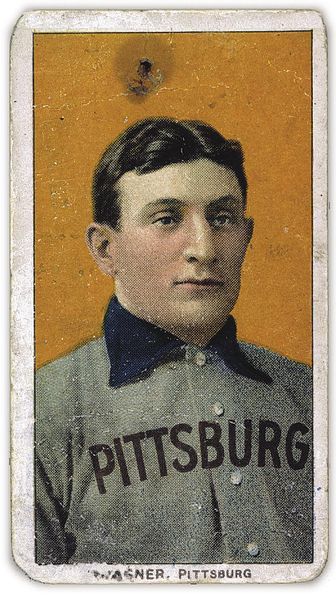
Recently, the now-famous Honus Wagner baseball card sold for $1.2 million. Around 1911, Wagner demanded the American Tobacco Company cease production of the card bearing his image, either because he was so square he thought it immoral for his image to be involved in potentially encouraging the vice of smoking among children, or he was pissed off his image was being used to generate money for a tobacco company and he wasn't getting a slice. Or something else. Anyway, there may only be around 50 of the cards in existence, many of them in a very bad state. The one that sold for $1.2 was in good condition, and another one sold for $2.8 million. I'm pretty sure that one was in very good condition.

Yes, we're talking about baseball cards.

Here's my story about cards. As a boy, I was crazy about the things, and a few of my friends were too. I mowed neighbors' lawns and washed their cars to make extra money to try to complete that year's set. I'd buy, for 15 cents, packs of 10 that had one very sharp-edged slab of hard, thin, pink bubble gum in them. We'd buy eight or twelve packs at a time, walk a few feet outside the store onto the sidewalk, rip open the packs and quickly rifle through the ten cards, noting with the dexterity of a Las Vegas croupier which ones were duplicates - which we could potentially trade with a friend who might have one we in turn didn't have - and which ones were new to us. There'd be about 600 unique cards per baseball season, and broken into series of around 110, released at different times during the season.  You'd get a call on some July morning: "The third series is out!," and feel your pulse quicken. The wrappers (and often the lousy gum) would go into the trash bin on the sidewalk, and we'd walk home talking about who we had, who we still needed to get. Boys as totally irrational collectors of images of romantic men we might be one day ourselves, if only we could hit the ball out of the infield. Our own little low-stakes micro-world version of Tulip-mania. Our entrance into the world of commodity fetishism. We would have no Critical Theory for another 15 years.

                                         The now-famous Wagner card, worth literally millions

Often we'd noticed some barely noteworthy player - a backup shortstop for the Brewers or some reliever with a high ERA - was the one card we couldn't find. When one of us found it, envy ensued. This may have been our first taste of a corporate conspiracy theory: to get us to waste as much of our allowances on cards as possible. Every kid I ever knew kept all his duplicates separate; they were little stacks of waste. They represented pitches swung at and missed. They were ordered pollution. May as well throw 'em away...but some other kid might actually "need" one of your banjo-hitting shortstops. You had five of that guy, or four more than you needed. It was stuff like this that was bothersome in our lives. (Did I really live that life?)

At some point, I think it was my dad who found an article in the Los Angeles Times about a very rare baseball card that might be worth $250. It was the Honus Wagner. Jeez, you'd think it would be Lou Gehrig, or Ty Cobb, or Babe Ruth. I knew Wagner was in the Hall of Fame. He was from the Dead Ball Era. He was so deep in ancient history it was freakish stuff. Who could afford to spend that much on a baseball card? I read the article with the same sense of irreality that attended an article about the history of the Hope Diamond, or how Champollion deciphered the Rosetta Stone: marvelous, uncanny, hard to believe.

One day, while reading the ads in the back of a comic book, I noticed some place on the other side of the country sold cards on demand - for five or ten cents each! I'd write them for a FREE catalog, and then send them cash in an envelope, noting exactly which cards I wanted. It took all the romance - and waste - out of buying packs of bubblegum, but I was able to collect complete sets, almost all in perfect condition, of the cards issued by Topps from 1969 through 1975, when I got tired of "all that" and moved onto other things. In the collecting years, I'd stumbled onto ways to obtain much older cards for relatively cheap prices, and I had all of those neatly bundled, by number in their own special shoe boxes I inherited from my mom. I had a few cards from the 1950s. I had a Mickey Mantle. I had...oh, nevermind.

                                       Here's a 1971 Hank Aaron card. I owned this one. 
                                       This was three years before he broke Babe Ruth's 
                                       all-time home run record. I remember the day he broke
                                       the record. I was glad for him. Hammerin' Hank is a 
                                       Good Guy. Always was. 

I had complete, mint collections of basketball, football, and hockey cards too. They eventually were stored in my closet, in the dark. If there were any shops that dealt in sports memorabilia, I had never heard of them. Sports cards were strictly kid's stuff, although over the years I had heard stories of some classmate's father who owned...everything. I assumed they were stories.

Around the age of 17, I realized if I wanted to have any realistic hope of getting laid, I'd require my own car, and therefore needed money fast. One way: I saw an ad in a local newspaper. Some guy would buy my sportscards. I remember he came out to the house and looked at them, and offered me $50, and I said okay. I don't remember haggling. I had ceased even thinking about those cards for a few years.

It only took about another three or four years before sports cards became a big deal. I thought, "Well, I was into that before anyone else was!" Then, closer scrutiny brought the devastating revelation that my collection I'd sold a few years ago would have probably been worth at least $5000 if I still had it. I saw a catalog of special cards that sold for $25 or $50 each. I had owned most of those. I told the truth to anyone who'd listen. I felt like a fool, but how could I have known that stuff would all the sudden become a Big Deal? The more I told my story, the more therapeutic it was, for some reason. Oh well: sometimes kids do hasty, stupid things, and how many people thought the earliest Apple stock was probably overpriced and passed?

There were storefront memorabilia shops all over the place now, and they sold cards, and I studiously avoided going in there to look, although I remember telling one guy who seemed to know the card market like a stock broker can talk stocks, and he thought I'd probably had a collection worth $8000. Which was not pleasant to hear.

Anyway: I was soon playing guitar in rock bands, enjoying college, smoking pot, having sex, teaching private music lessons to people aged 6 to 60, but mostly 16.

                                                       Walter Benjamin

On my own, one day, I was reading a book on Marshall McLuhan, who was a very trippy genius; I didn't quite "get" him, and I still don't. But to this day I enjoy reading him. I "get" him a little more every year. This book happened to mention an essay by someone named Walter Benjamin, who I'd never heard of. I found the essay, I forget where. It was called "The Work of Art in the Age of Mechanical Reproduction." Here was this old German dude, heavy thinker, writing in the 1930s (and I soon learned he'd tried to escape from the Nazis to join his Frankfurt School friends in Unistat, only to be caught in Catalonia and committing suicide with an overdose of morphine in late September, 1940), and he was trying to convince us that films and photography rob individually-made works of their "aura." It didn't make sense to me, probably because I loved photography books. And I was crazy about film. But in the ensuing years I noted that this essay by Benjamin was becoming more and more famous.

One night I got stoned and read the essay again and it made sense. These things happen.

"To perceive the aura of an object we look at means to invest it with the ability to look at us in return." - Walter Benjamin

I didn't know it until a few years later: Benjamin, an intellectual of astonishing depth and breadth, had been heavily influenced by Charles Baudelaire's writings on drugs, especially hashish. Benjamin has undergone a systematic program of using drugs and writing while stoned, or recollecting the stoned state, in order to build up a body of work - along with other painters, poets, and intellectuals - that would catalog the temporary moments of internal freedom from Ordinary Reality. It was theorized that, for humans to carry out a successful revolution away from the types of "mind" that led to World War I, the various fascisms in Europe, and the deadening of the senses that life under industrial capitalism brought, systematic inquiry into stoned (and other non-ordinary states) would lead to a jumping off point for true Revolution.

And Benjamin's idea of "aura" was arrived at during an investigation of hashish.

I thought about my relationship to the mass-produced cards I had been obsessed with as a kid. I still remember time alone, looking at the cards, studying the data of the player's career. Bats left, throws right. Hit .382 one year in the minor leagues! I think I perceived an aura with some of those cards. I think some of them "spoke" to me. To this day I vividly remember a handful of cards, for some odd reason. Why? Why should I have cared? What did it mean? These were not one-offs, invested with - and this is what Benjamin thought an aura was - a quality that was apart from its material signifier in the world. Like an afterimage, but more ethereal. He thought mass production of the same old cookie-cutter item washed out the aura of the Original. I like the idea. It's a great "stoned" idea, and indeed: Benjamin, a mystical quasi-secular Jewish intellectual, was one of the great stoner-artists of all time. (See Benjamin on Hashish. This is intellectual stonerism at its "highest" high...) A work of Art could, when the perceiver focuses upon it, return its own feelings of profound wonder of existence, beauty, truth. Let me be clear: you the viewer can perceive these things AND the Work Itself can permeate some level of existence with its own feelings about the Profound.

Benjamin's idea of "aura" - the now-famous essay was first published around 1935  - turned out to have a strong influence on Critical Theory and postmodernism. So when your professor had you read Frederic Jameson and you thought to yourself, "Maybe if I was stoned I could make sense of this stuff," you probably weren't far off.

Now rare baseball cards are bought by wealthy investors as if they were paintings by minor Expressionist masters. The idea of value in Art will never cease to be a wonder to me.

But I still think I had that experience of "aura" with a few mass-produced baseball cards when I was 12. I can't explain it. I remember feeling it. I think it best not to try to explain it. I remember that time as golden.

There is this French word flaneur. An idler, a lounger. It's often been used in the sense of...well, myself as the sort of blogger-writer the Overweening Generalist represents: the sort of bookish person you see in a cafe, writing poetry or some essay on the meaning of History. Benjamin thought the flaneur turned his back on history, all the while being swept up by it. The flaneur reads and ponders the endless expanse of ruins in history and is blown forward by history, into the future, a supermassive vortex of Progress carrying everything within its forces...

I must leave you with the supreme intellectually stoned feel of Benjamin. Here's the first paragraph of his essay, "Theses on the Philosophy of History," translated from German by Harry Zohn:

The story is told of an automaton constructed in such a way that it could play a winning game of chess, answering each move of an opponent with a countermove. A puppet in Turkish attire and with a hookah in its mouth sat before a chessboard placed on a large table. A system of mirrors created the illusion that this table was transparent from all sides. Actually, a little hunchback who was an expert chess player sat inside and guided the puppet's hand by means of strings. One can imagine a philosophical counterpart to this device. The puppet called "historical materialism" is to win all the time. It can easily be a match for anyone if it enlists the services of theology, which today, as we know, is wizened and has to keep out of sight. - p. 253, from a collection of Benjamin essays called Illuminations: Essays and Reflections 


The Wiki for the Honus Wagner card, with hints and outlines as to its history and intrigues.