I don't know what part of me remained surprised, or even why, after Snowden outed the NSA. Because the topic has been a leitmotif in conversations with all of my friends, since at least the too-Orwellianishly-named Patriot Act passed. But I guess there were a few clusters of neural circuits that were in denial: maybe no one's really spying on me. And you know: that would be just...grand.
[But: in 2011, hadn't Dana Priest's and William Arkin's "Top Secret America" articles in the Washington Post annihilated any last vestige of that neurally stubborn naivete? Apparently not...]
Now: the more "adult" clusters of neurons, the ones that neurobiologists implicate in learning, which have been actively buzzing each others' synapses, exchanging glutamate and acetylcholine, strengthening each other's connections, building on other circuits, merging different circuits, looking for patterns...that part of me was not surprised. Because I've been following the topic of "surveillance" and "privacy" and "the corporate state" and the Panopticon ever since that summer after I graduated from high school, when, just for "fun" I read Brave New World, then immediately: 1984. As soon as Winston Smith learned to love Big Brother and that whole boot stomping on the face of humanity forever thing, I chased those two novels with Fahrenheit 451. I was naive. I was a budding conspiracy theorist. I was an adrenaline junkie. I didn't know what to make of these three books, which acted synergistically in my nervous system...and well, frankly, they fucked me up one side and down the next pretty good. And yet: I "enjoyed" them.
Since then, I like to think my thinking/feeling in those areas has become far more nuanced. I mean: that poor 18 year old gangly naif! All hair and fear and testosterone and yea, verily: idealism.
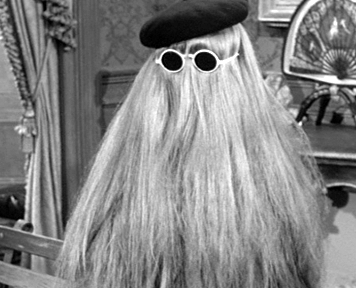
Other times I seem to have not changed much, only lost a lot of that hair. (And I was all hair, really. I played guitar in metal bands and it was sorta like Marty Friedman's, only dyed with Miss Clairol Number 52 Blue/Black...and I was 6 feet tall and weighed about 135. Yes: a freak. Like Cousin It, only with a well-used library card.)
So what to make of Snowden coming out and confirming what intellectual paranoids like myself already suspected?
Well: I was pleased to see that sales of 1984 jumped 5000%, but was equally disappointed by my fellow Unistatians that they weren't already on board with Orwell's ideas. I mean: you'd think the Patriot Act would've done it fer ya, eh? Also: I suspect only about 15% of those who ordered it from Amazon will actually read it all the way through. Also: I remembered the story of Amazon's Kindle owners having their Orwell (and other books) erased. Remotely. Because they could. Hey, they apologized and gave your money back. And said they wouldn't do that again under "those circumstances." But they can do that. Just another reason why I love the dead-tree book.
No need to point out irony. I hope...
As far as Ray Bradbury's book: no one is burning libraries. Not yet. Oh, you have your Christian fascists getting together for a good ol' Two Minutes Hate and burning, say, Harry Potter books. And there are always classic Murrrkin a-holes harassing librarians and school boards for teaching from commies like John Steinbeck or Mark Twain. Get a load of it HERE.
I think Aldous Huxley's 1932 book cements him as a seer. Just that book alone. The ideas about an entire society made drug-dependent and infantilized, with the overwhelming assumption that some people are "naturally" better than others so there ought to be a way to keep the lessers away from the betters...all with an overarching ethic of consumption, of buying things and consuming them as a way to obtain a self-identity? Aldous was legally blind, a modern Tiresias. Aldous's World Anti-Sex League is far too...2013 Kansas for me. It's spooky.
Orwell. Let's see. For his dystopian state to meet ours we need, indefinite detention just because the State says so (check!). We need the State to be able to torture people for any reason they want and get away with it. (We have lift-off on that. Roger!) The State can decree that it can kill anyone they want, anywhere, and they're supposed to have a reason for this but they can choose to not tell anyone what those reasons are, and no one can compel them to tell why they're assassinating people. (We have this, now, under a "liberal" President in Unistat, June, 2013.)
And of course, the State can have surveillance over all communications. (Edward Snowden on Line 1.)
Hmmm...
What about..."Justice"? Presumably there's a Justice system. I mean, there's a Justice Department, just as there was a Ministry of Truth, that put out non-stop propaganda. One of my favorites from 2013 - so far, and there's a cornucopia of this crap to choose from - was the President of Unistat coming in, assuring us that his would be the most "transparent" administration we'd seen. In "reality" as I see it, his Admin has been one of the most opaque when it comes to..."extrajudicial" (Orwell!) matters. (My blogspew on "neomedievalism" might be a germane link here?) And other matters. Liberals have been taken for a ride with this guy.
Time to re-think. What? Hillary Clinton will clear it all up and make it better in 2016? If you believe that and you're reading this blog, you're in the wrong place. Hillary is set as a Neoliberal thinker...better than NeoCon, but really: she's an embodiment of the very outmoded way of thinking about economics and foreign and domestic policy that led us into this morass: a new sort of Failed State, where the government can't even get background checks on gun sales despite about 90% of the public wanting them, us Idiot Citizens thinking it's about time we take even the most trivial steps towards trying to keep from getting accidentally slaughtered by a "lone nut" when we go the goddamned mall. This new sort of Failed State spends as much on military matters as the rest of the world, combined, while the infrastructure crumbles, the actual unemployment level is closer to 20%, and there's a welter of staggering statistics that show how the 1% have run away from the 99%. This government can't even insure its citizens health care, but it can kill any one of its citizens, for any reason.
Justice? Who goes to prison? The poor. And any insider who blows the whistle on the rampant theft in banking, or the gross injustices in the military policies overseas. And let's just wait to see what happens to Snowden.
One thing that many smart writers have missed: even if the NSA can decide to hone in on a domestic citizen with potentially "subversive" ideas, they probably are really only after communications from abroad, looking for "real" terrorists: the infrastructure for a future President Brownback/Palin/Ted Cruz/Newt Gingrich is in place, and it's not going anywhere. If Wall Street or the college loan debt bubble or a combination of both plus something else (another terrorist attack?) happens, this is a real threat to make Orwell's Oceania look like Sesame Street.
We now know that young well-educated people in Unistat who became politically active in order to avert more economic or environmental disasters were heavily surveilled by the State apparatus. As Chomsky has been telling us for at least 15 years: the internal dialogue of the Military/State/Corporate complex refers to the citizenry as "enemy territory."
"The U.S. is the greatest, best country God has ever given man on the face of the Earth." - Sean Hannity, "Hannity's America," June 6th, 2008.
Seth Rosenfeld, author of the stunning Subversives
Seth Rosenfeld Hasn't Had A Proper Hearing Yet:
Another thing a lot of smart, perspicacious writers are missing surrounding the NSA/Snowden clusterfuck: there seems an assumption of linearity in history: we're getting dangerously out of hand, and we need to dial it back. But it's not that simple. Look at what turned up in 30 years of Freedom of Information Act requests in Seth Rosenfeld's 734 page book about Ronald Reagan's and J. Edgar Hoover's wildly paranoid hatred of the University of Berkeley, Subversives, which came out last year. The FBI fought Rosenfeld tooth and nail, but ultimately, the 9th Circuit sided with him. What did we find? A dizzying number of new things that haven't yet filtered into our discourse. Among them:
That Reagan was a snitch for the FBI since 1947. That the FBI sent poison-pen letters (where they make up stuff about someone they don't like) to officials in order to get people fired...that the FBI helped Reagan get elected Governor or California. That the FBI broke into offices, stole and copied and planted information, falsified documents and planted false news stories, assumed both Mario Savio (a brilliant but disturbed Philosophy student and architect of the Free Speech Movement) and UC Berkeley President Clark Kerr (a Quaker and pacifist) were both "communists." The FBI did everything they could to ruin both of their lives, and they succeeded fairly well. (Kerr and Savio were, in actuality, opposed to each other politically regarding the policy of Berkeley.)
To those students of COINTELPRO: yes, it seems like you've seen this; it's not "new" to you. But the depth of Rosenfeld's research ought be considered a series of at least "major" important footnotes to "all that." To those of you who have not been students of COINTELPRO, or only have a cursory knowledge of it: Rosenfeld's book is a perfect place to start, if only because he's so wonderful at narrative using his research. It's a thick book but I found it hard to put down. (Get it from your library as some sort of ethereal shout-out to Ray Bradbury?)
Above all, for our purposes here: the FBI created massive secret lists of "subversives" who should be rounded up "in case of emergency." This included students who were interested in alternative points of view about political and social ideas. If you were an 18 year old English major who signed a petition agreeing that the HUAC should be disbanded, you got on the Hoover/Reagan shitlist. And if your friends or family members subscribed to (or especially: wrote for) publications they thought were "UnAmerican" you were suspect. The brightest young people at the best public university (where much of our actual wealth originates: in new ideas) were enemies to Hoover and Reagan.
This is a hell of a book, so far criminally overlooked. Just because it's about one university, albeit maybe the top public university in Unistat, always productive of Nobel Prize winners, in one small area of Unistat, doesn't mean it's not germane to you who live in some other part of the country...or the rest of the <cough> "free world."
So - and sorry I've gone on far too long once again here - it has already happened here. But a digital infrastructure just makes it possible to do again, but about a million times more - and here's a favorite fascist's word - efficiently. Or, as Edward Snowden put it, we have extended the "architecture of oppression."
Oh, and the "subversives" in Rosenfeld's book?: they're not Savio or the SDS or professors who ordered books on communism. Guess who they are.
The Overweening Generalist is largely about people who like to read fat, weighty "difficult" books - or thin, profound ones - and how I/They/We stand in relation to the hyper-acceleration of digital social-media-tized culture. It is not a neo-Luddite attack on digital media; it is an attempt to negotiate with it, and to subtly make claims for the role of generalist intellectual types in the scheme of things.
Overweening Generalist
Showing posts with label Ray Bradbury. Show all posts
Thursday, June 13, 2013
Friday, July 29, 2011
Keeping Up-To-Date on Time Travel
Or to render time and stand outside
The horizontal rush of it, for a moment
To have the sensation of standing outside
The greenish rush of it.
-from "Time and Materials," by Robert Hass
I see that recent experiments in physics have ("temporarily"?) put the kibosh on our hopes for time-travel, especially travel backwards in time. (See links at the end of this article.) When you've fantasized about somehow traveling to another time, is it usually the past or the future? I think when I was a child I'd fantasize about some future-world, one with my own jet-pack. Now I tend to fantasize about going back...and not to kill my grandfather, either: that, as I understand it, is definitely out-of-bounds, and leads to all manner of hideous paradoxes. Not to mention: I loved my grandpa!
(But if I ran into Hitler, I wouldn't hesitate to shoot that mutha; I'm usually a Gandhi nonviolent dude, but in this extreme case I'd make an exception, even though I'd probably be haunted by an old Ray Bradbury short story in which some Disney-like company allows you to travel back in time and see the dinosaurs, but you must not step off the special track and change the world "back then" in the slightest way, because it could have enormous ramifications down through the years. One person steps in the jurassic mud, and...oh, you go ahead and read "A Sound of Thunder" from The Golden Apples of the Sun
; it's also collected in Twice 22
.)
It seems to me a psychological state of openness to infinitude aligns with daydreams about time-travel. Unless you catch yourself wishing you could go back to that time not long ago when you said or did something deeply embarrassing, and...not do that thing (but then you'd have to stay stuck there in time, or do you imagine you get back into the telephone-booth-like dealio and presto!: you're back in "real time," whatever that is?), you probably want to see for yourself what Things Would Be Like Then. And I don't blame you. But the physicists have just outlawed it, so forget it. But we can't forget it, right?
If I met someone and eventually I asked him or her, "When you fantasize about time travel, where do you go?," and the person quickly replied that they had never fantasized about time travel, it's for imbeciles and science fiction freaks and seriously disturbed people or all of the above, I would assume there was something wrong with a person who asserts they'd never dabbled with their imagination in such a way. I just tend to assume there's something a bit off-kilter with the person who - truly - has never fantasized about time travel. But maybe I'm the weird one in this instance. It wouldn't be the first time!, to put it mildly...
Now, I admit: the people who've memorized every line from every script of Star Trek and the convention is the best three days of the year for them, every year: those people seem a tad "much" for me. I just think it's healthy to fantasize about time travel every now and then, even if you know it's "impossible."
Why would I think it's somewhat unhealthy to not fantasize about time travel every now and then, even if you know it's impossible? Maybe because I think we ought to desire freedom from the constraints and limitations of time. It just seems healthy to me to desire an ecstasy like that. And it seems culturally ubiquitous (nota bene science fiction and movies and TV), which makes me happy. There are a lot of others who'd like to somehow transcend time's vast-yet-still-limited elbow room. Sure, it's impossible. But...
I think maybe I time travel when I read books and see movies. It's good enough for me. When I'm reading Plato, I can't help but see myself in a white robe and sandals, walking through the Agora in Athens, listening in on Socrates. (In recent years, I tend to favor the Sophists, but that's for another blogspew.) When I read Montaigne I find I've developed a picture of what his round book-lined tower room looks, feels, and even smells like.
"Are you kiddin' me? You wanna be wit all dem whattyacall philosophy majors? Don't know 'bout you, but, uhhh...Me? I'm goin' back in time for one ting and one ting only: to get into Cleopatra's panties! She looked exactly like Liz Taylor when she was thin...Oh! Hold on a minute! Wait! No, no, I got it: I'm going back to 1951 and jumpin' Marilyn Monroe's bones! Wham bam thank you m'am and then I hop out the window, find the gizmo in the bushes, and ZAP!: I'm back here in time for the game."
Yea, okay. Different strokes for different folks. Good luck to you anyway...and how did you get into this blog? Who let you in? Anyway...
Hey, I'd like some circa-1960 Anne Bancroft sex, but somehow that's not the kind of scenario that comes to me, unbidden, when I find myself thinking of "being" back There somewhere, in "time."
I put "time" in quotes, because we know that space and time are two sides of the same coin. So we ought to say "space-time travel." But we don't. It's a convention, I guess. Kinda like how we say,"I don't have time for this nonsense, " and not "I don't have the space-time for this nonsense."
Space travel! For now, it's impossible, but could we engineer the worm hole thing? It keeps the dream alive, at least. As for us, we'll have to alter out own perceptions of time via sex, drugs and rock and roll.
If that's all I have to offer you, I'm okay with that. Enjoy.
Do you tend want to go forward or backward in time, if you could?
Recent studies that tend to suggest time travel is a no-no are found here and here. The Wikipedia article on time travel is pretty cool, and it's here.
The horizontal rush of it, for a moment
To have the sensation of standing outside
The greenish rush of it.
-from "Time and Materials," by Robert Hass
I see that recent experiments in physics have ("temporarily"?) put the kibosh on our hopes for time-travel, especially travel backwards in time. (See links at the end of this article.) When you've fantasized about somehow traveling to another time, is it usually the past or the future? I think when I was a child I'd fantasize about some future-world, one with my own jet-pack. Now I tend to fantasize about going back...and not to kill my grandfather, either: that, as I understand it, is definitely out-of-bounds, and leads to all manner of hideous paradoxes. Not to mention: I loved my grandpa!
(But if I ran into Hitler, I wouldn't hesitate to shoot that mutha; I'm usually a Gandhi nonviolent dude, but in this extreme case I'd make an exception, even though I'd probably be haunted by an old Ray Bradbury short story in which some Disney-like company allows you to travel back in time and see the dinosaurs, but you must not step off the special track and change the world "back then" in the slightest way, because it could have enormous ramifications down through the years. One person steps in the jurassic mud, and...oh, you go ahead and read "A Sound of Thunder" from The Golden Apples of the Sun
It seems to me a psychological state of openness to infinitude aligns with daydreams about time-travel. Unless you catch yourself wishing you could go back to that time not long ago when you said or did something deeply embarrassing, and...not do that thing (but then you'd have to stay stuck there in time, or do you imagine you get back into the telephone-booth-like dealio and presto!: you're back in "real time," whatever that is?), you probably want to see for yourself what Things Would Be Like Then. And I don't blame you. But the physicists have just outlawed it, so forget it. But we can't forget it, right?
If I met someone and eventually I asked him or her, "When you fantasize about time travel, where do you go?," and the person quickly replied that they had never fantasized about time travel, it's for imbeciles and science fiction freaks and seriously disturbed people or all of the above, I would assume there was something wrong with a person who asserts they'd never dabbled with their imagination in such a way. I just tend to assume there's something a bit off-kilter with the person who - truly - has never fantasized about time travel. But maybe I'm the weird one in this instance. It wouldn't be the first time!, to put it mildly...
Now, I admit: the people who've memorized every line from every script of Star Trek and the convention is the best three days of the year for them, every year: those people seem a tad "much" for me. I just think it's healthy to fantasize about time travel every now and then, even if you know it's "impossible."
Why would I think it's somewhat unhealthy to not fantasize about time travel every now and then, even if you know it's impossible? Maybe because I think we ought to desire freedom from the constraints and limitations of time. It just seems healthy to me to desire an ecstasy like that. And it seems culturally ubiquitous (nota bene science fiction and movies and TV), which makes me happy. There are a lot of others who'd like to somehow transcend time's vast-yet-still-limited elbow room. Sure, it's impossible. But...
I think maybe I time travel when I read books and see movies. It's good enough for me. When I'm reading Plato, I can't help but see myself in a white robe and sandals, walking through the Agora in Athens, listening in on Socrates. (In recent years, I tend to favor the Sophists, but that's for another blogspew.) When I read Montaigne I find I've developed a picture of what his round book-lined tower room looks, feels, and even smells like.
"Are you kiddin' me? You wanna be wit all dem whattyacall philosophy majors? Don't know 'bout you, but, uhhh...Me? I'm goin' back in time for one ting and one ting only: to get into Cleopatra's panties! She looked exactly like Liz Taylor when she was thin...Oh! Hold on a minute! Wait! No, no, I got it: I'm going back to 1951 and jumpin' Marilyn Monroe's bones! Wham bam thank you m'am and then I hop out the window, find the gizmo in the bushes, and ZAP!: I'm back here in time for the game."
Yea, okay. Different strokes for different folks. Good luck to you anyway...and how did you get into this blog? Who let you in? Anyway...
Hey, I'd like some circa-1960 Anne Bancroft sex, but somehow that's not the kind of scenario that comes to me, unbidden, when I find myself thinking of "being" back There somewhere, in "time."
I put "time" in quotes, because we know that space and time are two sides of the same coin. So we ought to say "space-time travel." But we don't. It's a convention, I guess. Kinda like how we say,"I don't have time for this nonsense, " and not "I don't have the space-time for this nonsense."
Space travel! For now, it's impossible, but could we engineer the worm hole thing? It keeps the dream alive, at least. As for us, we'll have to alter out own perceptions of time via sex, drugs and rock and roll.
If that's all I have to offer you, I'm okay with that. Enjoy.
Do you tend want to go forward or backward in time, if you could?
Recent studies that tend to suggest time travel is a no-no are found here and here. The Wikipedia article on time travel is pretty cool, and it's here.
Subscribe to:
Posts (Atom)