At some point in the past 12 years I began to develop a Shadow that watched me consume information. Metaphorically, the Shadow set up lines of communication with "me" and took measures to insert redundancy and insulated wires, etc: the clarity of signal between Shadow and "me" became less and less noisy. I am not describing a clinical picture here; I'm not mentally ill.
Not yet, anyway.
The Shadow seemed only concerned with how I felt when reading books or on Internet, or any other media in which we decode alphabetical "words." (i.e., It's a lot like what you're doing right where you are sitting now.) I noticed It didn't care very much about my listening to music or watching TV. There had been a similar sort of Entity many years ago that watched my TV watching, but it was blunt and always correct. A typical message: "You're not really enjoying this program. Not anymore. Turn it off and do what really makes you happy."
A lot of the time that happy-making thing was reading. It still is.
I know now this Shadow and the earlier Entity were parts of myself I'd constructed from reading and thinking about how media affects me. And I know my reading can make me unhappy, but sometimes I ward that off by saying to myself, "This is very unpleasant information, and it seems mostly true, or true enough. But I'd rather be one who knows how the world 'really' works than an oblivious bore. It's what Jefferson said was essential for democracy to work." Something like that.
Mostly my reading brings me great joy and wonder. That's why I'm addicted to it. I'm okay with the addiction. Resonant energy-language from books interacting with my nervous system has become some sort of activity that acts symbiotically: I derive a sort of secular religiosity of wonder from it; it derives my attention and money, but I think the thing it really likes is how I propagate its seed. It wants pullulation; I deliver. We're both happy.
And, like playing a musical instrument, reading on and on for years and really challenging yourself makes you a more formidable reader. I can pick up Finnegans Wake at any point, read a page and yack about my interpretations there for 20 minutes. I'm currently reading my first Murakami book (and it's great!: Hard-Boiled Wonderland and the End of the World, not that you'd asked) and I get the palpable feeling that my intense readings of Borges make this book "easier" because of the earlier heavy lifting of the Argentine and Chandler, maybe William Gibson and a handful of like-marvelous writers...
I've at times (twice at minimum) read myself into Chapel Perilous, and reading was part of finding my way out. Nowadays the only worry I have in these regards is Info-Glut. I first became aware that I was not the only one who experienced the vertigo of info when a book called Information Anxiety appeared on the New Books shelf at my local library in 1990. It was by some guy named Richard Saul Wurman, who later invented the TED Talks. He gave some historical perspective. Misery loved company yet again. I forget whether Lassie ever really did come home...
Since then: a flood/deluge/onslaught/barrage/din of books and articles on the effects of too much information interacting with the nervous system. Ironic? Hell yes. Those terms (flood/deluge, etc) are some of the same ones people use when they talk about their own "info overload."
So: I guess I model internally my reading on some sort of Bell Curve, and most of the time I'm right near the top, on the lefthand slope, enjoying myself. And if I get to the top and tip over and start sliding down the righthand side, I know some good breathing exercises. I know to go be with friends. I know when to take a walk or play guitar, lose myself in that.
Some Notes From Outside Me and My Shadow
-David Foster Wallace, in an essay collected in Both Flesh and Not, addressed the combination of boredom - which his friend and fellow writer Jonathan Franzen said DFW died from (boredom) - and information anxiety: Total Noise. He not only addressed the personal responsibility to be informed as a citizen in a "democracy" but he felt like he was drowning, losing his autonomy, in "the tsunami of available fact, context, and perspective." In order to stay afloat, we need allies, proxies, and subcontracting friends who will maybe read that long article for you, and tell you what's the gist and pith. A bulwark against info-glut were those invaluable writers of concision who knew how to marshall the flood of facts and convey them meaningfully. They seem to be essayists.
While I doubt I'll ever totally understand DFW's boredom problem - some things seem simply beyond me, temperamentally - the irony for us here is that he was one of those writers who provided that bulwark for us.
What further complicates DFW for me: in his brilliant discussion of Kafka and short stories and jokes in Consider the Lobster, he addresses Danish science writer Tor Norretranders's idea of exformation, "which is a certain quality of vital information removed from but evoked by a communication in such a way as to cause a kind of explosion of associative connections within the recipient." - that's how DFW unpacks Norretranders here.
DFW's suicide is too sad -not to mention too arch and far too simplifying - to posit that his boredom-unto-out-of-control-depression-and-suicide was due to going over the Bell Curve, down the right-hand slope, careening into oblivion. His writing gives me nothing but pleasure; he makes me feel smarter. He helps me deal with the Glut.
-In David Ulin's The Lost Art of Reading he tells us about the Global Information Industry Center's 2009 study about information consumption by Unistatians in 2008: tons of shallow crap. Okay, but why? This led me to Elizabeth Eisenstein.
-Around 1962, the honcho primo of the American Historical Association, Carl Bridenbaugh, gave a talk about how the new media of TV, telephones, polaroid cameras, transistor radios, data processing machines and "that Bitch Goddess, Quantification."
Bridenbaugh: "Notwithstanding the incessant chatter about communication that we hear daily, it has not improved; actually it has become more difficult."
Eisenstein's massive, 2-vol The Printing Press as an Agent of Change argued the opposite of Bridenbaugh, who thought we were losing our history, our memory, who we are, due to the new media. Eisenstein showed how utterly profound the Gutenberg explosion was responsible for the rise of science, the Protestant Reformation and the Renaissance. She cited Marshall McLuhan's Gutenberg Galaxy for pointing to scholars that they can be blind to the very medium in which they swim: books. The past was becoming not less accessible, but more accessible. Scholars translate books, crack codes like Linear B, uncover the Dead Sea Scrolls, etc.
Still: how to make sense of that part of the glut you're mired in at present? Does info glut make us culturally crazy? Is this ultimately behind the phenomena of "FOMO" and other mediated maladies since 2000CE?
-T.S. Eliot, by 1934 quite the reactionary, but still:
Knowledge of speech, but not of silence;
Knowledge of words, and ignorance of the Word.
All our knowledge brings us nearer to our ignorance,
All our ignorance brings us nearer to death,
But nearness to death no nearer to GOD.
-"The Rock"
While I don't share Eliot's Anglican bend by any stretch, why not constantly wonder about the principles and workings in us of data/information/knowledge/wisdom? And, perhaps especially: silence? It seems to me worthsomewhiles.
-Aldous Huxley and the stoned intelligentsia that followed in the wake of his Doors and Perception and Heaven and Hell often picked up Aldous's metaphorical riff: that tripping on LSD and psilocybin was flooding the nervous system with information. Huxley compared the experience of rapid info-flow on psychedelics as if ordinary life was spent while your mind was a garden hose with a crink in it, so we experience those dribbles and drabs as "reality. With psychedelic drugs, the garden hose is straightened out, and it feels like a goddamned fire hose of info-deluge. With the slightest tweak of a serotonin molecule, "reality" is seen in a profoundly new light. Lots of us have at times freaked out on that...glut.
It doesn't seem too much to see why robotic cults follow in the wake of this: the replacement by a very low-info environment. The grasping at quotidian Our Leader Will Tell Us crap. Jesus Told Me To Tell You crap. In order to feel better. I get it.
Back To My Shadow and Me
One thing that helps me in staving off the fear from Info-Glut: I find it feels good to imagine being part of a conspiracy of readers/knowers who are privy to certain things. (If I recall correctly, the Shadow turned me on to this cabal.) This seems to me at once both a product of my arrested adolescent Walter Mitty-mindedness, and a hedge against, for lack of a better word, insanity. I mean, Ted Kaczynski read the Great Books. Cosmic humor and frequent erotic flings with the Infinite Goof seem quite on the jocoserious order in face of the Glut. Or: do you have a better way?
l'image de bobby campbell
The Overweening Generalist is largely about people who like to read fat, weighty "difficult" books - or thin, profound ones - and how I/They/We stand in relation to the hyper-acceleration of digital social-media-tized culture. It is not a neo-Luddite attack on digital media; it is an attempt to negotiate with it, and to subtly make claims for the role of generalist intellectual types in the scheme of things.
Overweening Generalist
Showing posts with label books. Show all posts
Monday, June 27, 2016
Friday, April 29, 2016
World Book Day/Night 2016
[Apparently World Book Night came again this year, and I was busy doing other things, totally oblivious. Yesterday I logged on to "surf the Net" - which fogies like me still say, by the way - and kept noticing all these new articles about Shakespeare and wondered, "wha?" Then it hit me: World Book Day/Night was April 23rd, so here I am, a mere six days late. - OG]
Fore-Words: Set the Tone
Here's part of a dialogue between Bill Moyers and Joseph Campbell:
Moyers: Who interprets the divinity inherent in nature for us today? Who are our shamans? Who interprets unseen things for us?
Campbell: It is the function of the artist to do this. The artist is the one who communicates myth for today. But he has to be an artist who understands mythology and humanity and isn't simply a sociologist with a program for you.
Moyers: What about those others who are ordinary, those who are not poets or artists, or who have not had a transcendent ecstasy? How do we know of these things?
Campbell: I'll tell you a way, a very nice way. Sit in a room and read - and read and read. And read the right books by the right people. Your mind is brought onto that level, and you have a nice, mild, slow-burning rapture all the time. This realization of life can be a constant realization in your living. When you find an author who really grabs you, read everything he has done. Don't say, "Oh, I want to know what So-and-so did" - and don't bother at all with the best-seller list. Just read what this one author has to give you. And then you can go read what he had read. And the world opens up in a way that is consistent with a certain point of view. - The Power of Myth, p.99
=====================================
Short Note on Books and Revolutions
My writing on the visceral thrill I get from reading "forbidden" or "dangerous" books, books with some purported "demonic" power, books linked to infamous crimes, etcetera, has appeared at this blog and in other places. Currently I've been reading in books about other books on the topic of what books can/might/did "do" to certain readers, and, oh, all kinds of fallout in human history. For those who want to look at some choice academic research quite readable about books and revolutions, two that I've recently found of surpassing interest are Robert Darnton's The Forbidden Best-Sellers of Pre-Revolutionary France, and John V. Fleming's The Anti-Communist Manifestos: Four Books That Shaped the Cold War.
Darnton - one of the great scholars of books in our time - breaks down the forbidden best-sellers during the 20 year period before the ancien regime turned to guillotine-time (a much different time than the time Joseph Campbell warned us about; I tend to agree with Campbell about best-sellers under the current dispensation); Darnton's sleuthing is marvelous, teasing out the many "underground" forbidden books from roughly 1769 or so to 1789. These books get classified into three categories: 1.) "Philosophical Pornography"; 2.) Utopian Fantasy; and 3.) Political Slander. Darnton writes a chapter on each. Later, Section 3 of Darnton is titled, "Do Books Cause Revolutions?" and this section constitutes a marvelous contribution to the sociology of knowledge.
Fleming writes at length about four books that influenced the Cold War: Koestler's Darkness At Noon (1940), which was the only one of the four I'd been familiar with. The others are Out of the Night (1941, but really only a few weeks after Koestler's book came out), by "Jan Valtin" AKA Richard Krebs, a supposed autobiography and the best-seller in Unistat by the end of the year; I Chose Freedom, by Victor Kravchenko (1944). The last anti-commie book for Fleming was one I'd known of, but that was the extent: Whittaker Chambers's Witness (1952), which Fleming calls "perhaps the greatest American masterpiece of literary anti-Communism," and a book which greatly benefited by the Cold War being then in full swing, and even more so by Chambers's nailing of Alger Hiss. At the end of last year I read a cracking good just-off-the-presses book about the history of today's Unistat right wing, Right Out of California, by UC Davis History professor Kathryn Olmstead. That book - which argues persuasively that the origin of the Unistat Right began in Depression Era California, where the migrant farmworkers were not considered under The New Deal, because FDR needed the South - foreshadowed a lot of the information in Fleming's book, and extended the boundaries of my own historical imagination vis a vis the refinement of propaganda techniques by Unistat spy agencies and the military/industrial/entertainment complex. Juxtaposing Fleming's book on mid-20th century political books that the State "likes" vs. the underground sales of books forbidden by the State in Darnton made me feel like 1789 was more like 500 years ago.
Darnton and Fleming and Olmstead (oh my!) also reminded me of Frances Stonor Saunders's must-read, The Cultural Cold War. Get a load of this:
"'Books differ from all other propaganda media,' wrote a chief of the CIA's Covert Action Staff, 'primarily because one single book can significantly change the reader's attitude and action to an extent unmatched by the impact of any other single medium [such as to] make books the most important weapon of strategic (long-range) propaganda.' The CIA's clandestine books programme was run, according to the same source, with the following aims in mind: 'Get books published or distributed abroad without revealing any US influence, by covertly subsidizing foreign publications or booksellers. Get books published which should not be 'contaminated' by any overt tie-in with the US government, especially if the position of the author is 'delicate.' Get books published for operational reasons, regardless of commercial viability. Initiate and subsidize indigenous national or international organizations for book publishing or distributing purposes. Stimulate the writing of politically significant books by unknown foreign authors - either by directly subsidizing the author, if covert contact is feasible, or indirectly, through literary agents or publishers." -p.245, Saunders, who is quoting from the Final Report of the Church Committee, 1976. Saunders quotes a NYT article published on Christmas Day, 1977, about the investigations into the CIA's history: "The New York Times alleged in 1977 that the CIA had been involved in the publication of at least a thousand books."
When I first read Saunders, I noted a CIA-backed book I had read that no one I personally knew had read. And I'd liked the book: The New Class, by Milovan Djilas. E. Howard Hunt, working for the CIA admitted he helped get that book published. Was I a dupe? I guess any one of us who reads books at this level will be reading "propaganda" at some point, unwittingly, or possibly quasi-wittingly. Chomsky has written many times that the intellectual class is most subject to this sort of thing, simply because they read so damned much...So there's another reason to embrace those rebel writers you love, the outre and declasse ones that never get reviewed by the New York intellectuals?
To return to our Big Q: do books cause revolutions? I'd like to think so. My oblivious reading of Djilas's CIA-backed book led me to read a wonderful book by the renegade "outlaw Marxist" Alvin Gouldner, and his The Future of Intellectuals and the Rise of the New Class. Gouldner turned Socrates and interrogated Marxism from within, walking the perimeter of "the dark side of the Dialectic," which I still find thrilling. I find the intellectual stimulation so bracing I return to this slim volume every few years. In it, Gouldner says that Marxism is a product of bookstores and libraries.
========================================
Thirdly, and really a bald non-sequitur, I will state a personal strong esthetic preference for reading "dead tree" books over reading them on any digital gadget, and that replacing paper books with e-books is - and I'm not the first to float this analogy - like replacing real cut flowers with plastic ones.
Dead Tree Books, Despite the Peril of Paper
Oh, okay yes: the "real" cut flowers will wither in a week or so, while your plastic flowers look the same year after year, so there's gotta be something wrong with this analogy. But I will throw in a monkeywrench and say that with cannabis and hemp legalization more publishers will probably want to use hemp for paper because it last many, many, many times longer than pulped paper.
And our diminishing world forests get a break. Lousy quality paper: have you ever picked up an old paperback novel produced in the 1950s at a yard or library sale? I've bought ones where the paper is increasingly sort of brownish-rusty near the edges, the paper itself has a rough fuzzy feel to it, and the pages are likely to break if you bend them. Lamentable books like this - even if you read 'em and they're great - are not the ones you'd give to someone else, "You've got to read this! It's fantastic!" Then you hand them the book and a couple of pages fall out, having detached from the spine during the apparently rough drive over, when you hit that pothole. Sad. What an overall lugubrious-evoking state of affairs, indeed.
40 years after a book rolls off the presses ready for the bookstore, it's literally disintegrating in your hands! (I first noted these books in the 1990s.)
In the bargain basement pulp paper era (BBPPE), which lasted into the 1980s, according to one source I probably just made up, publishers of paperbacks sought to save money by buying the cheapest pulp paper they could find, then "extend" this pulp by throwing in some acid.
No, that's cutting corners. It's more like this: when you use wood to make paper there's this stuff called lignin, which went into making the cell walls of wood and bark and helped make up the vascular structures of a plant. This is odorless, mostly colorless, and I imagine fairly tasteless. (Ever get one of those old crappy paperbacks that actually have a big fleck of wood embedded in a page? This I count as one of those Things That Ought Not Be in my world.)
You get rid of the lignin when you're making the paper by adding acid, particularly something called peroxycetic acid. It's more complex than this (of course!), but adding the acid is part of the delignification process. We worry about old Ray Bradbury paperbacks - or at least I think we should - but documents and artworks, if not delignified, will break down and deteriorate, and even faster if exposed to light and heat. And don't we do some of our best reading under light, with adequate heat? To get the pH level of your pulp back to something closer to the 7 of alkaline/acid balance, you need to go through another process or two, but that costs money. Just take the acid-riddled pulp and print that dimestore novel on that. Take the money and run...
To cut to a less technical aspect of this spiel, hemp has lower lignin content. If treated just right, it's fairly inexpensive to produce paper for books from hemp that will last 500 to 1000 years before it noticeably starts to deteriorate. Robert Anton Wilson cited an article in a February, 1938 issue of Popular Mechanics about a hemp harvesting machine that would make farmers rich and allow us all to have the most fantastic paper in our books, no cutting down forests either. The male (you don't get high off it) cannabis plant: hemp. Easy to grow. Here's RAW's bit:
"Well, kiddies, the wonderful invention was a device that made it possible to harvest hemp more cheaply than ever before. Hemp was the chief ingredient in paper throughout most of history (our Declaration of Independence was written on it, for instance) and paper made of hemp lasted a good long time compared to paper made of wood pulp. Ever notice how 19th or 18th century books, or even 17th century books like the original folio of Shakespeare's plays, printed on hemp, are still around, while modern books printed on wood pulp fall apart in only decades?"
-p.178, "Deforestation," Email To The Universe
Wilson then goes on to link this to the War on Drugs, including pot. The Unistat gummint found out people were getting high, so sorry: millions of lives must be ruined, forests chopped down, and books must fall apart. I wish I believed in "hell" so I could imagine someone like Harry Anslinger paying for his part in all this, but he's probably just food for worms.
The Good News: we have good reason to believe we'll get lots of hemp in our paper in our books, soon, the cultural winds finally having shifted. And I'm sorry, but we cannot extend the life of our cut flowers indefinitely, and I'm sure someone's working on it. (Then where will the florists be? Uber drivers? Oy!)
I love the story about Ts'ai Lun, who made paper out of hemp and mulberry bark and tried to convince the Chinese bureaucracy to adopt his invention, paper, in 105 CE. The stuffed shirts wouldn't give Ts'ai a decent hearing, so he pulled the old shamanic stunt of burying himself alive and then returning to the living. He used a hollow reed to breathe, and his friends burned a bunch of his hemp-paper over his grave, which caused Ts'ai Lun to miraculously come back to life. Quite a trick! The bureaucrats were impressed (jeez, the shit The Suits put you through before they'll listen to a new idea!), and his paper was adopted, and Ts'ai became a palace favorite. But political winds shifted after a spell, and Ts'ai faced a trial, which he wasn't up for. So, as Dale Pendell writes, Ts'ai Lun "dressed in his best robes and drank poison." - PharmakoPoeia, p.183
Coda: A Future?
So, we're all used to the print/dead tree/dead hemp plant "codex" book vs. the book read on some electronic gadget argument. Well, Google is working on a combination of the two, but as I read about it, I had mind's eye trouble: an "augmented reality" pop-up book that adds sound, lighting elements, and video projection? And it interacts with other personal information you had stored on your other e-gizmos? You can add content? I'm not sure if I understand what these visionaries want to do, but I guess there are some areas in all our lives and - I'll speak for myself here - I think I already add that stuff to my reading of the plain old paper-bound book. I do it in exercising my imagination. For what the wizards at Google and Apple want to do, I'll just watch a fucking movie, your mileage may vary. See the article I'm getting all reactionary over HERE. What am I missing?
On second thought: this could become the next great art medium, and you know what? I hope it does...
Adieu
I wish you all a Joseph Campbell-ian "nice, mild, slow-burning rapture all the time" in your reading, chums.
fantasztikus grafikus Bob Campbell
Labels:
banned books,
books,
CIA,
communism,
demonic power of books,
Frances Stonor Saunders,
French Revolution,
hemp,
intellectuals,
John V. Fleming,
Karl Marx,
paper,
propaganda,
reading,
Robert Darnton,
World Book Night
Sunday, March 27, 2016
On Psychedelic Frames and Peter Bebergal
I've just finished Peter Bebergal's 2011 memoir, Too Much To Dream: A Psychedelic American Boyhood and found it gripping because much of it seemed to speak directly to my own boyhood. Bebergal grew up in a suburb of Boston around the same time I was "growing up" (for some reason that term suddenly felt alien to me, ergo the quotation marks) in the sprawling 'burbs of Los Angeles.
A huge difference between Bebergal and me: here, in Bebergal, is once again a subspecies of character structure that I'm fascinated in and love to read about, but which seems alien to me: Bebergal is a "god intoxicated" person. All his forays into dropout punk culture (hilariously, he gets into 1960s-70s "psychedelic rock" after his punk phase), hanging out with street people and smoking pot, doing LSD (a couple of bad trips are rendered very well here), alcohol, cocaine, etc. Trying to "know" god or the Ultimate Transcendent Whatsit and chasing it with drugs and a fierce autodidacticism. Bebergal grew up in what looks like a non-observant rationalist Jewish home; I grew up in a non-theist, broken home. From the most rudimentary ideas in world religion, I had to teach myself what all the fuss was about. It wasn't discussed and my parents didn't bring my brothers and I up in any faith and we never went to church. I asked my father about this many years later and he said that he and mom had a talk about this: they'd seen far too much damage done to their friends and families in the name of religion than anything that might be considered uplifting. I was most decidedly not god-intoxicated, but I did want the gnosis, although it would be many years before I ever encountered the term.
Peter Bebergal (photo: Andrea Shea/WBUR)
Throughout, Bebergal wants that gnosis, he wants direct experience of life-shattering knowledge of The Transcendent. I think I was looking for whatever blew my mind and made me think. I confess I seem to have not changed much since then, which may explain the quotation marks used above under "growing up."
Eventually, Bebergal crashes hard, gets into AA, and realizes he's an addict. He's been "clean" for 20+ years now, has a family, works at M.I.T., and also wrote a wonderful book on the underrated influence of occult ideas on the history of rock and roll, briefly reviewed by my colleague Tom Jackson.
Here's a short passage that gives us the tone of yearning in Bebergal's late adolescence:
Staying connected to even an idea of some transcendent reality without devolving into the psychedelic dreamspace was a challenge, and one I was not convinced I had to let go of. How to make it work without being lured back to the drugs themselves? Could I have a psychedelic experience - or even a shadow one - sober from my head to my toes, in my brain and in my blood?
-pp.160-161
In the final quarter of the book, Bebergal shifts his tone. He's straight but still wanting to unite with the transcendent. His tone turns scholarly, he goes to Divinity School, he reads like mad about magic, mysticism and illumination. After a marvelous observance about Hermes in his own life, he writes, "The difference between ecstasy and illumination is the same as that difference between magic and mysticism. Magic is often about instant results. Mysticism, while often characterized by dramatic singular moments, is about the long haul. In the same way I mistook magic for mysticism, I mistook ecstasy for illumination." (pp.191-192)
Problem With The Psychedelic Frame
Bebergal begins following the work of Strassman with DMT and other (resurgent) experiments done by academics and doctors with psychedelics and healing. After most of the book's peripatetic and picaresque episodes of a bright young god-seeking loveable fuckup, we see Bebergal, sober, as the thoughtful intellectual who knows his stuff. I did not know that, in 2000, two guys named Pickard and Apperson got busted for making probably 70% of the LSD used at raves in Unistat. Pickard got two concurrent life sentences. Bebergal discusses Rick Doblin, Dr. Strassman, Leary, William James, Aldous Huxley. He addresses why psychedelic researchers started using the term "entheogen" over "psychedelic" (too much cultural baggage) and "hallucinogen" (too misleading).
Then, the famous Johns Hopkins double-blind, active-placebo-controlled psilocybin experiments done under Dr. Roland Griffiths. (The active placebo here was Ritalin.) In effect, this was a chance to confirm the Harvard "Good Friday"experiment done at Marsh Chapel by Walter Pahnke under the auspices of Timothy Leary, in which divinity school students who did receive the psychedelic said many years later it was one of, if not the most important experiences in their lives. The same thing happened under Griffiths and Robert Jesse. One of those who received the psilocybin was a Psychologist and self-described "Zen Catholic" named John Hayes, who had never taken a psychedelic drug but who said he had had mystical experiences:
"It was like, 'Alright, what's the big deal?' Then, ba-boom!" he says. "There was a sense of moving in some sort of astral space with stars whizzing by me. It was like getting the big picture."
Hayes tried to describe his psilocybin trip, using "elusive" and "dream" and like he'd experienced something from another space-time dimension. Then, he fell back on his religious vocabulary. Here's where it got really interesting to me, and the book is worth reading if only for this final stretch: the problem of psychedelic experience and inadequate language. Culture - especially religious culture and its terminology - will lead to a sort of Heisenbergian Uncertainty Principle: there is no unmediated mystical or psychedelic experience. Our culture flows through us. Metaphors and framing are in the very air we breathe. And we don't know - can't know?, objectively? - if your experience is the same as mine when we walk through the forest on that Perfect Day, or ingest 2 1/2 grams of psilocybe cubensis. It's in the realm of qualia, no?
At Johns Hopkins the researchers took great care to prevent "expectancy": when someone doesn't know a thing about psychedelics, they tried to keep others who did know from using language or metaphors that might subconsciously alter the expectations of a subject who might not get the placebo. But Bebergal says there's nothing to do about the "deep pop-cultural language or preconceptions that most of us share. It is easy to imagine someone signing up to be a participant in the research and then immediately going home and googling all the associated terms, reading about Marsh Chapel and the studies of the past, even watching movies on YouTube of Timothy Leary describing his psychedelic breakthroughs." (p.179)
The language used in the questionnaires furthered this contamination of expectancy. Internal unity, God, transcendence of time and space, ineffability, awe, noetic qualities: from which area of world culture do these terms seem to emanate? Berkeley professor of East Asian languages and culture Robert Sharf had a problem with the language in the experiment, saying religious experiences can't be reduced to a "supposedly value-neutral, empirical, scientific kind of domain." Bebergal reminds us the late great scholar of Jewish mysticism, Gershom Scholem, said there was no such thing as a generic mystical experience, there is only Hindu mysticism, Jewish mysticism and Christian mysticism. (Bebergal studied the Sufis too, so probably would have wanted to argue with Scholem there was an Islamic mysticism, or so I'd guess he would've.)
It seems that Dennis McKenna - whose framing about psychedelic experiences seems quite different from his more famous brother Terence - had the most articulate arguments for Bebergal about why psychedelics have too much religious language baggage around them. Foremost these substances are "tools to explain consciousness" and that when the experience is described in spiritual terms this is merely an interpretation. (My emphasis...to draw us back to Bebergal's most active god, Hermes, who gave us Hermeneutics.) Dennis McKenna also thinks we give too much power to shamanic experts and other guides, because "Ultimately, the experience is yours." McKenna says that for people without a grounding in a spiritual tradition (this was me in my late adolescence), psychedelics can be used to solve problems, gain insight into natural phenomena, "or simply explore what human consciousness is capable of." It was with that last one that I received the message, and have since hung up. (For now.) McKenna says the experience can be so mindblowing that people want to share it through language and they create a context and try to get others to buy into that context.
Do we have a non-religious vocabulary to describe non-church-related ineffable experience? Is it in poetry? Blake? Ginsberg? Wordsworth? Rumi? Pound?
Talk About Cultural Baggage!
This week, meditating and reading, I happened upon a news story: one of our best writers on the War On Certain People Who Use The Wrong Drugs, Dan Baum, had interviewed John Ehrlichman, one of Nixon's right-hand men. Ehrlichman told Baum in an interview that the advent of the all-out War on Drugs (1971) began as a way to marginalize and imprison Nixon's enemies: hippies and blacks. ("Oh you're such a conspiracy monger, OG!") This way, every night on the TV news, Nixon's "silent majority" would see what scum all those weirded-out blacks and hippies were, with their pot and their LSD, etc. It worked. Enough of our fellow citizens bought it. It seems to me profoundly criminal that this was done. Also, I bet few reading this blog think this is all that "newsworthy" because of course this was how it was done. And furthermore, we've been trying to call attention to it for 40 years. Talk about cultural baggage and imagery that infects minds about certain drugs Control doesn't want used in the population...
Too Much To Dream was put out by one of my favorite publishing houses, Soft Skull Press, and I have not done the book justice. Bebergal has some terrific insights on music and psychedelic phenomenology, among other things. Read it!
Labels:
books,
Dan Baum,
Dennis McKenna,
Gershom Scholem,
gnosis,
Harvard,
Hermes,
hermeticism,
music and drugs,
Peter Bebergal,
psychedelic drugs,
qualia,
religion,
Richard Nixon,
Roland Griffiths,
Timothy Leary
Thursday, March 17, 2016
Every Last Tie, by David Kaczynski: Review
David Kaczynski, brother of Theodore, AKA, "The Unabomber," has written a memoir subtitled, "The Story of the Unabomber and His Family." It's Dostoeyevskian but all-too true. I've been fascinated with Ted Kaczynski since a few years before he got busted, and in all my readings the thing that bothered me most were the tropes explaining Ted as "evil," and his brother's book rectifies this. It's a much-needed book in the Unabomber literature and it's filled with Buddhist compassion.
Ted Kaczynksi, with parrot on his shoulder, his little brother
David at his side. This was their mother's favorite photo of them,
although the cover of David's book doesn't cut his face in half.
While the book is filled with the sorrow and psychic weight of a family member who turned out to be a serial killer, it sheds light on mental illness in Unistat and lends insight into a mind like Ted's that only a brother could. In a 26-page Afterword by David's friend, James L. Knoll, another Buddhist but also a Forensic Psychiatrist, we're invited to practice "forensic empathy" in order to put oneself in the mind of someone of a schizoid personality, which comes closest to a diagnosis of Theodore Kaczynski.
The schizoid craves human intimacy but is filled with terror over the possibility of humiliation or exploitation of their emotions by others. They desperately need but at the same time cannot allow themselves to have what they need. Knoll brilliantly contrasts the semantics of Buddhist's "attachment" and Psychology's "attachment," which has to do with the at times profound influence on infants of their caregivers.
When Ted was nine months old, he broke out in a rash that covered his body. At the hospital, Ted was separated from his parents, who were only allowed to see him every other day. David's mother told him, "I remember how your brother screamed in terror when I had to hand him over to the nurse and she took him away to another room."
Knoll elaborates on the schizoid personality - which is not the same as the "hearing voices" paranoid schizophrenic. (That was my brother.): "Such individuals inevitably choose the only 'reasonable' route: isolation and inwardness." Knoll notes that such suffering can be found in ordinary persons, and in writers such as Beckett, Kafka and Salinger. With time and distance, the ability to check one's own well-being becomes inaccessible, and their inner struggles constantly echo in their own minds, in self-imposed isolation.
David Kaczynski paints his family as lower-middle class secular Jews: intensely rational and progressive intellectually. When Ted threatened to kill more if the New York Times and Washington Post didn't print his Manifesto, someone at the Post read what "The Unabomber" had to say about progressive leftists in Unistat. This unnamed person found the serial killer so harsh toward US liberals that Unabomber was at first thought to be a "neoconservative." In fact, Ted was intensely technophobic and thought liberals were more to blame for the technology that was destroying Nature.
Ted was also reacting against his family. After he disappeared into the Montana woods for good, he at first sent long letters home to his parents and his brother. These letters gradually become emotionally violent toward his parents, who by all accounts were loving, nurturing people. In 1977 he sent his parents a 23 page letter accusing them of emotional abuse, filled with details from childhood of, as David writes, an "immense, dark tapestry of rejection and humiliation." Like when mom yelled at Ted for throwing his dirty socks under the bed. His parents were devastated but continued to their dying days to worry about Ted's well-being.
David always looked up to older brother Ted, who was always the most brilliant student in class. It's one of the darkest moments in the book, for me, when, David writes to Ted that he'd like to come visit him again in the woods. It had been a long time. Two weeks later a reply arrived:
I get just choked with frustration at my inability to get our stinking family off my back once and for all, and "stinking family" emphatically includes you. I DON'T EVER WANT TO SEE YOU OR HEAR FROM YOU, OR ANY OTHER MEMBER OF OUR FAMILY, AGAIN.
This was at the point when Linda, David's wife who had never met Ted but who listened to the family talk about him, had brought up the idea that Ted might be the Unabomber. David didn't really watch TV (he himself spent eight years alone in the wilderness, in West Texas) and had barely heard the word "Unabomber." Linda convinced David to read the Manifesto to look for tones, word choice, or a voice that reminded him of his brother. Or not. The very first time David ever used Internet (1995) was in a college library, reading the Manifesto. He and Linda walked out, and he whispered to her, nervously, "To be honest with you, some parts of it do sound like him..." He told Linda he'd estimate there's one chance in a thousand that Ted was the Unabomber.
After holing up together after work night after night, Linda and David reading the stacks of old letters from Ted and the Manifesto, David eventually thought there was a 50/50 chance his brother was the ingenious serial killer. Linda, a Philosophy professor, reminded David of Plato's dialogue Gorgias, in which Socrates argues that treating others unjustly harms the perpetrator too, not just the victims. The FBI gets called in, then a media frenzy, and a grappling with stigma, which the pioneering sociologist Erving Goffman defined as "a process by which the reaction of others spoils normal identity."
At its peak, the FBI employed 125 agents full-time on the Unabomber case, spending millions, but Linda solved the case. Prior to her textual analysis (which, by the way, see the chapter on literary forensic techniques and the Unabomber case in Don Foster's thrilling Author Unknown), Linda had connected her moments listening to David and his parents talk about Ted - what she took as emotional violence from Ted - with someone who might commit physical acts of violence as well. David needed a lot of convincing, and admits to a terror of "ratting" on his brother, or worse: provoking a violent FBI standoff with his brother. Why did he and Linda eventually call the FBI? They didn't want anyone else to be a victim of Ted's violence, if indeed Ted was the Unabomber. I tried to place myself in David's shoes throughout the book, and it was emotionally traumatic at times. I can't imagine the stress!
David Kaczynski depicts vividly his brother, mother, and father, which was something I needed, being a minor scholar of the case. But David - from the same genes and environment as his serial killer brother - somehow manages to combine his intense rationalism with a profound compassion based in Buddhism. He became good friends with one of his brother's victims who wasn't killed. (Which speaks to the exceptional forgiveness of Gary Wright of Salt Lake City as well.) David helped run a shelter for runaways and has given more than a thousand talks about the need for improved mental health treatment in Unistat, as well as many talks against the death penalty.
Finnegans Wake exegetes: try on David and Ted as yet another warped version of Shem and Shaun?
Some who read this review who also followed the Unabomber case will be saying to themselves by now, "Where's the talk about what happened to Ted as a CIA MK-ULTRA subject at Harvard?" What David was willing to cover ran lightly from pages 10-12.
Personally, I think Prof. Harry Murray's Harvard work for the CIA probably had at least as much to do with why Ted eventually lost it, at least as much as childhood trauma or an errant gene and this Harvard criminality probably influenced Ted to perpetrate unspeakable harm to people he didn't even know, in the most devilishly clever ways. But David must not see it that way. For those interested in this aspect of Ted's life, I direct them to Alston Chase's terrific Harvard and the Unabomber, and the documentary The Net, by Lutz Dammbeck.
I wrote in the opening paragraph that I had problems with explaining Ted (or other schizoidal, wounded narcissist mass-shooters in Unistat) as "evil." This term will never get us closer to alleviating the problem, because we know it from myth and ancient stories. Clearly, we need to highlight a more empathic bio-social model, and I've been cheered the last few years over the anti-bullying and "It Gets Better" campaigns in schools. Hey, it's a start.
Saturday, January 16, 2016
Stranger Than We Can Imagine, by John Higgs: A Review
A magisterial "alternative" Tale of the Tribe-like history of the 20th century, and something that was desperately needed. Higgs has produced a book that somehow manages to function as a page-turner and to speak to three different classes of readers:
1. Those quite well-read folks over 30 who perhaps need to view the century they were born in from such an "alternative" angle Higgs provides.
2. Those of us over 30 who have tended to assemble a narrative of the 20th century from the occasional history book, TV, radio, newspapers, and now Internet. Like water to fish, we all lived in a world where individualism was one of the primary values. Higgs shows us how vital the movement toward individualism was in that chaotic century, and how we must learn to see how the downside of individualism as a primary value has led us homo saps into the quandary we're in now. This is a real eye-opener for many of us.
3. Those born after 1990, who probably feel "how odd" that people lived in a world without massive digital connectivity. Higgs shows them how uncanny, how weird, how what we found out about ourselves in the 20th century was indeed "stranger than we can imagine," and Higgs reminds us where he got this phrase. After a brief discussion about HG Wells and how, around 1900, Wells was able to predict many seemingly amazing things that did indeed come true, proving Wells as one of the great forecasters of all time, "But there was a lot Wells wasn't able to predict: relativity, nuclear weapons, quantum mechanics, microchips, postmodernism and so forth. These were not so much unforeseen as unforeseeable. His predications had much in common with the expectations of the scientific world, in that he extrapolated from what was then known. In the words commonly assigned to the English astrophysicist Sir Arthur Eddington, the universe would prove to be not just stranger than we imagine, but, 'stranger than we can imagine.'" While I read this book, I thought of young, smart artistically-minded people I know, and how I wanted to press this book into their hands and say, "You will really love this one. Trust me on this."
Stranger Than We Can Imagine is written from the standpoint of the generalist intellectual who is not beholden to a larger institution, and I see Higgs as a good example of the type of intellectual Karl Mannheim wrote about in his Ideology and Utopia, still the ur-text in the sociology of knowledge. Mannheim wrote of a "relatively classless stratum" of "free-floating"thinkers who, because they were not beholden to institutions, probably had the most valid overview of social life and current ideas. Higgs's erudition is quite great and yet he wears it lightly, and I found the book difficult to put down once I started it. Whether he's discussing Einstein and how artists contemporary with him who couldn't understand Einstein's math yet were still projecting a worldview that demanded a relativistic /multi-perspectivalist view, or a stirring encapsulation of the horrible irony of the space race (Jack Parsons, Werner von Braun and Sergei Korolev were visionaries who ended up beholden to nations who demanded their research be used to develop killingry, or hi-tech nuclear missiles)...there are no dull moments in this book.
There are chapters on chaos mathematics (Higgs makes it understandable to the most math-phobic among us), the advent of "teenagers" (a word that wasn't coined until 1940!), feminism and the rise of "free sex" with its misunderstandings and missed opportunities, post-Hiroshima nihilism and existentialism, how quantum mechanics showed that uncertainty is baked into the human condition, and the function of Freud's metaphor of the "Id" as it relates to fascism, advertising, individualism and alienation. The author manages to thread together all of these disparate ideas, which I find marvelous.
Higgs's work is vital in a world filled with paramilitary death squads answering to corporations, nuclear weapons, and banks/corporations that behave like psychopathic individuals and are in many cases more powerful than many countries and not subject to criminal law to boot. In a world of ISIS and the prospect of someone like Donald Trump as leader of the free world, we citizens in 2016, bombarded by information about our comparatively "little worlds," need broad overviews of How We Got Here. In a very substantive sense, this book can function as a map that will help us avert catastrophe. Higgs cites climate change and that the 21st century appears to be the penultimate century "in terms of Western civilisation." Id est, it's curtains for humanity in the 22nd c. But: "That's certainly the position if we look at current trends and project forward. We can be sure, though, that there will be unpredictable events and discoveries ahead, and that may give us hope."
Most of the books I've read on 20th century history address relativity, cubism, Godel's Incompleteness Theorem, cultural anthropology, quantum mechanics, postmodernism (which Higgs compares to New Age thought in a provocative section), neuroscience and perception, and the "linguistic turn" in philosophy as a world that found itself foundation-less. Or, as Stephen Dedalus thinks in Joyce's 1922 Ulysses, we can never be certain about our big ideas, because they are "ineluctably constructed upon the incertitude of the void." Higgs uses the metaphor of the omphalos. Is the ultimate Source for our normative claims the Church? Our "selves"? Our money? Our country and our ways? Logic? Rationality and science? All of these were severely undermined during the Roaring 20th century, some moreso than others.
The deepest structure of Higgs's argument about what just happened to all of us in the 20th century, and where we might be going seems of the utmost importance in our understanding of our prospects as a species. With the demise of at least 30 centuries of rigid hierarchical institutions that governed every aspect of our lives falling apart at the start of the 20th century, individualism reigned. But an overweening individualist ethos turned out to cause more problems than it was worth. What arose at the end of the century was something to combat it: massively networked sociality and constant feedback and accountability, and those who grew up in this digital world seem to intuitively understand game theory: the zero-sum games we're running (especially with banks/corporations and politics) are no longer sustainable: the generation born after 1990 implicitly understands that we must all come together, under no hierarchy, to solve problems, then disperse back to our own lives. The only semblance of omphalos we have is the articulation of our own values and the idea that all of us are in this together. This younger generation - certainly younger than me - may be the best card history has dealt us. Let's hope Higgs is right, 'cuz if he isn't, we probably are living in the penultimate century for human Being.
It has shimmering prose, luminous details, and a rhythm I can dance to. Oh yea: it could also help save our species, and I'm only about 1/3 joking. You can't afford NOT to read it. 23 stars out of a possible 20.
Labels:
20th century,
books,
climate change,
Einstein,
fascism,
history,
history of science,
Internet history,
John Higgs,
postmodernism,
reading,
Sigmund Freud,
sociology of knowledge,
Tale of the Tribe,
uncertainty
Saturday, January 2, 2016
Books: Notes on My Better Reading Experiences in 2015
Readers: I have not been doing the OG much over the past year, my previous post being on July 23. The reasons available to my conscious mind are numerous. Do a search for "why I quit blogging" and one of the most-cited reasons is depression. I think I've had some of that, but I guess I internally framed it in other ways: frustration/anger/hopelessness. How does someone make money writing? Where are we going in Unistat, politically? To quote the old Stones song "19th Nervous Breakdown,": "Nothing I do don't seem to work/It only seems to make matters worse. Oh pleeeeeeeze."
But I hang in there. I teach guitar and music theory and love my students and most of 'em love me. I love doing it. I did it a lot in my 20s. Boy, have things changed with the digital world vis a vis music teaching!
Over the last six weeks or so, I realized: well, about five people read this blog (the numbers that Blogger gives you for hourly/daily/weekly/monthly/yearly readership seem infinitely corruptible; never for one second did I believe 683 people had actually read anything from my blog in one day), and when I did write I almost always wrote a "tl/dr" post. Apparently? Anyway, I realized, there was a therapeutic aspect to posting an article/essay/rant/whatever. Even if one person "out there" liked it and never commented, I guess I'm now cool with it. (I imagine that one Ideal Reader of the OG, btw.)
Moreover, I recall one of the writing gurus - fergit which 'um - titled a book Writing To Learn. And I bet it was Zinsser, but I'm too lazy to look it up and it's immaterial anyway: it was a way to learn. That sealed it: I stopped going on. I will go on. I...
So yea: books I read in 2015 that I really really RILLY liked...
Blood and Volts: Edison, Tesla and the Electric Chair, by Th. Metzger (1996)
Metzger's essays first showed on my radar in supplements to the yearly Loompanics catalog. As far as I can tell, he has yet to collect those in a book. He's taught college in upstate NY for awhile and I consider him one of the greats in the so-called "marginals milieu." He writes fiction too. (Check out Big Gurl. ) B&V is a gripping, well-researched and in-your-face look at the early uses of electricity in capital punishment. There are scenes that feel like Wm. S. Burroughs at his most depraved. These were liberals who wanted a more "humane" way to kill people. Because killing is just plain wrong, we're gonna kill ya, in the name of The People. Recent news stories of the "kinder" method of lethal injection and the specific, horrific ways it doesn't work the way rationalists thought it would might prepare you for Metzger's descriptions of the experiences (if you can call them that) of the earliest electric chair recipients. We also get vivid pictures of Edison and Tesla: their personalities and attitudes towards science, business, ethics and fame. Most readers of a blog like this probably already know: the two geniuses couldn't possibly be more different. I love how Metzger depicts late 19th.early 20th century American society and its excited misunderstandings of an emergent electrical world.
Acid Test: LSD, Ecstasy and the Power to Heal, by Tom Shroder (2014)
Journalistic, and among a sudden welter of books and articles in major publications about how psychedelics are slowly re-emerging after perhaps the most egregious moral panics of the 20th c. When I took this one home from the library and did a quick thumbing for index, structure, bibliography, style, etc: I was excited to note that a major section of the book was about Rick Doblin and his long strange trip trying to get psychedelic drugs back in the hands of researchers and scientists. And that part of the book delivered, for me: Doblin is one of the names that should be better known among those who consider themselves among what may be termed the psychedelic cognoscenti. But the interwoven story of the Iraq war vet with PTSD, and his treatment: utterly gripping. The descriptions of what this young guy went through gave me a bit of quasi-PTSD, and the only thing that would've alleviated it would be his ability to deal with life effectively after treatment, with a psychedelic drug, under knowledgeable, loving medical care. It worked!
Overall, the gradual acceptance that psychedelic drugs may have profound therapeutic effects seems to me one of the happiest of historical turns for our years, early 21st century. Know Thyself. Set and Setting. Sacrament. The Numinous and healing. A 2011 study revealed that one major psilocybin trip could make a person open-minded to new viewpoints and experiences for life. Let us weigh the pros and cons and the in-betweens?
Culture Crash: The Killing of the Creative Class, by Scott Timberg (2015)
I first became aware of Timberg many years ago when I read a feature piece he published in the LA Times, about a ridiculously erudite classical music clerk at Tower Records in West Hollywood, California. This book seems to have grown out of that piece and several others like it: the old business model for writing and performing music, poetry, doing architecture, cultural criticism - most of the creative arts - has changed so radically with the digital revolution that we're suddenly in a winner-take-all situation that seems unsustainable. And how some record store and bookstore clerks had been minor cultural heroes themselves, with tiny cult followings, simply because they knew so much and were tremendous sources for people who are into Their Thing. These clerks and weirdo-experts go away too, when it's all Amazon from here on out. Timberg is wonderful in fleshing out the etiology of all this, and has some compelling suggestions for how we get out of it. This book was written, seemingly, with almost all my friends I've ever had in mind. I do wish Timberg had suggested the Universal Basic Income idea, but you can't have everything...or rather: if you're trying to make a living doing creative work in the Arts, you can barely have anything. This book seems vital for those who have disposable incomes but who are only transiently aware that real people are behind their joyful cultural consumptions. The problem is: if these people thumb the book in a kiosk somewhere, it's likely to look like too much of a bummer, and they won't read it. It seems written for the very class who are suffering under the current dispensation. Timberg loves independent music, writers, weirdo painters, visionary builders. He really knows...more than you do about all these people and how they sought to contribute to culture. The book seems to function as: hey, thanks for reading, and I'm here to tell you I hear you. Maybe things will get better. It's very well-informed, empathetic, but a bit of a reality sandwich for many of us. Still: I couldn't put it down.
Galileo's Middle Finger: Heretics, Activists and the Search for Justice in Science, by Alice Dreger (2015)
This might seem like a weird riff, but right off I'm going to assert readers of Robert Anton Wilson will probably love this book, which I think will prove to be influential in the sociology of science. Especially if those RAW readers liked his The New Inquisition: Irrational Rationalism and the Citadel of Science. (<---of course I'd say this, but one of the great underappreciated books in the sociology of science) Only Dreger is not taking on CSICOP, but liberal academics who attack other scientific researchers for coming up with data, information, journal articles and books that offend - in the widest sense - Political Correctness. I've long been fascinated by the late 1960s-now fallout around the cultural anthropologist Napoleon Chagnon, who famously studied and wrote an ethnography about the Yanomamo. From there: sociobiology/evolutionary psychology and the raucous campus backlashes from feminists, charges and counter-charges, how knowledges are constituted, the political ramifications of knowledge, the molten topic of what's "human nature," etc. And this is but one tendril in Dreger's story. For me, it's easy to see why the Right attacks science it doesn't like; what I want is a more balanced view: how do liberals react to science they don't like? The stories here are sobering. If you're fascinated by intersex folk and the political in-fighting among transsexuals, between those who brook no dissent from the line that "I was born in the wrong body" and those who changed sexes because they thought it would be exciting and sexy (I'm simplifying), here is a story for you. Or: what if your data shows that rape is not - according to feminist dogma - always and only an act of violence, that there's a sexual attractiveness component to rape? And that this data could be placed within the framework of evolutionary psychology? Even if you're a male feminist/liberal and know your data will cause great anger, do you deserve death threats? To get fired? All of the stories Dreger covers seem to violate this basic sequence: First: do good science and trust in your methods and data and your scientific peers. Second: we hope social justice will occur. If you get these two backwards, you may be in for a world of hurt. A captivating read for me, and Dreger combines her (rough) academic life with a journalistic flair. She's fearless, frank and I love her. Maybe some day I'll meet her.
Eminent Hipsters, by Donald Fagen (2013)
The brainiest and wittiest rock star book I've ever read. One half of Steely Dan, this is a short work in which the latter half Fagen describes in great detail what it's like to do the rock star tour when you're around the age of 60. The road, the dealings with different concert attaches, the poor sleep, whether to sleep on the bus on in your room, etc. And Fagen is cantankerous, if highly literate and funny. You understand why young rock stars trash hotel rooms, overdose, turn in bad performances, and act like ridiculous assholes: constant touring is rough on the nervous system; it tends to drive people nuts. And here's 60 year old Fagen doing it, making the best of it. There are short essays about taking LSD at Bard College, reading science fiction and Korzybski and the Beats, growing up in post-war suburbia, slowly developing musical chops and an esthetic. I hadn't ever heard of the Boswell Sisters, but Fagen sold me. Chevy Chase once played drums in a proto-Steely Dan? Yep. Fagen is, one of my musical gods: I love his composing and piano playing, not to mention that any studio guitarist who played on a Steely Dan record has...unworldly chops. To this day I go ga-ga over any lead break in any SD record. (Jimmy Page said his favorite solo of all time was "Reelin' In The Years," which was by Elliot Randall; if I were forced to pick one it would be Larry Carlton's first solo in "Kid Charlemagne" which is about Owsley. Carlton's second solo in that song is merely great.) One last tidbit in this capsule quasi-review that kept me thinking for a long time: I have long had a very deep love-hate relationship with television, and Fagen's take on much of his audience addresses this when he uses the term "TV Babies" over and over when sizing up his audience:
"Incidentally, by 'TV Babies' I mean people who were born after, say, 1960, when television truly became the robot caretaker of American children and therefore the principle architect of their souls. I've actually borrowed the term from the film Drugstore Cowboy, in which Matt Dillon, playing a drug addict and dealer, uses it to refer to a younger generation of particularly stupid and vicious dealers who seemed to have no soul at all." (pp.98-99) This seems a pungent articulation for the loyal opposition, if you like what TV has done to you and balk at the idea that it was the "principle architect" of your "soul."
Ahem. Well. I see I've done it again: I meant to write about another 15-20 books, but the word spewage is probably too much for the Busy Person, so I shall quit for the day.
artwork by Bobby Campbell
Labels:
academia,
Alice Dreger,
artists,
blogging,
books,
Donald Fagen,
economics,
politics of science,
psychedelic drugs,
reading,
Robert Anton Wilson,
rock stars,
science,
Scott Timberg,
television,
Th. Metzger
Tuesday, June 30, 2015
Drug Report: LSD and Flying; Future Drugs; Cannabis Potency, etc.
First off: tidbits of drug news I've found interesting: Science Inches Closer To Home Brew Heroin. While I don't think smart guys with a few flasks, some re-agent, a Bunsen Burner and a worn out copy of Principles of Organic Chemistry, 31st edition, will be making this stuff soon, let's face it: it's only a matter of time before we will all be able to make our own heroin, or maybe even Dave Nichols and Sasha Shulgin-level psychedelics. The costs of hardware are falling precipitously. Others are doing it right now. But can you trust them? NB the Doctor who says to consider illicit drugs a disease that we've been treating with antibiotics for 50 years. Wouldn't we expect the drugs (and their users?) to become antibiotic-resistant after 50 years?
Speaking of Shulgin: he's only been dead for 13 months and he seems bigger than ever, if my Internet reading is an accurate indicator. No doubt the main reason is that he published two fat books on psychedelic chemistry - PIHKAL and TIHKAL - despite the DEA telling him they'd rather he not. In a conversation Shulgin had with Martin Torgoff, author of Can't Find My Way Home: America In the Great Stoned Age, 1945-2000, Torgoff writes, "His reason for publishing this remarkable collection of how-to recipes was twofold. The first explanation was philosophical. 'Every drug, legal or illegal, provides some reward,' he wrote. 'Every drug presents some risk. And every drug can be abused. Ultimately, in my opinion, it is up to each of us to measure the reward against the risk and decide which outweighs the other...My philosophy can be distilled in four words: be informed, then choose.' The other reason had to do with Shulgin's passionate belief in the freedom of information. As he explained it, 'You know where all of Wilhelm Reich's notes and his manuscripts and writings went after he died? the FDA burned them. I felt the same thing could have happened to my work, which is why I wanted to get the stuff scattered as widely as I could.'" (p.393)
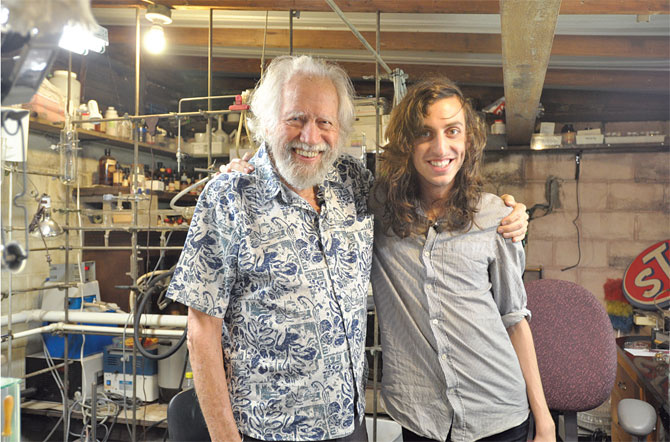
Alexander "Sasha" Shulgin, with fan Hamilton Morris, in Shulgin's
home lab in Lafayette, CA. Photo probably by Ann Shulgin?
Fans of Robert Anton Wilson will be familiar with this idea of Reich's books being burned by the Unistat government less than 15 years after we supposedly fought a war against fascism, because, among other things, those fascists violated our basic ideas about freedom of information, and they burned books. (See RAW's Wilhelm Reich In Hell, for the uninitiated.)
Take a moment or two and ponder the AMA-FDA burning Reich's books, and Shulgin's recipes flying all over the world, to some exotic place where people are now tripping on some analogue of mescaline or DMT, or Ecstasy.
Also: those seeking to buy their own copies of PIHKAL and TIHKAL via online vendors: caveat emptor; the fascists no doubt are monitoring the movement of these books. I have them for my own "Walter Mitty" reasons I've discussed many times before here in blogspews about "dangerous" or "demonic" books. I somehow manage to screw up microwave dinners, so I'm a far cry from being able to understand, much less cook up something like Shulgin's underground favorite (or one of 'em), 2C-B:
"A solution of 100 g of 2,5-dimethoxybenzaldehyde in 220 g nitromethane was treated with 10 g anhydrous ammonium acetate, and heated on a steam bath for 2.5 h with occasional swirling. The deep-red reaction mixture was stripped of the excess nitromethane under vacuum, and the residue crystallized spontaneously. This crude nitrostyrene was purified by grinding under IPA, filtering and air-drying, to yield 85 g of 2,5-dimethoxy-(Greek beta letter)- nitrostyrene as a yellow-orange product of adequate purity for the next step..." (PIHKAL, p.503)
The text goes on to make the previous look like "heat on high for 4 minutes, remove, wrapper, let cool for one minute before eating." It gets way out there. It's like reading some experimental poetry to me: I don't get it at all, but the odd linguistic effects of reading it give a sort of Joycean thrill. Clearly, I want my future psychedelic bathtub chemists to have at least gotten an "A" in Organic Chemistry Lab. At a really good school.
Where's the buzz in having/reading the Shulgin cookbooks if you wouldn't know a methyl group if they ganged up on you behind the tennis courts? After all his abstruse chemical prose, there are always abrupt, jarring tonal shifts in prose: trip reports from his select group of elect psychonaut explorers of inner space, scattered around Berkeley, Oakland, and San Francisco (Shulgin's lab was on his property in nearby Lafayette, California). And now, one would guess, because of the dissemination of the two books all over the world, there are vast unpublished trip reports for such Shulgin drugs as AMT; 5-MEO-DMT; 5-MEO-DIPT, 4-Acecoxy-DiPT, and DOB.
Drugs That Alter Auditory Perception
A second little thing: about psychedelics and perception of sound: In my old copy of Lee and Shlain's Acid Dreams, I ran across a wild line about the CIA developing futuristic drugs, and there was one that "only alters auditory perception, under its influences all sounds become atonal, while other human faculties remain unaffected." (p.292) The authors give no citation, and when I first read about this, years ago, I thought they had to have been taken in by someone, if not some CIA person, then someone who had been reading a lot of William S. Burroughs. This sounds like a WSB-invented fiction. I would like to think the drug was called "Schoenberg," but I didn't really believe a drug could be that specific in the brain.
That is, until I read about Shulgin's DIPT, which supposedly makes people hear music one octave lower (or so) than its normal pitch. That reminded me of trying to learn blazing fast scale passages from my favorite guitarists by putting the record on at 16rpm rather than 33 1/3: a Randy Rhoads passage played high on the neck suddenly sounds like it's down around the 2nd fret, with Ozzy sounding truly evil and not like the carnival barker I believed him to be in so-called "real life." And then I read about Takao Hensch, a Harvard (those guys again?) professor of molecular and cellular biology, who took adult non-musicians and had them do musical ear-training tests on valproic acid, a mood-stabilizing drug. The subjects developed perfect pitch! I'd love to have perfect pitch, but with follow-up research I see Hensch's subject group was small. Even more irritating: what valproic acid does is potentiate the brain's neuroplasticity: your brain gets a re-set to the time when you were very young, and soaking up language and info like a vast sponge. We could all learn quantum field equations! and Swahili! and Chinese! and...how to do chemistry like Shulgin!? Ah, but the Big Caveat: the brain's neuroplasticity and our earlier "critical periods" for learning (before some neural window closed on us) seem very basic, and evolution probably did that for some good reason, which we won't want to tamper with. For right now, my main model to reason with this is If It Sounds Too Good To Be True, It Probably Is Too Good To Be True. So, we probably ought not tamper with this ancient system of learning.
But we will. Someone will, right? Stay...<ahem> "tuned." Maybe this will turn out to be Something Veddy Innaresting...
Cannabis Potency: A Law-Enforcement Myth That Even Most Pot Smokers Believe?
You've all heard this one: the pot you find now is 10 to 30 times stronger than the stuff the hippies were smoking in the late 1960s/early 1970s. I remember when we bought dime bags of Acapulco Gold and Panama Red: stringy, leafy, stems-and-seedy stuff we loved. Rarely anything that looked like an actual bud. And then rarely we'd find some guy who'd have Thai Stick (awesome!), or even more rarely, "Hawaiian," like Maui Wowie, which was the best stuff I'd ever had. Then, as recounted wonderfully in Michael Pollan's book, The Botany of Desire, Reagan got elected and started a campaign of spraying the Mexican pot crops with paraquat, an herbicide linked to Parkinson's Disease. And so, as Pollan writes, our best gardeners went underground, played with the genes of various strains of cannabis and came up with the most amazingly strong weed, which was grown in the Emerald Triangle of far northern California. And when "sensimilla" (without seeds: a truly utopian concept at the time) filtered into my suburb of Los Angeles, circa 1982: I took one hit and felt like I was on acid. So for awhile even I believed the stories about vastly increased potency.
But I had had conversations with renegade pot growers, guys who really knew their stuff, and they said that was all Cop Propaganda. I said, but what about all the amazing buds you guys have come up with, like Blue Cheese, Purple Urkel, Green Crack, and others? They said that stuff was always around, but I was too penurious to be able to afford it. Because it was scarce. Only the Beautiful (and rich) Dope Smokers were indulging in stuff like Dogshit Orgasm or Purple Kush...But still I was skeptical.
Then I read Ben Goldacre's book Bad Science. Goldacre is a tireless debunker of "woo" and at one point in the book smelled bullshit about the "it's 30 times more potent now...so...the children will all be KILLED!" shit the cops were playing. He uses math and stats and logic to debunk increased potency since 1970. (see Goldacre, pp.189-193) I was impressed by his zeal and rationality, but...I had access to all sorts of weed that was so potent, so...good I required more dissentual data about increased potency. It turns out if you look, you can find. I read Brian Preston's Pot Planet: Adventures in the Global Marijuana Culture, which I remember liking a lot, but I don't remember much about <cough>. Preston quotes an expert who says it's not true that pot is way more potent than in the 1970s; it's just that the very potent stuff [17%-30%THC] is way easier to find now.
Blueberry Afgoo, left. NYC Diesel bud on right. Photos by Erik Christiansen
I've started to come around. I think Goldacre and Preston's expert are probably right; Pollan is not wrong; he's inadvertently explaining (in his wonderfully written chapter in Botany of Desire about cannabis) why the Really Good Stuff is so omnipresent now. And some people still doubt Progress!
Flying on LSD: Literally
Who knows the deep story about Captain Trips? Who was Al Hubbard, anyway? We have reason to suspect he's telling the truth about growing up poor in Kentucky and getting rich in uranium. Why disbelieve his stories and documents about working for the OSS (and then the CIA?) Aldous Huxley found him charming. (Two more disparate personalities you'll rarely find in a friendship, by the way. Hubbard was a spy, a Cold Warrior, and not educated. Aldous was nothing if not ridiculously well-educated.) Hubbard had a mystical experience on LSD, seeing himself being conceived during his parents' sex act. He flew all over the world in his own plane, with his seemingly unlimited supply of great acid. He wanted to turn on the world. Was his motivation on the level? And his ties to the highest levels of the Unistat government made his "Johnny Acidseed" jaunts easy. He received a happy birthday card from Ronald Reagan just before he died. At a party at Oscar Janiger's house in 1979, Timothy Leary greeted Captain Al with "I owe everything to you!" (Acid Dreams, p.293)
Now: I haven't flown anywhere in a long time, largely because 1.) before 9/11 every time I took my bags to airport I got sidelined while everyone else went on with their business of passing through security, waiting for their flight, etc. But not me. I always had to wait for my "security" to be cleared. Sometimes this only took five minutes. Other times: 30 minutes or more. Why? Because, at some point in the 1970s - this is all I've ever been able to get from airport security people and researches online - some person in Canada hijacked a plane, and they used a false name. That name is my exact name. (You may have seen this on 60 Minutes many years ago.) The hijacker used one of the most common Unistat names there is: "Robert Johnson." The name on my birth certificate is this name, although I've always gone by my middle name: Michael. But then I asked, "How come you cleared me six months ago, this is the same airline, and you have to clear me again?" Just following orders. So, my name is on a list, totally undeservedly so, and yet no one can do anything about it? Later I found out I could pay some fee to...someone and it would make all that go away. But I thought this was just bullshit. I still do.
Then: 9/11 and the quasi-fascistic/quasi-Kafkaesque TSA of true "security theater" arrived. I'll do a blog on how profoundly worthless the entire TSA security theater show is some other day. Or, as Ring Lardner said, "You could look it up."
Anyway: when I did fly, it was always a tad sensory overload to me. Aside from the security issues and the waiting, flying was a rich source of stimuli, observation, and odd perspectives that I actually enjoyed. (I once flew 16 hours to Tokyo, which was grueling and not fun at all. Another story...) The idea of being on LSD while flying just seems like too much to me. But not to Timothy Leary. Here he is in 1969. The Supreme Court had set him loose from a 30 year charge for having half an ounce of weed. He was finally free, after four years, to leave the country:
"In mixing sacrament for the trip I had accidentally taken too much and sat primly in the Air Iberia waiting room at JFK, rushing, sorting out James Bond paranoias, hoping that Franco's agents would fail to penetrate my disguise. (I've been busted three times in airports.)"
Leary and his wife Rosemary get on the plane. "Two elderly men in uniform tottered by, painfully lugging briefcases, gold teeth flashing forlorn smiles. 'They look like retired generals from the Spanish Civil War,' I whispered. 'Hush,' said Rosemary. 'They are our pilots.'"
Leary starts to get telepathic signals from the other elderly Spanish passengers. He imagines them all as old, committed fascists under the Franco regime. He says to Rosemary, "What have we got ourselves into this trip? This plane is like the second-class bus from Malaga to Torremolinos. It will never make the Atlantic!
"Rosemary was pretending she didn't know me. 'How much did you drop? Really!'" Leary felt like it took "3 1/2 hours to wheeze down the runway and takeoff." He's convinced the steward is a secret police agent. Eventually two Spanish stewardesses approach Leary. We know who you are...do you mind if we ask you some questions? Leary, to himself: "Here we go!"
The stewardesses asked Leary if he had any dope on him. He denied it. You always deny it, he'd learned. The stewardesses were disappointed. "What a drag. Our friends in Madrid will be disappointed. Well, at least give us your autograph."
Leary, taken aback, asked, but what about Catholic Spain, Franco, the secret police?
"Young people are the same all over the world, Doctor Timothy. [...] Young people like to get high and feel good and make love." (Jail Notes, pp. 137-138)
Michael Horowitz in 1972. Photo by Timothy Leary
It's July 1970 and Leary is back in California, in prison. Recently he'd made Michael Horowitz his official archivist. Horowitz writes, "I was no longer a hippie minding his own business; I was now a member of the entourage/support team of the High Priest, the Disgraced Harvard Professor, the Pied Piper, the Acid Martyr - the world's best advocate of 'better living through chemistry.'"
Leary was doing 10 years for possession of two roaches. Leary had asked Horowitz to visit him in prison. Michael's friend came to his Berkeley apartment to drive him to the airport. Michael decided to cut a hit of strong Windowpane acid in half, to share with Leary. His friend honked his horn, and impulsively, Horowitz swallowed his half and kept the other half hidden underneath his fingernail. "The desire to be tripping on acid while meeting the High Priest of LSD got the better of me, so I slipped the other half under my tongue."
In less than an hour Horowitz climbed into a Navaho Piper Cub to fly to the California Men's Colony at San Luis Obispo. Horowitz writes that he enjoyed flying while stoned, while I get a panic attack just reading about this...and typing it to you, Dear Reader. But just think: Horowitz was going to enter the world of the Prison. As they approached, a sign said 20 years for bringing in "narcotics" or weapons. He became acutely aware of the "tiny thing under my thumbnail." Horowitz had a huge hippie 'fro, purple-tinted glasses, and a fringe-leather jacket with "Timothy Leary for Governor" on it, bell-bottom jeans. He felt all the guards were staring at him, and the paranoia, mounting, he wished the acid would quit coming on stronger and stronger. Hilariously, Horowitz writes, "What was I thinking? That this was something other than a fucking prison?"
"'Look at that freak visiting Leary!,' one of the guards hissed from across the room." As he's given multiple forms to fill out, using the writing hand that had the other half-hit of Windowpane under the nail, eight burly guards came up and surrounded him. He tried to read and fill out the forms, but the words swirled on the page. (If you've never done acid you have no idea how INSANE this scenario must have felt.)
When asked his purpose for the visit, Horowitz somehow blurted out "editorial and archival matters." One of the guards sneered, "What does that mean?" Michael answered.
He was directed to a gate. A guard said to another, "It looks like like he's on something, don't it?" And they laughed. Security doors, gates, drab prison dullness of walls, electronic security. Finally he meets Leary and they hug and Horowitz relaxes a little, buys them both a coffee and candy bars, feels less like "Joseph K visiting the Castle" and more like a fellow Merry Prankster. Finally, Leary realizes Horowitz is on acid.
"You're on acid? Shit! What do you think this is? Fillmore East? I'm looking at ten years! I desperately need your help - and you show up on acid!"
"I have some for you."
"Great. I just can't wait to trip in this place! Look around - it's the perfect set and setting, isn't it?"
"Sorry," I said, downcast, feeling I had totally blown it.
Leary perks up, tells Michael about the book he's writing on DNA and LSD and the stages of evolution and says, wait till the guard turns away before you slip me the hit of acid. Horowitz is elated: he gets to get high with Leary and hear him talk about his ideas. Then he looks down and notices the hit is gone: it's not on his fingernail.
"Um, Tim..."
Okay, so that was more about prison than flying. But when I first read this story (in Psychedelic Trips For the Mind, pp. 49-51), the flying in a Piper Cub to a prison was enough to give me an mild anxiety attack. What's all the fuss about whether we can explore parallel worlds as theorized by some High Priests of physics? We already have ways to explore parallel worlds. It's called literature.
Finally: Allen Ginsberg, while the Bard of the counterculture, had also, from an early age, believed in watching the watchers. He'd kept files and clippings and notes on the FBI, the CIA, police of all kinds, politicians, world leaders. (And you bet your ass they had a massive dossier on him, too.) He'd come to realize the CIA's role in disseminating LSD in Unistat, and it was always a hot topic of conversation with his friends.
From Ed Sanders's book The Poetry and Life of Allen Ginsberg:
October of '77
he was in the air on the way
to a symposium called LSD: A Generation Later
at UC Santa Cruz
and dropped a hit on the plane
thinking about the CIA and LSD.
Later at the symposium
he told what he'd done and asked
"Am I, Allen Ginsberg, the product of
one of the CIA's lamentable, ill-advised, or
triumphantly successful
experiments in mind control?"
(p. 129)
Other Writings Consulted
"SiHKAL: Shulgins I Have Known and Loved," by Hamilton Morris
Nomad Codes, Erik Davis, pp.207-211, wonderful writing on the impact of Shulgin
Visionary State, by Erik Davis. Contains two wonderful large, full-color photos of Shulgin's lab, taken by Michael Rauner.
Pharmako-Gnosis, by Dale Pendell. Stunning erudition throughout.
Storming Heaven, by Jay Stevens
"Why Harvest Opiates When You Can Get Yeast to Produce Them?"
Imagine Nation: The American Counterculture of the 1960s & '70s, pp. 17-40, "The Intoxicated State/Illegal Nation: Drugs in the Sixties Counterculture," by David Farber
art by the wild Bobby Campbell
Labels:
Al Hubbard,
Alexander Shulgin,
Allen Ginsberg,
auditory perception,
books,
chemistry,
CIA,
drugs,
flying,
LSD,
Michael Horowitz,
music and drugs,
paranoia,
psychedelic drugs,
Timothy Leary
Subscribe to:
Posts (Atom)