Prelude
Less than two months ago as I write this, J. Craig Venter and his team published in Science the deets on how they built a synthetic organism, called "Syn3.0," and it's got only 473 genes. This is the lowest number of genes that we know of for a self-replicating living thing that doesn't require a host.
It's a sober-seeming Frankenstein scene, is it not?
HERE is a nice write-up in Nature on this.
They did this via trial and error; they didn't build Syn3.0 from scratch. They took a bacterium, Mycoplasma mycoides, which lives in cattle, and painstakingly and systematically knocked out genes to see if they were truly essential. If a gene seemed to be essential for life, or a gene played a critical role in the regulation of other genes, they left it in. They whittled away a lot.
A complex bacterium like E. coli has around 6000 genes; humans have around 19,500.
What appears most fascinating to Venter and his crew (and me too) is this: once they finished and confirmed they had synthesized/whittled away a new organism, they still couldn't figure out exactly what 149 of the 473 genes did that were so essential to life. So: we don't know 1/3 of what is essential to life. We have our work cut out for us...or these synthetic biologists/fancy bio-hackers do.
The rest of us, like the girl who just ate a slice of pizza with anchovies, wait with baited breath.
This highlights how much we don't know, and makes ever-clearer the reason why, after Venter and scientists working for the Unistat government "mapped" the human genome 13-16 years ago, miracle breakthroughs in health and medicine did not pour forth immediately after.
a human-made bacterium, believe it or not
A Variation on a Theme
My favorite analogous explanation for this went something like: for hundreds of years we heard wonderful music but weren't sure where it was coming from. Through a Herculean effort by legions of biologists, eventually we learned that this music had the structure of something we discovered was a "piano." Tremendous efforts by public sector genius and private wizards finally produced a map of the music: a Steinway piano! What a fantastic discovery of human ingenuity!
But then: you need to learn how to play Beethoven. Just having the piano and knowing that you press certain keys little hammers inside struck strings and made "notes"? Not good enough. We had to actually understand the thing. We had to learn how to play something like the Appassionata.
Tall order? Of course! Would we shrink from it and ditch our lessons and not practice our Hanon exercises? No. We're all in. Here's where Vico makes his entrance...
Expository Material
Giambattista Vico (1668-1744), an early admirer of Descartes, later did a 180 from "Renato" (as Vico refers to him in his Autobiography) and said no: it's not correct that we humans can only truly have knowledge of the physical world because we can apply our rationality and math to understand it; Renato said we can't know the human past, so forget about it. Vico said, anzi, we can only truly know what we have ourselves made: the social world. Law, politics, art, history, etc. Even mathematics is a human construction. We did not make Nature, so we can't truly know it. Scholars of Vico (who call themselves Vichians and not Viconians) refer to this idea as Vico's principle of verum factum.
Because of verum factum, various scholars have called Vico the first Anthropologist, the inventor of the sociology of knowledge, the first great modern sociologist, etc. It's interesting. I don't know what to think, because Vico's writing - especially in his magnum opus The New Science - seems to alternate between staggeringly prescient ideas and really crazy and "wrong" ones. Here is one of his most famous passages, and the one cited most often with regard to verum factum:
Still, in the dense and dark night which envelopes remotest antiquity, there shines an eternal and inextinguishable light. It is a truth which cannot be doubted: The civil world is certainly the creation of humankind. And consequently, the principles of the civil world can and must be discovered within the modifications of the human mind. If we reflect on this, we can only wonder why all the philosophers have so earnestly pursued a knowledge of the world of nature, which only God can know as its creator, while they neglected to study the world of nations, or civil world, which people can in fact know because they created it. The cause of this paradox is that infirmity of the human mind noted in Axiom 63. Because it is buried deep within the body, the human mind naturally tends to notice what is corporeal, and must make a great and laborious effort to understand itself, just as the eye sees all external objects, but needs a mirror to see itself. - section 331, translation by Dave Marsh
A couple of notes:
- The Inquisition was very strong in Naples, when Vico was doing his thing. The reference to "God" in his text is problematic, to my eyes. Perhaps he truly believed all the things he says about "God," but I see plenty of room for doubt. In his Autobiography he certainly seems to have been heavily influenced by Lucretius, who popularized Epicurus. Vico also has plenty of oblique things to say about the deep and enduring history of class warfare and he doesn't seem all that admiring of history's aristocracy. Vico was one of those thinkers who seemed to have read everything available; he had personally known thinkers around Naples who had paid for speaking out for thought free of Church restrictions. He certainly had read about others who'd suffered at the hands of the Inquisition.
-Hobbes and many other thinkers of antiquity and the Renaissance had ideas like verum factum, but they only mentioned this notion in passing; with Vico this idea is central to his thought.
-Axiom 63 reads thus:
Because of the senses, the human mind naturally tends to view itself externally in the body, and it is only with great difficulty that it can understand itself by means of reflection. This axiom offers us this universal principle of etymology in all languages: words are transferred from physical objects and their properties to signify what is conceptual and spiritual.
Finally: OG's Point, If Indeed He Has One?
When I first delved into Vico I thought verum factum was wrong: the revolution in modern science since the Renaissance was based on a special way of looking into nature: some phenomenon needed to be explained, hypotheses competed until a line of very fecund thought - a theory - led to a cascade of knowledge about the physical world. Ideas were freely exchanged and published and the idea that my experiment, while exciting, needed to be replicated by many others working independently for it to be considered "true"...this seemed to me like a vast leap in human knowledge. At the same time, the idea of "knowledge" in the Humanities (which to this day I love with a very deep passion) was not making gigantic strides. When scientific knowledge cashed out into Technology, which accelerated the human world, I just thought Vico, while exceedingly erudite and weird and entertaining, was a bit daft here.
Later, when reading people like Popper, Kuhn, Feyerabend, Foucault and Latour, I realized the physical sciences didn't actually work as neatly as I'd been led to believe. Further, the most successful physical theory ever - the quantum theory - led to philosophical quagmires dizzying and surreal. Did we really understand the physical world, or did we pragmatically go with what worked, while retroactively explaining what was "really" going on?
Richard Feynman's blackboard at CalTech
Apocalypse and/or Utopia
Now, we are making living things. I'm quite sure Syn3.0 is merely the first of thousands of human-made living things. And Venter and his colleagues are playing Creator in order to understand, at a fine-grain level, the physical, chemical and biological way something does its thing.
Is verum factum then a "dead" idea? I don't know, but when Venter and his guys came up with an artificial living thing a few years ago, it prompted Obama to issue a bioethics review and the Vatican challenged Venter on his claim of creating life. And so has it ever been...
Finally: if you read the link to the article in Nature, you may have noted that Venter and his crew inserted their own names - literally - into the deep structure of Syn3.0. Why? As watermarks, a way of marking this territory of Life as human-made. They also inserted some quotes and one was from Richard Feynman's blackboard, as seen in the photo above: "What I cannot create I do not understand."
Sounds a lot like Vico to me.
Reading:
"In Newly-Created Life Form, a Major Mystery," by Emily Singer
"Scientists Synthesize the Shortest Known Genome Necessary For Life," by Amina Khan
"Why Would Scientists Want to Build a Human Genome From Scratch?", by Sally Adee
The New Science, by Giambattista Vico, translated by Dave Marsh
藝術鮑勃·坎貝爾
The Overweening Generalist is largely about people who like to read fat, weighty "difficult" books - or thin, profound ones - and how I/They/We stand in relation to the hyper-acceleration of digital social-media-tized culture. It is not a neo-Luddite attack on digital media; it is an attempt to negotiate with it, and to subtly make claims for the role of generalist intellectual types in the scheme of things.
Overweening Generalist
Showing posts with label epistemology. Show all posts
Friday, May 20, 2016
Wednesday, August 28, 2013
Where The Hell Am I?
Often, when meditating whilst sitting quietly or even walking alone with "my" thoughts, I often use the gimmick of thinking about the Bohr Model of the atom (leave aside that it can be viewed as a "flawed" model for now), and how we're made up of atoms, which have a tiny nucleus with neutrons and protons "inside." And inside that are just all sorts of quarks and other surrealist "material" shenanigans.
And I read once in some popularization of quantum mechanics that the nucleus is so small relative to the electrons buzzing around in discrete "orbits" or "outer shells" that, if the nucleus were an orange put at the center of the 50 yard line at the Rose Bowl, then the electrons are whirling around - relatively speaking - outside the entrance gates, all around. What's "inside" all that "space"? It's empty! (But it's probably "really" not...no time to get into it now, here.)
Hell, every-thing else on this planet seems subject to the same laws of physics, and as Stephen Dedalus said, we are "ineluctably constructed upon the incertitude of the void." (Ulysses, p.697, "Ithaca")
[Interestingly to me, Joyce wrote Ulysses between 1915-1922; it was published in 1922. Quantum physics would show there was a physical basis for this poetic line, but not until 1925-27 or so.]
And therefore "I" am mostly empty space. "I" just seem solid because "I" can only make investigations with the sensoria Nature gave me: clunky stuff. Gigantic, really. And seemingly a plenum of bone, skin, blood, lymph, viscera. But - and "I" still think on one level this model "is" legitimate - "I" seem really quite ghost-like. "I" only bump into stuff because the stuff "I" bump into has roughly the same levels of non-emptiness that "I" have. What a world!
Usually this has served me well: thinking of myself, as Bucky Fuller said, "I seem to be a verb." Yea: what's not all about the empty space seems more about electrons and energy exchanges between "me" and my surrounding environment. I meditate on this physics and get outside of my (mostly empty?) "self."
I end up summoning some picture of myself as a cloud of energy, with a module near the top that seems to want to make everything into some solid "meaning." But that module seems utterly foolish and but one of the modules that make up what Marvin Minsky called The Society of Mind: what's going on seems a "booming buzzing confusion" of energies, everywhere and everywhen. When I do this I've entered what the phenomenological sociologists call a "finite province of meaning." This particular province of meaning seems about blissful meaninglessness, and it's a second cousin to being stoned on cannabis, only it's still legal. For now...
Going "Up" One Level
But lately - say, the last 24 months - I've been trying to understand the human genome. It turns out to be absurdly complex, for the OG. But it's abecedarian compared to what I found out about epigenetics. HERE's an amusing short explanation about some of what is entailed by epigenetics. He does it far better justice than I could; I'm afraid I'd bore you with my explanations about methyl groups and histones and how your grandmother's smoking habit effects your health. My favorite metaphors so far for the genome and the epigenome are this: the genome is the hardware; the epigenome tells the genome what to do with its information, and when. Talk about complexity!
So getting back to trying to find out where "I" am: who and what I seem to be is not only atoms and the void, but information inherited roughly 50/50 from mom and dad, plus the environments I've accidentally been born into or found myself in, the choices I made about what environments to go into (and "environments" here means something closer to what McLuhan meant than saying "I grew up in the San Gabriel Valley area of Los Angeles County"). Although geography does seem to matter quite a lot. But what my parents worried about, what they ate, what their parents experienced...and just an enormous amount of CHANCE occurrences seem to be a lot about where "I" am.
Then I found out something wonderfully disturbing that makes what I've mentioned so far seem trivial.
Going "Up" Another Level
In the 20th century, modern medicine finally arrived. O! The things we learned! About surgery (lots of insanely brutal war wounds provided ample practice), and what worked and what didn't, and doctors caught up to the washing their hands dealio. And we began to merge our physics (harnessing light) and chemistry with technology and imaging, and...we're on our way! We even found out we'd been acting like superstitious fools for millenia: if we wipe out bacteria, we'd live a lot longer, and healthier. And so: antibiotics (miracles!), antiseptics of all sort, cleaning products in every modern home. But we were wrong about bacteria: we need Them to maintain a healthy immune system. And oh wow: just sooooo much more.
You know this "I" that I'm trying to find? Turns out "he" is part of a system that's not only genome and epigenome, but microbiome. 90% of the cells in "me" are bacteria. And I'm healthy! "I" took a long bike ride today, got all kinds of work done, had some Big Laffs. But if "I" am 90% bacteria...I'm not sure what to think. And it turns out bacteria in my gut influences what I think and feel.
Who is running the show here?
Preliminary Ideas About Where the Hell "My" "I" "Is"
I understand the history of modern "self" hood had to do with rationalistic ideas about agency and law and responsibility. It was a convenient fiction. If some crime was committed, we want to gather the evidence and convict that rational actor for his wrongdoing and make that person "pay" a debt to another convenient fiction: The State. Or "society." But if we're driven by things our ancestors did and we're mostly empty space or bacteria, as the kids say, WTF?
At this point I take a deep breath and remember what Robert Anton Wilson said, in generalized account of what the Copenhagen Interpretation of quantum mechanics: every model we make to account for some aspect of "reality" tells us as much about our own minds as it does Nature, or what's "out there." As we grew up, toddling around some environment, as mostly empty space, our genes being played by histones and methylations and other Damned Things, we were constantly ingesting atoms and incorporating them into our "selves" without knowing it. Most of us still seem blase about the whole schmeer! And even then we were mostly bacteria. And if our parents found out this fact, they probably would've killed us. Literally. With antibiotics and a lot of scrubbing.
We're toddling around and our brains are receiving signals and ignoring others, setting up our nervous system to perceive the world a certain way and - this is crucial - not other possible ways. But some kid on the other side of the world was making grooves in his brain, connecting neural clusters in a different schema. That kid was "learning" a different language, for one thing. And language, being part of the world, also influences further how we'll "see" the world, and take action. (Sorry anti-Whorfians! You're on the outs, now.)
And yet: many of us grow into adulthood and enjoy enduring alliances and deep, satisfying relationships with someone from a remote (relative to "us") region of the world. We're terrifically malleable, plastic. But not infinitely so. Yep: I was born in LA, grew up there, lived in Colorado for a a few minutes, then moved back to LA, lived in a few areas in the vast sprawling metropolis around La-La Land, then moved to a different state within the state of California, a place called "Berkeley." And yet: I have friends who speak Chinese, who are also mostly empty space and bacteria. And it's good.
Okay, okay. I'm starting to feel better now. "I" accept my verbishness, my existence as a dissipative structure, and don't really care all that much where "I" am. Because, not being a solipsist, I assume you're reading this now, and you are enough like me, so what does it matter? How do I know I'm not being dreamed by some gaseous vertebrate of astronomical heft? I don't. Hell: maybe YOU are dreaming all this? And "I" don't care. This seems like a cosmic funhouse to me. All of it. What the hell: I'll just assume we sort of exist, and that it matters, bacteria and all.
And I read once in some popularization of quantum mechanics that the nucleus is so small relative to the electrons buzzing around in discrete "orbits" or "outer shells" that, if the nucleus were an orange put at the center of the 50 yard line at the Rose Bowl, then the electrons are whirling around - relatively speaking - outside the entrance gates, all around. What's "inside" all that "space"? It's empty! (But it's probably "really" not...no time to get into it now, here.)
Hell, every-thing else on this planet seems subject to the same laws of physics, and as Stephen Dedalus said, we are "ineluctably constructed upon the incertitude of the void." (Ulysses, p.697, "Ithaca")
[Interestingly to me, Joyce wrote Ulysses between 1915-1922; it was published in 1922. Quantum physics would show there was a physical basis for this poetic line, but not until 1925-27 or so.]
And therefore "I" am mostly empty space. "I" just seem solid because "I" can only make investigations with the sensoria Nature gave me: clunky stuff. Gigantic, really. And seemingly a plenum of bone, skin, blood, lymph, viscera. But - and "I" still think on one level this model "is" legitimate - "I" seem really quite ghost-like. "I" only bump into stuff because the stuff "I" bump into has roughly the same levels of non-emptiness that "I" have. What a world!
Usually this has served me well: thinking of myself, as Bucky Fuller said, "I seem to be a verb." Yea: what's not all about the empty space seems more about electrons and energy exchanges between "me" and my surrounding environment. I meditate on this physics and get outside of my (mostly empty?) "self."
I end up summoning some picture of myself as a cloud of energy, with a module near the top that seems to want to make everything into some solid "meaning." But that module seems utterly foolish and but one of the modules that make up what Marvin Minsky called The Society of Mind: what's going on seems a "booming buzzing confusion" of energies, everywhere and everywhen. When I do this I've entered what the phenomenological sociologists call a "finite province of meaning." This particular province of meaning seems about blissful meaninglessness, and it's a second cousin to being stoned on cannabis, only it's still legal. For now...
Going "Up" One Level
But lately - say, the last 24 months - I've been trying to understand the human genome. It turns out to be absurdly complex, for the OG. But it's abecedarian compared to what I found out about epigenetics. HERE's an amusing short explanation about some of what is entailed by epigenetics. He does it far better justice than I could; I'm afraid I'd bore you with my explanations about methyl groups and histones and how your grandmother's smoking habit effects your health. My favorite metaphors so far for the genome and the epigenome are this: the genome is the hardware; the epigenome tells the genome what to do with its information, and when. Talk about complexity!
So getting back to trying to find out where "I" am: who and what I seem to be is not only atoms and the void, but information inherited roughly 50/50 from mom and dad, plus the environments I've accidentally been born into or found myself in, the choices I made about what environments to go into (and "environments" here means something closer to what McLuhan meant than saying "I grew up in the San Gabriel Valley area of Los Angeles County"). Although geography does seem to matter quite a lot. But what my parents worried about, what they ate, what their parents experienced...and just an enormous amount of CHANCE occurrences seem to be a lot about where "I" am.
Then I found out something wonderfully disturbing that makes what I've mentioned so far seem trivial.
Going "Up" Another Level
In the 20th century, modern medicine finally arrived. O! The things we learned! About surgery (lots of insanely brutal war wounds provided ample practice), and what worked and what didn't, and doctors caught up to the washing their hands dealio. And we began to merge our physics (harnessing light) and chemistry with technology and imaging, and...we're on our way! We even found out we'd been acting like superstitious fools for millenia: if we wipe out bacteria, we'd live a lot longer, and healthier. And so: antibiotics (miracles!), antiseptics of all sort, cleaning products in every modern home. But we were wrong about bacteria: we need Them to maintain a healthy immune system. And oh wow: just sooooo much more.
You know this "I" that I'm trying to find? Turns out "he" is part of a system that's not only genome and epigenome, but microbiome. 90% of the cells in "me" are bacteria. And I'm healthy! "I" took a long bike ride today, got all kinds of work done, had some Big Laffs. But if "I" am 90% bacteria...I'm not sure what to think. And it turns out bacteria in my gut influences what I think and feel.
Who is running the show here?
Preliminary Ideas About Where the Hell "My" "I" "Is"
I understand the history of modern "self" hood had to do with rationalistic ideas about agency and law and responsibility. It was a convenient fiction. If some crime was committed, we want to gather the evidence and convict that rational actor for his wrongdoing and make that person "pay" a debt to another convenient fiction: The State. Or "society." But if we're driven by things our ancestors did and we're mostly empty space or bacteria, as the kids say, WTF?
At this point I take a deep breath and remember what Robert Anton Wilson said, in generalized account of what the Copenhagen Interpretation of quantum mechanics: every model we make to account for some aspect of "reality" tells us as much about our own minds as it does Nature, or what's "out there." As we grew up, toddling around some environment, as mostly empty space, our genes being played by histones and methylations and other Damned Things, we were constantly ingesting atoms and incorporating them into our "selves" without knowing it. Most of us still seem blase about the whole schmeer! And even then we were mostly bacteria. And if our parents found out this fact, they probably would've killed us. Literally. With antibiotics and a lot of scrubbing.
We're toddling around and our brains are receiving signals and ignoring others, setting up our nervous system to perceive the world a certain way and - this is crucial - not other possible ways. But some kid on the other side of the world was making grooves in his brain, connecting neural clusters in a different schema. That kid was "learning" a different language, for one thing. And language, being part of the world, also influences further how we'll "see" the world, and take action. (Sorry anti-Whorfians! You're on the outs, now.)
And yet: many of us grow into adulthood and enjoy enduring alliances and deep, satisfying relationships with someone from a remote (relative to "us") region of the world. We're terrifically malleable, plastic. But not infinitely so. Yep: I was born in LA, grew up there, lived in Colorado for a a few minutes, then moved back to LA, lived in a few areas in the vast sprawling metropolis around La-La Land, then moved to a different state within the state of California, a place called "Berkeley." And yet: I have friends who speak Chinese, who are also mostly empty space and bacteria. And it's good.
Okay, okay. I'm starting to feel better now. "I" accept my verbishness, my existence as a dissipative structure, and don't really care all that much where "I" am. Because, not being a solipsist, I assume you're reading this now, and you are enough like me, so what does it matter? How do I know I'm not being dreamed by some gaseous vertebrate of astronomical heft? I don't. Hell: maybe YOU are dreaming all this? And "I" don't care. This seems like a cosmic funhouse to me. All of it. What the hell: I'll just assume we sort of exist, and that it matters, bacteria and all.
Friday, July 19, 2013
Are We Living In A Robert Anton Wilson Novel?
This topic is related to a recent question over at my blogger-colleague Tom Jackson's blog RAWIllumination.
My knee-jerk reaction: it seems evermore so, aye.
With some introspection (okay, a bowel movement): definitely maybe.
Ken Cuccinelli (my friends and I just refer to him affectionately as "Cooch") is quoted very recently thus:
“My view is that homosexual acts, not homosexuality, but homosexual acts are wrong. They’re intrinsically wrong. And I think in a natural law based country it’s appropriate to have policies that reflect that … They don’t comport with natural law. I happen to think that it represents (to put it politely; I need my thesaurus to be polite) behavior that is not healthy to an individual and in aggregate is not healthy to society.”
Robert Anton Wilson writes in his book Natural Law (Or Don't Put A Rubber On Your Willy):
"It appears that the reason that the term 'Natural Law' is preferred to 'Moral Law' may be that many writers do not want to make it obvious that they speak as priests or theologians and would rather have us think of them as philosophers. But it would seem to me that their dogmas only make sense as religious or moral exhortation and do not make sense in any way if one tries to analyze them as either scientific or philosophical propositions."
Two recent articles on Cooch and his moralic acid-laced Low-Medium Level Bullshit:
Katie McDonough's "Ken Cuccinelli Keeping The War On Sodomy Alive"
Amanda Marcotte's "Ken Cuccinelli Really Wants To Ban Oral Sex"
Are the voters in Virginia really this retrograde? We'll see. At this point I'll believe anything.
Also, no doubt Cuccinelli as a Republican in 2013 agrees that government is intrusive on the rights, liberties, and freedoms of his corporate sponsors.
Robert Anton Wilson often said he not only wanted government "off our backs" but "off our fronts, too." This latter proposition would seem to exclude Cooch.
Are You Naturally "Unnatural"?
-------------------------------
pic I'll be happy to give credit)
One of the weirdest interviews RAW ever did was in November, 1996, with someone named Nardwuar; RAW seemed to think it was a put-on but he played along with good humor.
17 years later, Mark O'Connell at Slate has crowned Nardwuar as the "pop music's best interviewer." (Neil Strauss on Line 1!)
Anyway, I was very surprised that anyone would raise Nardwuar to such lofty heights. But as RAW often said, "Different lanes for different brains."
-----------------------------------
A link between quantum mechanics and game theory seems to have been found.
Yes, the two areas seem far apart, and RAW did not accentuate Bayesian games, but from the age of 16, in 1948 (!) he was interested in the findings in both areas and how they may interact. The article I cited doesn't mention John von Neumann, but JvN was an early theorist in both areas, and RAW wrote about John S. Bell, Norbert Wiener, von Neumann, Claude Shannon, Erwin Schrodinger and the philosophical implications of the wave equation, the interplay between The Theory of Games and Economic Behavior and multi-valued non-Aristotelian logics, semantics, the ontological basis of math, the EPR gedankenexperiments, Einstein's disagreements with Niels Bohr, how information might play in biology, and psychological theories of interpersonal communication and "games" and how quantum mechanics, language, information, games, and the human nervous system all interact in social "reality."
----------------------------------
A few weeks ago, Scott F. Aikin and Robert B. Talisse advocated for Philosophy to go public, for the public good. They consider "repackaging" philosophy - by which they mean: the stultifying and dull Thing that philosophy has become in the Academy - and make it more accessible. They reject this as impractical. I disagree with them here, mostly because their arguments using specialized philosophy-language is pretentious in the first place, and they ought to realize that if they unpack their epistemology and ontology and hook it up to their Wittgenstein and other turns of language, they'll see that their use of the copulae "to be" (i.e, use of "is" "am" "are" "was" "were" and "be") seems inconsistent with their overly technical language in the first place. They're writing for each other in small journals, hoping for citations and to keep their jobs as the Humanities wither under the Leviathan of corporate capitalism.
If they can't write about their Big Topics for the intelligent layperson, maybe they aren't as fine thinkers as they suppose themselves "to be"? Take more English courses, academic Philosophers?
Aikin and Talisse then consider that philosophy should go public by addressing the concerns of the public and not arcane subjects. But then they look at the journals and see that philosophers have been writing about immigration, surveillance, human enhancement technologies, the biology of race, the nature of lying and the ethics of torture. But while they don't bluntly say it: those articles are impenetrable. To quote the Beat poet Jack Spicer out of context, "My vocabulary did this to me!"
Circling back around, these advocates for a public philosophy finally realize that philosophy must be repackaged nonetheless, and I wholeheartedly agree with them here:
"On this version of “public philosophy,” what is called for is not a change in what philosophers do or in the topics they address; rather the call for public philosophy is call for better spokespersons for philosophy. It is a request that those who are especially skilled at presenting complex and difficult ideas come forward and speak publicly for the discipline. It is also a call for the profession at large to acknowledge the need for such spokespersons, and to find ways to recognize the scholarly importance of public outreach. But, importantly, it is also implicitly a call for those philosophers who are not very good at representing the discipline to go back to their offices."
And many of us who are longtime readers of Robert Anton Wilson would argue that RAW was doing this in the 1960s, but the exigencies of rising in the Academy, together with an iron curtain put up by mainstream media and the "counterculture" concerning identity and publishing and who gets reviewed and what topics are to be considered out-of-bounds, and "style" (and other Damned Things)...militated against RAW being taken more seriously by people who think public philosophy is important for a healthy democratic society. A "science fiction writer" was not to be taken seriously by Serious People, the guardians of True Philosophy. A writer who wrote so candidly about sex, drugs, Timothy Leary and Aleister Crowley and Wilhelm Reich and Ezra Pound and Alfred Korzybski (all banished to the Region of Thud by the curators of Official Culture) could not be taken seriously. A writer who speculates about the phenomenology of UFO contactees, who mixed genres (too irresponsible and promiscuous?), who openly declares himself an "anarchist" and who chronicles a 14-odd-year odyssey of self-experimentation to probe the vast reaches of his own consciousness...this was something not fit for mainstream Philosophy. And then there is the ludic play with deep researches into conspiracy theory, a subject so demonized by the True Knowers of Unistat, there's no way this Wilson should be allowed anywhere near the Conversation about true Philosophy. Best to ignore his work until he finds himself living in the marginalist's milieux, where he properly resides...
So I argue: RAW was at least 40 years ahead of Aikin and Talisse. But RAW's readers found him anyway, and they think his unified field hypotheses about media and language extremely interesting, philosophically. RAW's ideas about the acceleration of culture, propelled by technological innovation, and its sociological fallout: paranoia, alternate religions, a Nietzschean multiperspectivalism, and the analysis of Conspiracy Theories as a way to test one's own epistemological plasticities? His readers enjoy these philosophical ideas too. Indeed.
While we may model the worlds we inhabit as "texts" we know these are only models, and that language does not map directly onto any sort of "reality" in a one-to-one correspondence, as RAW wrote about starting in the 1960s, largely influenced by discarded thinkers.
I would like to suggest to Aikin and Talisse that their world has finally caught up with Robert Anton Wilson's but after many years of talking to academics, I'm afraid the response would be, "Who?"
I asked Prof. George Lakoff of Berkeley if he knew of RAW's work, and he said, "I once had a student who was really into him." That's the only admission I've personally ever heard from a True Serious Thinker that RAW even existed.
RAW can never serve as a "spokesperson" that Aikin and Talisse advocate for, because he was not from academe. However, I strongly suggest that their sought-after spokespersons take into account the playfulness and sense of humor Wilson brought to philosophical topics, especially the officially outre topics of conspiracy, altered states, and pop kulchur. And because humor is difficult, the Aikin and Talisse plea may not gain traction. If so, 'tis a pity. (I'd like to once again suggest George Carlin as a sociolinguist for any who'd be interested...)
---------------------------------
Coming back around, Tom Jackson wrote a concise and cogent piece on the occasion of the death of Holy Blood, Holy Grail co-author Michael Baigent, and defended a court's findings in favor of Dan Brown, who the authors of HB,HG sued. If you like the OG and you haven't read RAW's The Widow's Son, consider adding it to your Summer Reading list. It might be instructive to compare its literary qualities to Brown's Da Vinci Code, and even more revelatory when you realize which one the public clamored over and which one is the "obscure" novel.
Tuesday, February 19, 2013
The Placebo Effect and Anthropology
My idiosyncratic survey so far of years of reading cultural anthropology tells me the field is sort of a mess, but it's where I live: totally thrilling intellectually and filled with endless epistemological brouhahas, High Weirdness, an ill-defined scope that I find charming, and chicanery among the natives towards the First World intellectuals who are studying them that seemingly knows no end. There's a lot of darkness too. Jeez, when you find out what Colin Turnbull was really up to with the Ik...and all that Yanomami stuff. If you ever get a chance, watch the documentary Secrets of the Tribe, directed by Jose Padilha. It's tempting to look at all the Yanomamo material from Chagnon to now, and say it would be a good way to model the possibilities inherent, of the species we call homo sapiens, were They to come into contact with some more technologically advanced Beings that truly meant no harm, but...
But I won't.
But I won't.
A Yanomamo tribesman. Pic probably taken by
Napoleon Chagnon?
I love the complexity of wildest ethnographic endeavor into Deepest Darkest (even driving five miles away from the university and living with crack dealers for a year) and the sheer audacity of it: if we can just rough it, move in with that wandering band society that lives in the rain forest which still seems to live a High Neolithic lifestyle, figure out their language by pointing at objects and writing stuff down, and just hanging out with them, taking notes, doing their drugs, eating, dancing and hunting game with them for a year or so...we'll write an ethnography and tell the First World who these people are, and maybe learn something about ourselves.
Endlessly ballsy. And yet...
That turned out to be quite naive, but I have had numerous thrills reading ethnographies and, the Walter Mitty type that I am, imagining I'm along for the ride, and let's just "bracket" the idea that the Heisenberg Uncertainty Principle is at work on a macro-level when we try to "study" other peoples. Let's "bracket" the knowledge that the natives will tend to lie to you, pull your leg, and bullshit you. (Margaret Mead fell for a lot of it with the Samoans, it appears, but still: read her!)
Robert Anton Wilson loved to talk about the power of word-magick and belief, and how this worked in the entire nervous system. If a shaman knew that you knew that if he pointed the Death Bone at you, you were finished: no one could survive that! But you had to have fucked up pretty bad to get the local shaman to point the death bone at you; far better to go into exile and see if the tribe over yonder hill will accept you. Bring in a bride price if you can and you just have to leave your tribe. But if exile was too terrifying, and the tribe demanded it, the shaman would get rid of you by pointing the Death Bone at you, and of course, this means you're finished. You'll soon be a goner. And guys did die when the shaman pointed the Death Bone at them. Why? Belief in the Death Bone.
Levi-Strauss in the field, 1930s, Brazil
Now, I have read a lot of stories about seemingly supernatural powers of certain shamans. But the best I've ever read was in Claude Levi-Strauss's Structural Anthropology.
In the early 20th century there was a Canadian Indian (First Nation-person) named Quesalid, who was pretty worldly. He thought shamanism was bullshit. But being a bright young native intellectual, he decided to go undercover and see how the bullshit worked, so he apprenticed himself to a shaman and learned all kinds of...sleight of hand. Magic tricks. He learned to jam some down feathers in his mouth, bite his lip enough so that the blood would mix with the down, then, attending a sick person, go into the act of furiously sucking on the body of the sick person, putting on a real wing-ding of an act, and then dramatically spitting out the bloody feathers: the source of the illness! It was tough work, but I have located the source of your sickness and extracted it! Here! Look at it in my hand! You'll be better soon! Everyone around is blown away by your "powers." If you're good at putting on the Show...
Most impressed by your act is the sick person. Why? Because they do get better. Quesalid had once been summoned by a very sick person's family; someone had dreamed of him as their "savior." He performed his act. They got better. Quesalid was flummoxed.
So Quesalid went on to a long career as a shaman. He was still skeptical about his fellow shamans, though. Why? Levi-Strauss didn't know, and this was as interesting to him as it is to you and me. He wrote that Quesalid takes pride in his work, practices his techniques with great attention to detail, and thinks the bloody feathers technique is superior to other shamanic schools' techniques of healing. "He seems to have completely lost sight of the fallaciousness of the technique that he so disparaged at the beginning."
Thursday, January 31, 2013
On (Some) "Educated" Liberals and Their Knee-Jerk Dogma Over "Conspiracy Theories"
I'd much rather be trying to entertain you with my grapplings to understand epigenetics, but this minor story got caught in my craw.
I'd rather take a few weeks and read a mess of stuff on a few topics, take illegible notes, gropingly trying to understand something way over my head and which seems as complicated as giving a good read to Finnegans Wake. I apologize for this entire blogpost-spewage, for it consists, to my mind, entirely of a digression from the endlessly truly interesting topics - interesting to me, at least - out there.
Salon Dot Com Shows Their Liberal Bona Fides
Robert Anton Wilson, still to my mind the greatest thinker about conspiracy theory I've ever read, once said in an interview with Philip H. Farber in 1997, "I am one hundred percent in favor of studying conspiracy theories because, next to quantum mechanics, they represent the best test of how well you can handle ambiguity and uncertainty."
Salon editor Kerry Lauerman, who went to the U.of
Indiana, where he - apparently - found out how to
know when the
interpretation of a public event qualifies as a "fringe"
"conspiracy theory" and
when good liberals should close their minds to any
further thinking about those events.
I don't know if you caught this story or not, but I thought it both revelatory and confirmed for me the quality of university-educated in the Humanities-like hive mind that operates at Salon dot com.
Did you happen to catch Greg Olear's "Not All Truther Movements Are Created Equal" article in the online mag The Weeklings? If you haven't, please have a look now (it's short and well-written) and note that his four-paragraph preface was appended after what happened when Salon, which uses The Weeklings as one of their content-affiliates, picked up his story and then pulled it.
Joe Coscarelli of New York Magazine covers Salon's pulling of Olear's piece. Skip down to the italicized quotes from Salon editor Kerry Lauerman, who apologizes for the "unfortunate lapse," and that they at Salon have a long history of debunking fringe conspiracists, most recently the Sandy Hook ones. (And yet...by covering fairly exhaustively the Sandy Hook "Truthers," weren't they giving them more press than they deserved? This idea seems at least somewhat consistent with pulling Olear's piece. Just wondering.)
Jeremy Stahl of Slate covers this "lapse" by Salon and goes on to suggest they were right to do so, by linking all of his stellar debunking of the nano-thermite and Popular Mechanics experts on how much heat it takes to melt steel beams, etc.
The OG Goes On To Rant:
But to me, the real point was that indeed, Olear's suggestions did seem mild. The idea that all 9/11 conspiracy theories are equal to - in my current opinion, given my present state of ignorance and (mis)understandings - the execrable and baseless theories about Sandy Hook, seems classic "I'm such a well-educated liberal" dipshittery on the part of Salon and its pretentious editors.
Stahl at Slate seems like a variant of this. He's far too certain of himself. But Lauerman is classic pretentious liberal asshole. Olear is merely saying there seems a lot of differences between 9/11 and Sandy Hook, and I think it was a valid point. Almost a trivial point. Olear also has doubts about the official story, AKA the 9/11 Commission Report. I think, after reading four and a half feet of books and articles on 9/11, that there seems valid room for doubt. (Olear's attempt to make distinctions between conspiracy theories, whatever your current position on Sandy Hook and 9/11 are, seemed sound to me, and did not deserve to be banished to the fringes in the Region of Thud. In my opinion.)
But Salon only seeks to apologize to their readers (which includes me; I read a lot of Salon's stuff) for fucking up and allowing a - again, I thought fairly benign - piece to sluice through. Their minds are closed about Sandy Hook (some really good reporting by Salon writers on the heinous a-holes fomenting conspiracies that a lot of it was faked so Obama could crack down/take away guns); Salon is also officially closed about 9/11, and I'd just guess also: the JFK/RFK/MLK hits, the Tuskegee Syphilis Experiments, the Reichstag fire, Gulf of Tonkin, that J. Edgar knew about Pearl Harbor before it occurred and FDR may have also, how the CIA tried to kill Castro, Watergate, Nayirah, Operation Northwoods, MK-ULTRA, Project Paperclip, and that the CIA was involved with the Contras and cocaine trafficking.
Such conspiracy theorists and their lowbrow ideation! My word and land o-goshen! Whatever has happened to our educational system! 'Tis a cryin' shame, just a shame!
Meanwhile, I still wonder about odd aspects of the whole 9/11 official narrative. For example, this piece ran in the San Francisco Chronicle just after. All I'm saying is I wonder.
Any one of us who think we should actually entertain ambiguity or uncertainty about real-world events must have gone to a bad community college; ambiguity is best left for reading Licherchoor...
I'd like Lauerman to tell me when a "fringe" "conspiracy theory" becomes that thing, and when does it become...Something Else. And how and when do you justify the changes?
Interestingly, one of the best books I read in 2012 was by David Talbot, Salon's founder. (I am trying to inject Irony here, folks. Please give me a modicum of credit.)
Talbot wrote the text of Devil Dog: The Amazing True Story of the Man Who Saved America, which resembles a graphic novel for kids (immaculately illustrated by Spain Rodriguez), but oh my: this is more for those adults out there who never heard about the most decorated Marine of his time, General Smedley Darlington Butler. And how he exfiltrated (is that even a word?) a fascist group headed by millionaires and Big Biz assholes like Alfred P. Sloan and Pierre Dupont, who sought to overthrow FDR. It's all true! (No foolin': if you want to read some US history that's hard to set down: read Devil Dog. Your head will swim. Why it hasn't been made into a movie by someone like Oliver Stone, I don't know.)
Even if Butler wasn't approached by fascists who wanted him to lead a military coup near the end of his public career, his story is still almost too much to believe. But his story is well-documented en extremis. Still, it's hard for me to comprehend the things Smedley Butler experienced in his life; 'tis the epitome of marvelous. The attempted fascist coup AKA "The Business Plot"? That's the sort of thing Hollywood comes up with, but it's true!
Or, as Kerry Lauerman might say, "a fringe conspiracy theory." (Because of the conspiracy to brainwash him into thinking that anything not common in his social circle is suspect? I'm just guessing here. What a pretentious dipshit.)
Final: A Head Test
Q: Does all this ranting by this Overweening Generalist dude indicate that he's a 9/11 "Truther"? Explain your answer.
I'd rather take a few weeks and read a mess of stuff on a few topics, take illegible notes, gropingly trying to understand something way over my head and which seems as complicated as giving a good read to Finnegans Wake. I apologize for this entire blogpost-spewage, for it consists, to my mind, entirely of a digression from the endlessly truly interesting topics - interesting to me, at least - out there.
Salon Dot Com Shows Their Liberal Bona Fides
Robert Anton Wilson, still to my mind the greatest thinker about conspiracy theory I've ever read, once said in an interview with Philip H. Farber in 1997, "I am one hundred percent in favor of studying conspiracy theories because, next to quantum mechanics, they represent the best test of how well you can handle ambiguity and uncertainty."
Salon editor Kerry Lauerman, who went to the U.of
Indiana, where he - apparently - found out how to
know when the
interpretation of a public event qualifies as a "fringe"
"conspiracy theory" and
when good liberals should close their minds to any
further thinking about those events.
I don't know if you caught this story or not, but I thought it both revelatory and confirmed for me the quality of university-educated in the Humanities-like hive mind that operates at Salon dot com.
Did you happen to catch Greg Olear's "Not All Truther Movements Are Created Equal" article in the online mag The Weeklings? If you haven't, please have a look now (it's short and well-written) and note that his four-paragraph preface was appended after what happened when Salon, which uses The Weeklings as one of their content-affiliates, picked up his story and then pulled it.
Joe Coscarelli of New York Magazine covers Salon's pulling of Olear's piece. Skip down to the italicized quotes from Salon editor Kerry Lauerman, who apologizes for the "unfortunate lapse," and that they at Salon have a long history of debunking fringe conspiracists, most recently the Sandy Hook ones. (And yet...by covering fairly exhaustively the Sandy Hook "Truthers," weren't they giving them more press than they deserved? This idea seems at least somewhat consistent with pulling Olear's piece. Just wondering.)
Jeremy Stahl of Slate covers this "lapse" by Salon and goes on to suggest they were right to do so, by linking all of his stellar debunking of the nano-thermite and Popular Mechanics experts on how much heat it takes to melt steel beams, etc.
The OG Goes On To Rant:
But to me, the real point was that indeed, Olear's suggestions did seem mild. The idea that all 9/11 conspiracy theories are equal to - in my current opinion, given my present state of ignorance and (mis)understandings - the execrable and baseless theories about Sandy Hook, seems classic "I'm such a well-educated liberal" dipshittery on the part of Salon and its pretentious editors.
Stahl at Slate seems like a variant of this. He's far too certain of himself. But Lauerman is classic pretentious liberal asshole. Olear is merely saying there seems a lot of differences between 9/11 and Sandy Hook, and I think it was a valid point. Almost a trivial point. Olear also has doubts about the official story, AKA the 9/11 Commission Report. I think, after reading four and a half feet of books and articles on 9/11, that there seems valid room for doubt. (Olear's attempt to make distinctions between conspiracy theories, whatever your current position on Sandy Hook and 9/11 are, seemed sound to me, and did not deserve to be banished to the fringes in the Region of Thud. In my opinion.)
But Salon only seeks to apologize to their readers (which includes me; I read a lot of Salon's stuff) for fucking up and allowing a - again, I thought fairly benign - piece to sluice through. Their minds are closed about Sandy Hook (some really good reporting by Salon writers on the heinous a-holes fomenting conspiracies that a lot of it was faked so Obama could crack down/take away guns); Salon is also officially closed about 9/11, and I'd just guess also: the JFK/RFK/MLK hits, the Tuskegee Syphilis Experiments, the Reichstag fire, Gulf of Tonkin, that J. Edgar knew about Pearl Harbor before it occurred and FDR may have also, how the CIA tried to kill Castro, Watergate, Nayirah, Operation Northwoods, MK-ULTRA, Project Paperclip, and that the CIA was involved with the Contras and cocaine trafficking.
Such conspiracy theorists and their lowbrow ideation! My word and land o-goshen! Whatever has happened to our educational system! 'Tis a cryin' shame, just a shame!
Meanwhile, I still wonder about odd aspects of the whole 9/11 official narrative. For example, this piece ran in the San Francisco Chronicle just after. All I'm saying is I wonder.
Any one of us who think we should actually entertain ambiguity or uncertainty about real-world events must have gone to a bad community college; ambiguity is best left for reading Licherchoor...
I'd like Lauerman to tell me when a "fringe" "conspiracy theory" becomes that thing, and when does it become...Something Else. And how and when do you justify the changes?
Interestingly, one of the best books I read in 2012 was by David Talbot, Salon's founder. (I am trying to inject Irony here, folks. Please give me a modicum of credit.)
Talbot wrote the text of Devil Dog: The Amazing True Story of the Man Who Saved America, which resembles a graphic novel for kids (immaculately illustrated by Spain Rodriguez), but oh my: this is more for those adults out there who never heard about the most decorated Marine of his time, General Smedley Darlington Butler. And how he exfiltrated (is that even a word?) a fascist group headed by millionaires and Big Biz assholes like Alfred P. Sloan and Pierre Dupont, who sought to overthrow FDR. It's all true! (No foolin': if you want to read some US history that's hard to set down: read Devil Dog. Your head will swim. Why it hasn't been made into a movie by someone like Oliver Stone, I don't know.)
Even if Butler wasn't approached by fascists who wanted him to lead a military coup near the end of his public career, his story is still almost too much to believe. But his story is well-documented en extremis. Still, it's hard for me to comprehend the things Smedley Butler experienced in his life; 'tis the epitome of marvelous. The attempted fascist coup AKA "The Business Plot"? That's the sort of thing Hollywood comes up with, but it's true!
Or, as Kerry Lauerman might say, "a fringe conspiracy theory." (Because of the conspiracy to brainwash him into thinking that anything not common in his social circle is suspect? I'm just guessing here. What a pretentious dipshit.)
Final: A Head Test
Q: Does all this ranting by this Overweening Generalist dude indicate that he's a 9/11 "Truther"? Explain your answer.
Saturday, August 4, 2012
John P. Ioannidis and Reading the Latest Dispatches From the World of Science, Featuring Jonah Lehrer
In 1905 - stop me if you've heard this one - a young Swiss patent clerk published three papers that have shaken the world of physics ever since. We have not thought about little things like matter, space and time the same way since Einstein published in Annalen der Physic, in his Wunderjahr 1905, papers that proved to be paradigm-shattering and which addressed puzzling anomalies surrounding the photoelectric effect and Brownian Motion. Then Einstein added a little something called special relativity.
In 2005, an epidemiologist and medical statistician published two papers that had a similar effect in medical research. His name? John P. Ioannidis. (Say "yo-NEE-deez") He was a math prodigy and, after studying rare diseases, became interested in the problem of solid research that backed almost all of the taken-for-granted truths that your doctor and most medical researchers were working with. At first he thought he would take the rather paltry and shoddy studies that formed the basis of sound medical practice, then perform his speciality: a critical analysis of the founding papers, do a meta-analysis, and shore up and legitimize what had been a bit non-rigorous and sloppy for a body of practice that was so basic to our understandings of the best modes of treatment.
And...just...oh boy...
This was in the 1990s. Ioannidis, in his research, found that about 90% of what doctors believe and what they tell their patients, what drugs they prescribe, was seriously flawed. The research that supposedly legitimized the dogma in most of our doctors' heads was riddled with mistakes.
John P. Ioannidis, hero of this blog-spew, underrated thinker?
Brief Digression
I admit it: I read probably 100 articles a week on little scientific findings that sound..."interesting." I love Science Daily! There are about six or eight other science sites I read regularly, and I'm interested in physics, chemistry, cosmology, medical findings, neurobiology, social psychology, genetics, archaeology, evolutionary studies, on and on, und so weiter. And I link to those in the OG, as for instance, earlier articles on the obesity problem, which is serious to me. But there's reason to believe, given what John P. Ioannidis has found, to read those studies with far more than a grain of salt. Rather read with something in mind between a dull news article about some crime that was committed...and fiction. Why? Read on.
Ioannidis and His Two Papers of 2005
One was published in PLoS and had a wonderfully provocative title: "Why Most Published Research Findings Are False," and was a rigorous mathematical proof that, summarized by David H. Freedman, who wrote the best journalistic piece I've seen on Ioannidis (HERE, and highly recommended you read it three times over the course of a year), as "Simply put, if you're attracted to ideas that have a good chance of being wrong, and if you're motivated to prove them right, and if you have a little wiggle room in how you assemble the evidence, you'll probably succeed in proving wrong theories right." This applies to medical research, but many researchers in other fields have taken note.
Another way of summarizing Ioannidis's meta-research here (the PLoS paper their most downloaded one ever, and heavily cited by others) could be like this:
1. Assume modest levels of researcher bias and add to that:
2. typically imperfect research techniques, and then add to that:
3. the human tendency (well-known) to focus on exciting rather than highly plausible theories, and it all adds up to:
4. VOILA!: researchers will come up with wrong findings most of the time
Isn't this sorta galling, freaky stuff? Or is it just me?
[I consider David H. Freedman one of our very best Expertologists, and I just now remembered that I wrote about him and his book HERE.]
Also in 2005, Ioannidis published, in Journal of the American Medical Association (JAMA), a paper that tested the idea that, sure, there's a lot of bad studies, but the larger social world of doctors and medical researchers will read these flawed studies and be able to identify them; the flawed stuff will get weeded out. As you may have guessed, this was not found to be true.
Ioannidis picked 49 of the most highly regarded research findings over the previous 13 years. These were the most widely cited articles in the best peer-reviewed journals. These papers had to do with hormone replacement therapy for menopausal women, vitamin E to stave off heart disease, the use of coronary stents, and daily low-dose aspirin for keeping the arteries unclogged, etc.
41% of these studies were shown to have major flaws. Physicians and researchers do not know how to see through dubious research findings. Or there's a herd mentality among medical professionals. Or some would rather not know. Or possibly all of the above and Something Else.
A Few Upshots From All of This
Ioannidis shows there are routinely problems at any and every step of the research process, and they have to do with conception and hypotheses, research techniques and other methodological problems, conclusions, conflicts of interest, the human desire to make a breakthrough, the human desire to publish to gain academic standing, the need to feel part of a larger research group by supporting their findings, and the politics of peer-review and how journals decide to accept or reject certain papers. Among other things. Like the common obsession of winning a big research grant, often from Big Pharma.
On top of all that, the field seems resistant to change what it already "knows." Sorta like the tuberculosis out there now, that's resistant to antibiotics because those antibiotics were too over-prescribed? (Hold on, that may be a Bad Analogy...)
Regarding obesity studies, Ioannidis says "ignore them all." Why? Because they're seriously flawed. Some studies found fat people live longer than expected, and were just as healthy as the non-fat. Why? The problem of bio-markers: they tell us something, but not the entire picture, and they don't take into account very many other interactions within the body. We may be spending far too much in the wrong places. What about using Vitamins A, D, and E? Forget those studies also, says Ioannidis. What about whether we should eat more fat or carbs? Forget it, says John P. Read the David Freedman article from The Atlantic that I linked to above for Ioannidis' reasons why these studies are to be ignored.
Then...then...then...if there's so much bad research done in the medical field, what about our health, as a society? Ioannidis answers: "That we're not routinely made seriously ill by this shortfall [of truly evidence-based medicine] he argues, is due largely to the fact that most medical interventions and advice don't address life-and-death situations, but rather aim to leave us marginally healthier or less healthy."
Ioannidis says bad ideas spread like an epidemic, "They're spreading it to other researchers through journals," says Ioannidis, who Freedman says looks "like Giancarlo Giannini with a bit of Mr. Bean."
How were Ioannidis's two bombshell papers received by the medical community? Very well. People seemed relieved. He was attacking general mistakes, and so every researcher could say to himself, maybe something like, "Yep, this stuff goes on a lot, and it's a problem. My colleagues need to be very careful..." It's not you who conducts bad research; it's other people.
Interestingly, in 1989, two Economists, Kevin Lang and Brad DeLong, published a meta-study of economic dogma and research and what they found was very much like what Ioannidis found: basic assumptions that formed the working models of almost all economists were found to be seriously flawed. However, the field of Economics has not embraced their research. There seems to be a profound lot of significance here about who we are, but I will leave that to my Dear Readers.
Here's Jonah Lehrer on video, for 30 seconds, explaining why he became a journalist:
Jonah Lehrer on This Stuff
Although I consider David H. Freedman's piece on Ioannidis most excellent journalism, Jonah Lehrer published a pretty terrific piece around the same time as Freedman, and about roughly similar problems in epistemology and scientific methodology, but for The New Yorker. It's HERE, and I was enchanted by the many examples of fascinating research Lehrer strings together. It's very entertaining, or at least I thought it was/is. Lehrer is trying to tease out a problem in science: that "the truth wears off," the name of his piece. The idea of verbal overshadowing and how it related to J.B. Rhine's studies in ESP was fascinating. One researcher's term, "cosmic habituation," reminded me of a fascinating outlaw biologist, Rupert Sheldrake, whose outre ideas about morphogenetic fields has not exactly been embraced by the larger Biology community.
Jonah quotes Ioannidis here, and many others. Irony-lovers: note the last paragraph of Lehrer's piece, where he writes, "Because these ideas seem true..." But I don't want to jump on Jonah here. He's gotta be reeling right now, the 31 year old fallen genius who fucked up royally. I am not one of those given to schadenfreude in this instance.
But read Lehrer's piece. Are you suspect of his research, now that you know he'd been outed as a fabricator of some sort? I find that I mostly believe what he's writing here. I particularly like what Jonah has to say about the "decline effect" in science, and I'll quote him here before giving Ioannidis the last say:
Jonah Lehrer: "The decline effect is troubling because it reminds us how difficult it is to prove anything. We like to pretend that our experiments define the truth for us. But that's often not the case. Just because an idea is true doesn't mean it can be proved. And just because an idea can be proved doesn't mean it's true. When experiments are done, we still have to choose what to believe."
Or, as Paul Feyerabend might've said, "Anything goes." Keep delving into the inner machinations of scientific research and it looks more and more like anarchy to us (well, I'll speak for myself and Feyerabend), and a lot less like the way Francis Bacon envisioned it.
I leave us with this quote from Ioannidis, which I find very poignant, hard-nosed, and revelatory of how rare and truly special the findings in any scientific field have been that have truly worked to provide major breakthroughs, research - like Einstein's - that led to a new paradigm:
"Science is a noble endeavor, but it's also a low-yield endeavor. I'm not sure that more than a small percentage of medical research is ever likely to lead to major improvements in clinical outcomes and quality of life. We should be comfortable with this fact."
Here's Jonah Lehrer on Charlie Rose, talking about Bob Dylan and creativity. 2 mins:
Here's a 15 minute video in response to Ioannidis's "Most Published Research Findings Are False," and I think it's pretty good in explaining the statistical methodology for determining good research. The narrator - who, to me, sounds very erudite and funny about this stuff - seems to want to stave off the possible reactionaries who already have problems with "science," or as he says, "on the road to science denialism." Sorry for taking so much of your time!
In 2005, an epidemiologist and medical statistician published two papers that had a similar effect in medical research. His name? John P. Ioannidis. (Say "yo-NEE-deez") He was a math prodigy and, after studying rare diseases, became interested in the problem of solid research that backed almost all of the taken-for-granted truths that your doctor and most medical researchers were working with. At first he thought he would take the rather paltry and shoddy studies that formed the basis of sound medical practice, then perform his speciality: a critical analysis of the founding papers, do a meta-analysis, and shore up and legitimize what had been a bit non-rigorous and sloppy for a body of practice that was so basic to our understandings of the best modes of treatment.
And...just...oh boy...
This was in the 1990s. Ioannidis, in his research, found that about 90% of what doctors believe and what they tell their patients, what drugs they prescribe, was seriously flawed. The research that supposedly legitimized the dogma in most of our doctors' heads was riddled with mistakes.
John P. Ioannidis, hero of this blog-spew, underrated thinker?
Brief Digression
I admit it: I read probably 100 articles a week on little scientific findings that sound..."interesting." I love Science Daily! There are about six or eight other science sites I read regularly, and I'm interested in physics, chemistry, cosmology, medical findings, neurobiology, social psychology, genetics, archaeology, evolutionary studies, on and on, und so weiter. And I link to those in the OG, as for instance, earlier articles on the obesity problem, which is serious to me. But there's reason to believe, given what John P. Ioannidis has found, to read those studies with far more than a grain of salt. Rather read with something in mind between a dull news article about some crime that was committed...and fiction. Why? Read on.
Ioannidis and His Two Papers of 2005
One was published in PLoS and had a wonderfully provocative title: "Why Most Published Research Findings Are False," and was a rigorous mathematical proof that, summarized by David H. Freedman, who wrote the best journalistic piece I've seen on Ioannidis (HERE, and highly recommended you read it three times over the course of a year), as "Simply put, if you're attracted to ideas that have a good chance of being wrong, and if you're motivated to prove them right, and if you have a little wiggle room in how you assemble the evidence, you'll probably succeed in proving wrong theories right." This applies to medical research, but many researchers in other fields have taken note.
Another way of summarizing Ioannidis's meta-research here (the PLoS paper their most downloaded one ever, and heavily cited by others) could be like this:
1. Assume modest levels of researcher bias and add to that:
2. typically imperfect research techniques, and then add to that:
3. the human tendency (well-known) to focus on exciting rather than highly plausible theories, and it all adds up to:
4. VOILA!: researchers will come up with wrong findings most of the time
Isn't this sorta galling, freaky stuff? Or is it just me?
[I consider David H. Freedman one of our very best Expertologists, and I just now remembered that I wrote about him and his book HERE.]
Also in 2005, Ioannidis published, in Journal of the American Medical Association (JAMA), a paper that tested the idea that, sure, there's a lot of bad studies, but the larger social world of doctors and medical researchers will read these flawed studies and be able to identify them; the flawed stuff will get weeded out. As you may have guessed, this was not found to be true.
Ioannidis picked 49 of the most highly regarded research findings over the previous 13 years. These were the most widely cited articles in the best peer-reviewed journals. These papers had to do with hormone replacement therapy for menopausal women, vitamin E to stave off heart disease, the use of coronary stents, and daily low-dose aspirin for keeping the arteries unclogged, etc.
41% of these studies were shown to have major flaws. Physicians and researchers do not know how to see through dubious research findings. Or there's a herd mentality among medical professionals. Or some would rather not know. Or possibly all of the above and Something Else.
A Few Upshots From All of This
Ioannidis shows there are routinely problems at any and every step of the research process, and they have to do with conception and hypotheses, research techniques and other methodological problems, conclusions, conflicts of interest, the human desire to make a breakthrough, the human desire to publish to gain academic standing, the need to feel part of a larger research group by supporting their findings, and the politics of peer-review and how journals decide to accept or reject certain papers. Among other things. Like the common obsession of winning a big research grant, often from Big Pharma.
On top of all that, the field seems resistant to change what it already "knows." Sorta like the tuberculosis out there now, that's resistant to antibiotics because those antibiotics were too over-prescribed? (Hold on, that may be a Bad Analogy...)
Regarding obesity studies, Ioannidis says "ignore them all." Why? Because they're seriously flawed. Some studies found fat people live longer than expected, and were just as healthy as the non-fat. Why? The problem of bio-markers: they tell us something, but not the entire picture, and they don't take into account very many other interactions within the body. We may be spending far too much in the wrong places. What about using Vitamins A, D, and E? Forget those studies also, says Ioannidis. What about whether we should eat more fat or carbs? Forget it, says John P. Read the David Freedman article from The Atlantic that I linked to above for Ioannidis' reasons why these studies are to be ignored.
Then...then...then...if there's so much bad research done in the medical field, what about our health, as a society? Ioannidis answers: "That we're not routinely made seriously ill by this shortfall [of truly evidence-based medicine] he argues, is due largely to the fact that most medical interventions and advice don't address life-and-death situations, but rather aim to leave us marginally healthier or less healthy."
Ioannidis says bad ideas spread like an epidemic, "They're spreading it to other researchers through journals," says Ioannidis, who Freedman says looks "like Giancarlo Giannini with a bit of Mr. Bean."
How were Ioannidis's two bombshell papers received by the medical community? Very well. People seemed relieved. He was attacking general mistakes, and so every researcher could say to himself, maybe something like, "Yep, this stuff goes on a lot, and it's a problem. My colleagues need to be very careful..." It's not you who conducts bad research; it's other people.
Interestingly, in 1989, two Economists, Kevin Lang and Brad DeLong, published a meta-study of economic dogma and research and what they found was very much like what Ioannidis found: basic assumptions that formed the working models of almost all economists were found to be seriously flawed. However, the field of Economics has not embraced their research. There seems to be a profound lot of significance here about who we are, but I will leave that to my Dear Readers.
Here's Jonah Lehrer on video, for 30 seconds, explaining why he became a journalist:
Jonah Lehrer on This Stuff
Although I consider David H. Freedman's piece on Ioannidis most excellent journalism, Jonah Lehrer published a pretty terrific piece around the same time as Freedman, and about roughly similar problems in epistemology and scientific methodology, but for The New Yorker. It's HERE, and I was enchanted by the many examples of fascinating research Lehrer strings together. It's very entertaining, or at least I thought it was/is. Lehrer is trying to tease out a problem in science: that "the truth wears off," the name of his piece. The idea of verbal overshadowing and how it related to J.B. Rhine's studies in ESP was fascinating. One researcher's term, "cosmic habituation," reminded me of a fascinating outlaw biologist, Rupert Sheldrake, whose outre ideas about morphogenetic fields has not exactly been embraced by the larger Biology community.
Jonah quotes Ioannidis here, and many others. Irony-lovers: note the last paragraph of Lehrer's piece, where he writes, "Because these ideas seem true..." But I don't want to jump on Jonah here. He's gotta be reeling right now, the 31 year old fallen genius who fucked up royally. I am not one of those given to schadenfreude in this instance.
But read Lehrer's piece. Are you suspect of his research, now that you know he'd been outed as a fabricator of some sort? I find that I mostly believe what he's writing here. I particularly like what Jonah has to say about the "decline effect" in science, and I'll quote him here before giving Ioannidis the last say:
Jonah Lehrer: "The decline effect is troubling because it reminds us how difficult it is to prove anything. We like to pretend that our experiments define the truth for us. But that's often not the case. Just because an idea is true doesn't mean it can be proved. And just because an idea can be proved doesn't mean it's true. When experiments are done, we still have to choose what to believe."
Or, as Paul Feyerabend might've said, "Anything goes." Keep delving into the inner machinations of scientific research and it looks more and more like anarchy to us (well, I'll speak for myself and Feyerabend), and a lot less like the way Francis Bacon envisioned it.
I leave us with this quote from Ioannidis, which I find very poignant, hard-nosed, and revelatory of how rare and truly special the findings in any scientific field have been that have truly worked to provide major breakthroughs, research - like Einstein's - that led to a new paradigm:
"Science is a noble endeavor, but it's also a low-yield endeavor. I'm not sure that more than a small percentage of medical research is ever likely to lead to major improvements in clinical outcomes and quality of life. We should be comfortable with this fact."
Here's Jonah Lehrer on Charlie Rose, talking about Bob Dylan and creativity. 2 mins:
Here's a 15 minute video in response to Ioannidis's "Most Published Research Findings Are False," and I think it's pretty good in explaining the statistical methodology for determining good research. The narrator - who, to me, sounds very erudite and funny about this stuff - seems to want to stave off the possible reactionaries who already have problems with "science," or as he says, "on the road to science denialism." Sorry for taking so much of your time!
Wednesday, September 14, 2011
There Is No "Scientific Method"
Or at least that's what the anarchist academic epistemologist/ontologist Paul Feyerabend argued, in his classic Against Method
, which first arrived in 1975 and was amended significantly over the next two editions, the third coming out in 1993, a year before Feyerabend died of a brain tumor at age 68. There exists a 4th edition as of 2010, but I have not perused it yet and so will stifle the urge to comment on it.
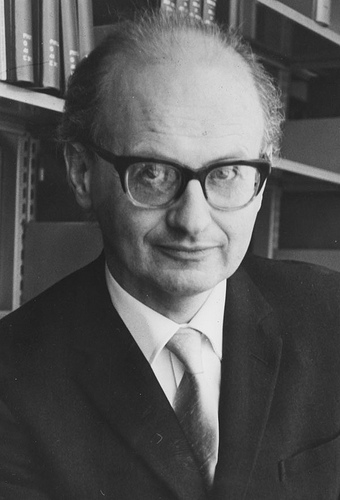
The pugnacious Feyerabend, ready to spar intellectually with all-comers.
He was officially a Professor at Berkeley from 1958 to 1989, when he left Unistat with a woman who'd seen him give a talk; both had been rattled by the 1989 San Francisco earthquake and it was time to leave.
A brief bracketed tangent on sources and "facts":
[The seemingly requisite Wiki article (I include links to Wikipedia because, while hit and miss, the entries are sometimes detailed and quite fine, and, if not, they at least give a few stats and links.) is here.]
[The always top-notch Stanford Encyclopedia of Philosophy entry, should you choose to accept reading it, is here. If you happen to read Wiki and/or Stanford or some other linked source and something is at odds with what I say in the blog, so much the better, as one of my aims is to impart some learned cognitive dissonance and spur you to your own exertions. That's what I want from my reading; I will assume my Ideal Reader as being somewhat akin to myself. - the OG]
Among a handful of books (less than 15 but more than 7) that I regularly delve into that are about the sociology of knowledge, Feyerabend's Against Method is one. What a bold and entertaining intellectual!
Imre Lakatos, Hungarian Popperian whose sense of humor Feyerabend greatly appreciated
It was supposed to be called For and Against Method, a collaborative work with his equally brilliant and dear friend Imre Lakatos (say "LAK-uh-tosh"), who was a disciple of Sir Karl Raimund Popper, and had developed Popper's ideas about rationality in science in novel ways. Feyerabend says that Lakatos told him, "You have such strange ideas. Why don't you write them down?," and Feyerabend suggested they pit each other's ideas about the scientific method (which Paul thought was a fiction) against one another in a book, possibly as an exchange of letters. But Imre died in 1974, shortly before the first edition of Paul's writings on the topic came out.
Basically: Feyerabend said that, contrary to secondary school stories, in fact scientists have tinkered and bumbled and stumbled and used innumerable quirky methods in order to make their breakthroughs. And after tinkering enough, happy accidents occur. The Francis Bacon story about empiricism just doesn't really fly. Science as an endeavor is far messier than the textbooks make it out. Are there many scientists who themselves buy into the mythos of "the scientific method" and try to work along those lines? Yes, there are: but the results seem pretty sketchy. At best the narrative of "the" method cashes out at a lot less than you'd think. And different sciences have different approaches. And it's far, far, far more of a social endeavor than ever. And the sophisticated gadgetry and measuring devices increasingly lead to computer modeling and statistical analysis. And...well, you get the picture.
For enthusiasts of the sociology of knowledge, the sociology of science, and maverick anarchistic ideas in philosophy, I consider Against Method a must-read, and I'll try to highlight a few reasons why...
Oh, but first: I wrote on David Kaiser's recent book How The Hippies Saved Physics
here. And Kaiser's cogent ideas about the structural reasons for physicists' unemployment in the 1970s should hold sway, but I would like to point out that Feyerabend was one powerful thinker around Berkeley throughout this period, and he had some ideas that may have gotten into the air and then the minds of the Berkeley hippie physicists. In his 1987 preface to the 3rd edition of Against Method, he says:
"None of the ideas that underlie my argument is new. My interpretation of scientific knowledge, for example, was a triviality for physicists like Mach, Boltzmann, Einstein and Bohr. But the ideas of these great thinkers were distorted beyond recognition by the rodents of neopositivism and the competing rodents of the church of critical rationalism. Lakatos was, after Kuhn, one of the few thinkers who noticed the discrepancy and tried to eliminate it by means of a complex and very interesting theory of rationality. I don't think he has succeeded in this. But the attempt was worth the effort; it has led to interesting results in the history of science and to new insights into the limits of reason."
Feyerabend was always against the "shut up and do your math" mantra with which physicists were inculcated during and after WWII in Unistat. (He also became friends with David Bohm, who influenced his thinking on quantum mechanics. Bohm also influenced the Berkeley hippie physicists.)
-----------------------------------------
Feyerabend noted that Thomas Kuhn had become duly famous and influential, but was preceded by John Stuart Mill and Niels Bohr in his line of thought. For Mill, see the passage on p.31 of the 3rd ed; Feyerabend quotes from Mill's Autobiography
and it reads like proto-Kuhn...from a book published in 1873!
----------------------------------------
He does something I like a lot, a throwback: he includes an "Analytical Index" at he beginning of his book, which summarizes the basic argument in every chapter. I've seen this in many olde pre-20th century books and always found this rhetorical flourish charming. For Chapter 3, we read this statement, which is one the first hooks he got into me:
"There is no idea, however ancient and absurd, that is not capable of improving our knowledge. The whole history of thought is absorbed into science and is used for improving every single theory. Nor is political interference rejected. It may be needed to overcome the chauvinism of science that resists alternatives to the status quo." And then he elaborates in the chapter. This seems like a world turned upside down to many of us in Unistat in 2011: we would rather political ideas stay out of science, as the State-Military-Industrial-Corporate-Entertainment Complex seems to be doing us in, slowly.
But Feyerabend has, ultimately, a longue duree in mind. He agrees in the separation of Church (in this he considers not only the Churches, but rationalists, secular humanists and Marxist ideologies as "religious" and interfering!) and State, but he also - and this blew me away when I first encountered it - thinks "democratic societies must be protected from science." Dig this epistemological wildness and weirdness:
"This does not mean scientists cannot profit from a philosophical education and that humanity has not and never will profit from the sciences. However, the profits should not be imposed; they should be examined and freely accepted by the parties of the exchange. In a democracy scientific institutions, research programmes, and suggestions must therefore be subject to public control [NB: recent concerns over nanoparticles, not to mention animal testing and those little things called "nuclear weapons" - the OG], there must be a separation between state and science just as there is a separation between state and religious institutions, and science should be taught as one view among many and not the one and only road to truth and reality. There is nothing in the nature of science that excludes such institutional arrangements or shows that they are liable to lead to disaster."
Oh wow! I've already gone on too long, but you must read him to understand where he's coming from here, especially with that bombshell of a statement of "one view among many." To quote Mr. X from the movie JFK, "You may think you know what's going on..." (Oh wait: wasn't that Noah Cross in Chinatown?)
---------------------------------------------------------
Feyerabend, who grew up in Nazi-controlled Vienna and fought for the Germans in WWII, wrote a surpassingly readable autobiography just before he died. Even though it's written by a philosopher of science, it's the sort of under-300 page book that any intelligent person can read for fun, and contains frank passages on his very active sex life (even though he was shot during the war, the bullet lodging near his spine, leaving him impotent for the rest of his life...he married four times and had many affairs!) and lurid anecdotes about Popper, Lakatos, and even the eminent philosophy professor John Searle, a longtime colleague at Berkeley. It's title is Killing Time
, and is a play on Feyerabend's name, which in German means "work-free time" or "after work."
---------------------------------------------------------
Finally, Paul was much-misunderstood - after reading his autobiography I'm not sure if he understood himself, emotionally, all that well - and he fed into this by his frequent changes of mind (any intelligent being "flip-flops" when they encounter new knowledge; it's part of a survival mechanism, something the Republican Party in Unistat seems to know NOTHING about), and Paul liked to say provocative things. But some seem to deliberately misread him. Here's an article from the National Catholic Register that seeks to defend Pope "Rats" Ratzinger in his "science ain't everything" screed of not long ago. Yes, "Rats" and Paul were both concerned about science run amok, but Feyerabend would vehemently distance himself from such an Authoritarian schmuck as the mitered infallible Pope-man, He who wears a dress and speaks on behalf of Gee Oh Dee. Oh, well...
---------------------------------------------------
While I don't agree with Feyerabend on everything - far from it - he was, to me, an overwhelmingly interesting thinker and personality. Sombunall readers of Robert Anton Wilson's book The New Inquisition: Irrational Rationalism and the Citadel of Science
might find they generate an abundance of dialectical sparks when they rub that book against Against Method. Just sayin'.
The pugnacious Feyerabend, ready to spar intellectually with all-comers.
He was officially a Professor at Berkeley from 1958 to 1989, when he left Unistat with a woman who'd seen him give a talk; both had been rattled by the 1989 San Francisco earthquake and it was time to leave.
A brief bracketed tangent on sources and "facts":
[The seemingly requisite Wiki article (I include links to Wikipedia because, while hit and miss, the entries are sometimes detailed and quite fine, and, if not, they at least give a few stats and links.) is here.]
[The always top-notch Stanford Encyclopedia of Philosophy entry, should you choose to accept reading it, is here. If you happen to read Wiki and/or Stanford or some other linked source and something is at odds with what I say in the blog, so much the better, as one of my aims is to impart some learned cognitive dissonance and spur you to your own exertions. That's what I want from my reading; I will assume my Ideal Reader as being somewhat akin to myself. - the OG]
Among a handful of books (less than 15 but more than 7) that I regularly delve into that are about the sociology of knowledge, Feyerabend's Against Method is one. What a bold and entertaining intellectual!
Imre Lakatos, Hungarian Popperian whose sense of humor Feyerabend greatly appreciated
It was supposed to be called For and Against Method, a collaborative work with his equally brilliant and dear friend Imre Lakatos (say "LAK-uh-tosh"), who was a disciple of Sir Karl Raimund Popper, and had developed Popper's ideas about rationality in science in novel ways. Feyerabend says that Lakatos told him, "You have such strange ideas. Why don't you write them down?," and Feyerabend suggested they pit each other's ideas about the scientific method (which Paul thought was a fiction) against one another in a book, possibly as an exchange of letters. But Imre died in 1974, shortly before the first edition of Paul's writings on the topic came out.
Basically: Feyerabend said that, contrary to secondary school stories, in fact scientists have tinkered and bumbled and stumbled and used innumerable quirky methods in order to make their breakthroughs. And after tinkering enough, happy accidents occur. The Francis Bacon story about empiricism just doesn't really fly. Science as an endeavor is far messier than the textbooks make it out. Are there many scientists who themselves buy into the mythos of "the scientific method" and try to work along those lines? Yes, there are: but the results seem pretty sketchy. At best the narrative of "the" method cashes out at a lot less than you'd think. And different sciences have different approaches. And it's far, far, far more of a social endeavor than ever. And the sophisticated gadgetry and measuring devices increasingly lead to computer modeling and statistical analysis. And...well, you get the picture.
For enthusiasts of the sociology of knowledge, the sociology of science, and maverick anarchistic ideas in philosophy, I consider Against Method a must-read, and I'll try to highlight a few reasons why...
Oh, but first: I wrote on David Kaiser's recent book How The Hippies Saved Physics
"None of the ideas that underlie my argument is new. My interpretation of scientific knowledge, for example, was a triviality for physicists like Mach, Boltzmann, Einstein and Bohr. But the ideas of these great thinkers were distorted beyond recognition by the rodents of neopositivism and the competing rodents of the church of critical rationalism. Lakatos was, after Kuhn, one of the few thinkers who noticed the discrepancy and tried to eliminate it by means of a complex and very interesting theory of rationality. I don't think he has succeeded in this. But the attempt was worth the effort; it has led to interesting results in the history of science and to new insights into the limits of reason."
Feyerabend was always against the "shut up and do your math" mantra with which physicists were inculcated during and after WWII in Unistat. (He also became friends with David Bohm, who influenced his thinking on quantum mechanics. Bohm also influenced the Berkeley hippie physicists.)
-----------------------------------------
Feyerabend noted that Thomas Kuhn had become duly famous and influential, but was preceded by John Stuart Mill and Niels Bohr in his line of thought. For Mill, see the passage on p.31 of the 3rd ed; Feyerabend quotes from Mill's Autobiography
----------------------------------------
He does something I like a lot, a throwback: he includes an "Analytical Index" at he beginning of his book, which summarizes the basic argument in every chapter. I've seen this in many olde pre-20th century books and always found this rhetorical flourish charming. For Chapter 3, we read this statement, which is one the first hooks he got into me:
"There is no idea, however ancient and absurd, that is not capable of improving our knowledge. The whole history of thought is absorbed into science and is used for improving every single theory. Nor is political interference rejected. It may be needed to overcome the chauvinism of science that resists alternatives to the status quo." And then he elaborates in the chapter. This seems like a world turned upside down to many of us in Unistat in 2011: we would rather political ideas stay out of science, as the State-Military-Industrial-Corporate-Entertainment Complex seems to be doing us in, slowly.
But Feyerabend has, ultimately, a longue duree in mind. He agrees in the separation of Church (in this he considers not only the Churches, but rationalists, secular humanists and Marxist ideologies as "religious" and interfering!) and State, but he also - and this blew me away when I first encountered it - thinks "democratic societies must be protected from science." Dig this epistemological wildness and weirdness:
"This does not mean scientists cannot profit from a philosophical education and that humanity has not and never will profit from the sciences. However, the profits should not be imposed; they should be examined and freely accepted by the parties of the exchange. In a democracy scientific institutions, research programmes, and suggestions must therefore be subject to public control [NB: recent concerns over nanoparticles, not to mention animal testing and those little things called "nuclear weapons" - the OG], there must be a separation between state and science just as there is a separation between state and religious institutions, and science should be taught as one view among many and not the one and only road to truth and reality. There is nothing in the nature of science that excludes such institutional arrangements or shows that they are liable to lead to disaster."
Oh wow! I've already gone on too long, but you must read him to understand where he's coming from here, especially with that bombshell of a statement of "one view among many." To quote Mr. X from the movie JFK, "You may think you know what's going on..." (Oh wait: wasn't that Noah Cross in Chinatown?)
---------------------------------------------------------
Feyerabend, who grew up in Nazi-controlled Vienna and fought for the Germans in WWII, wrote a surpassingly readable autobiography just before he died. Even though it's written by a philosopher of science, it's the sort of under-300 page book that any intelligent person can read for fun, and contains frank passages on his very active sex life (even though he was shot during the war, the bullet lodging near his spine, leaving him impotent for the rest of his life...he married four times and had many affairs!) and lurid anecdotes about Popper, Lakatos, and even the eminent philosophy professor John Searle, a longtime colleague at Berkeley. It's title is Killing Time
---------------------------------------------------------
Finally, Paul was much-misunderstood - after reading his autobiography I'm not sure if he understood himself, emotionally, all that well - and he fed into this by his frequent changes of mind (any intelligent being "flip-flops" when they encounter new knowledge; it's part of a survival mechanism, something the Republican Party in Unistat seems to know NOTHING about), and Paul liked to say provocative things. But some seem to deliberately misread him. Here's an article from the National Catholic Register that seeks to defend Pope "Rats" Ratzinger in his "science ain't everything" screed of not long ago. Yes, "Rats" and Paul were both concerned about science run amok, but Feyerabend would vehemently distance himself from such an Authoritarian schmuck as the mitered infallible Pope-man, He who wears a dress and speaks on behalf of Gee Oh Dee. Oh, well...
---------------------------------------------------
While I don't agree with Feyerabend on everything - far from it - he was, to me, an overwhelmingly interesting thinker and personality. Sombunall readers of Robert Anton Wilson's book The New Inquisition: Irrational Rationalism and the Citadel of Science
Monday, June 27, 2011
Closing In On My Chomsky Problem, OR: The Chomsky From 20,000 Fathoms
Studying this issue highlights my basic epistemological stance of "model agnosticism": I consider all of my perceptions and thoughts about "reality" as necessarily contingent. This is mostly due to my understanding of the way the nervous system processes information, and how easily we fool ourselves into thinking we have the One True Model for some phenomena. Model agnosticism means I try to have at minimum three different models for thinking about any issue or phenomena, and I must always be taking in new information, changing my mind a little bit here, combining some ideas there, discarding or relegating other ideas at other times. As I understand it, modern model agnosticism was born of Niels Bohr's Copenhagen Interpretation of quantum mechanics, which was influenced by William James and American pragmatism.
So: I'm trying to figure out my version of the Chomsky Problem, which might be stated: Given all the work Noam Chomsky has done in linguistics and in a seemingly unrelated field, politics, how might they cohere? And what's most pressing for me: why does Chomsky seem to not want to deal with semantics in the way that Frank Luntz, George Lakoff, "public relations" and other advertising people, Alfred Korzybski, or George Orwell deal with it?
I have explicated some of this in previous blogposts; I'm still working on it. Where I've become mired is in Chomsky's seeming fear - and I'm not sure I'm on "the" right track here - that if he admits that the realm of linguistics called "pragmatics" or "sociolinguistics" or especially a Neural Theory of Language as all far more powerful in the phenomenal-existential worlds we live in, then he has to admit he's living in a runaway world where masses of people can be swayed by the manipulation of words and symbols, that some sort of...what might be called...Skinnerian behaviorism is still at play? Despite Chomsky's famous "demolition" of Skinner back in the 1960s/early 70s? One of the intellectual moves that put him on the map as major player in the intellectual world? If Chomsky's semantics/"surface structure" is so trivial because of his overweening emphasis on syntax, he can't really account for this...Monstrous Thing that acts like a virus that eats human brains!
I may be dramatically overstating it a bit here, but this scenario I call Chomsky's Nightmare, and it's here, it's been here, at least since the advent of "public relations" in the very early 20th century (Nietzsche's and Vico's work in philology suggests it goes back a loooong way), and Chomsky - for some reason I'm still trying to figure out - seems to evade this Hideous Truth, although he certainly hints that he knows it's going on. My working hypothesis/abduction is that admitting that language actually works socially in a way all-too-close to the way Skinner said it did, would amount to admitting his cherished notions of how a "human nature" could be defined had been tragically lost, and that his entire linguistics project was fundamentally flawed.
[For background on Chomsky's famous attack on B.F. Skinner see "Psychology and Ideology" from 1972, collected in The Chomsky Reader
and For Reasons of State
. I think Chomsky did a fantastic job of demonstrating that the human mind is far more complex than the operant conditioned chimp-like thing Skinner assumes, then proves. But: I see Chomsky's demolition as a tad too nifty: people need to decide not to be automatons; very many of them do not do that, and that's part of My Nightmare. Skinner still lurks; he's still relevant. Chomsky's Nightmare and mine seem closely related; I seem to have a more jaundiced take on "human nature." But I still hold hope...ironically for the very reason Chomsky does, which I hope to briefly elucidate at the end of this post - the OG]
Chomsky is taking questions from the audience from 1989 -1996, the text for "Community Activists," chapter six of Understanding Power: The Indispensable Chomsky
is unclear on where/when this exchange took place:
Another Man: People often ask you about the connections between your scientific work in linguistics and your politics, and you tend to say something about, "Yes, there are a few tenuous connections." Would you amplify on that? I myself have been thinking that maybe part of our political problem is that the human brain is very good at seeing things in competitive terms like "more" and "less" and it's not very good at conceptualizing "enough."
Chomsky: Well, that may be true - but these are topics where the scientific study of language has nothing to say. I mean, you know as much about it as the fanciest linguist around.
Man: Where are they, then - even the tenuous connections?
Chomsky: Not there; the tenuous connections are somewhere else. First of all, we should remember that the kinds of things that any sort of science can shed light on are pretty narrow: when you start moving to complicated systems, scientific knowledge declines very fast. And when you get to the nature of human beings, the sciences have nothing to say. There are a few areas where you can get a lot of insight and understanding, and certain aspects of language happen to be one of those areas, for some reason - but that insight still doesn't bear on questions of real human concern, at least not at the level that has any consequences for human life...The connections are quite different - and they are tenuous. The only reason for stressing them is because they've been pointed out many times through the course of modern intellectual history, and in fact they lie right at the core of classical liberalism. I mean, contrary to the contemporary version of it, classical liberalism (which remember was pre-capitalist, and in fact, anti-capitalist) focused on the right of people to control their own work, and the need for free creative work under your own control - for human freedom and creativity. So to a classical liberal, wage labor under capitalism would have been considered totally immoral, because it frustrates the fundamental need of people to control their own work: you're a slave to someone else.
-pp. 215-216, op cit
------------------------------------------------------
Noam then goes on for four more paragraphs about Descartes, Rousseau, Humboldt, and his - Chomsky's - ideas about "human nature" that are in that line of Old Enlightenment, 18th century thought. It's a marvelous idea, it's romantic, I tend to agree with it, but it's an idea about "reason" that, it turns out, is wrong in about eight ways, I'm sorry to say. I will elaborate on this in a blog post soon. What galls me is Chomsky's radically - maybe even arrogant - deflationary view of modern research. At the end of the answer to this "Man" in the audience, Chomsky says this:
"You can read any book you want about sociobiology [theory that specific social behaviors and not just physical characteristics result from evolution], and it's mostly fairy tales - I mean, it's all fine when it's talking about ants; when it goes up to the level of mammals, it starts being guesswork; and when it gets to humans it's like, say anything that comes to your head. But I think you can see a possible connection of that sort - a potential connection. Whether that connection can actually be made substantive, who knows? It's all so far beyond scientific understanding at this point that you can't even dream about it. So that's the main reason why I don't talk about these things much. I just think they're interesting ideas, which are maybe worth thinking about in the back of your mind, or maybe writing poems about or something. But they're simply not topics for scientific inquiry at this point."
--------------------------------------
I find this maddening. The "tenuous connections" are "somewhere else"?
--------------------------------------
What more do I need to address? Does anyone reading this have something to add? A citation from a text that would illuminate me? Do I need to elaborate on something more, or have I elucidated My Chomsky Problem sufficiently above, taken with previous posts on the topic?
--------------------------------------
Oh yea: Chomsky's reason for optimism regarding political and social problems: It's based on Pascal's Wager. Chomsky's adaptation: "On this issue of human freedom, if you assume that there's no hope, you guarantee that there will be no hope. If you assume that there is an instinct for freedom, that there are opportunities to change things, that hope is possible, then hope may be justified, and a better world may be built. That's your choice."- adapted from Milan Rai's Chomsky's Politics
, p. 58
--------------------------------------
Subscribe to:
Posts (Atom)


