Overweening Generalist

Showing posts with label drugs. Show all posts

Monday, August 29, 2016

Occultists, Mystics, Artists, and Asthma

Recently, in the group reading of Robert Anton Wilson's Cosmic Trigger Vol 1 over at RAWIllumination.net (see this entry), there is a brief discussion about ceremonial magicians and their problems with asthma. MacGregor Mathers, Allan Bennett, Aleister Crowley, and Israel Regardie are mentioned as occultists who had varyingly lengthy bouts with asthma.

In Regardie's book on Crowley, The Eye In The Triangle: An Interpretation of Aleister Crowley, there is a passage about when Allan Bennett moved in with Crowley and taught him a lot about magick:

Bennett must have also taught him the art of skrying in the spirit vision, traveling clairvoyance, investigating symbols, their meanings known or not, so that their true significance could be divined. He must have given Crowley a good training in Qabalistic processes too. There is an essay or two of his remaining which indicates profundity and depth of insight. It was an invaluable training for Crowley -- one too that is at the bottom of the very real skill he came to have in practical occultism. 

However, there was something else that must have had a far-reaching effect on him. And that was bronchial asthma. I imagine the damp, wretched English climate did nothing to alleviate this condition.
-p.113

                                           Allan Bennett: taught Crowley a lot, severe 
                                           asthmatic, Buddhist, died in 1923.

Regardie mentions (this period with Bennett was around 1898-1900) that the drugs prescribed for asthma then were opium, morphine, chloroform and cocaine. These worked for a while, but then "narcosis" brought an end to a drug's efficacy. In Lawrence Sutin's biography of Crowley, Do What Thou Wilt, Sutin writes that Bennett's asthma was worse than Crowley's and we get this picture of Bennett from Uncle Al:

Allan Bennett was tall, but his sickness had already produced a stoop. His head, crowned with a shock of wild black hair, was intensely noble; the brows, both wide and lofty, overhung indomitable piercing eyes. 

Crowley believed that due to Bennett's asthma, Bennett, "regarded the pleasures of living (and, above all, those of physical love) as diabolical illusions devised by the enemy of mankind in order to trick souls into accepting the curse of existence." -p.66

Yea, I can see how asthma might contribute to such a worldview. Especially when whatever drugs you were using stopped working. Or made things worse.

Crowley's asthma got worse and worse through the first 15 years of the 20th century, and by 1919, when he came back to England after spending time in Unistat during World War I, a doctor prescribed heroin. He remained hooked for the rest of his life, one of the horrible ironies of Crowley's life, which was overwhelmingly about using the powers of the human Will to overcome anything.

In Wilson's book, asthma is discussed as a "chest disease" which some people catch and some are eventually cured. Because of my lifelong "moderate-severe" asthma, which has long been under good control by allopathic medicine, I dispute this picture of asthma, but acknowledge the wheezy sufferings of others quite readily. For example, Crowley smoked, according to Regardie (who for a while was Aleister's personal secretary), "dark perique tobacco by the continuous pipeful, which could only aggravate the already grossly irritated condition of his bronchi." (Regardie, p.114)

Regardie links asthma to stress, and I think he's probably right, but stress seems to make a flare-up of my own asthma less likely. This is one reason why I subscribe to the psycho-biological idea around asthma as a syndrome. Any asthmatic can tell you of conversations with other asthmatics in which a discussion of what your "triggers" are vary wildly. For instance, Regardie assumes the "wretched English climate" made Bennett's asthma worse, but I do really well during cold, damp rainy weeks. When growing up in the San Gabriel Valley part of Los Angeles, the hot, dry Santa Ana winds were menacing and treacherous to me. (ER at 3AM).

So certain climates, pollens, foods, exercises, pets, etc: there's quite a variance among asthmatics. It does appear to be an autoimmune disease, but read the best, most up-to-date technical literature on what happens with with the immune system and you'll quickly realize it's a pretty complex cascade of events. For some "reason" your body thinks it's being invaded by something dangerous, and over-reacts.


I assume this has something to do with epigenetic effects, early exposure to smoke or smog, the individual's microbiome, and the Hygiene Hypothesis probably has something to do with it too.

Regardie, after getting into a tiff with Crowley and splitting with him in 1932, developed asthma, and relates the time he spent with occultist Dion Fortune and her physician-husband, and Regardie's asthma attack, and how they took care of him. Regardie returned to New York and kept a correspondence with an asthmatic English writer interested in the occult, and this was where Regardie learned of the idea "that somehow asthma is an occupational disease of occultists and mystics!"-p.116

By the mid-1930s ephedrine and epinephrine inhalers were available, and these work better than anything else for asthma attacks, but they stimulate the heart too much. Regardie thought he had a heart attack at one point, eventually received Reichian therapy, pronounced himself "cured" and had little problem with asthma after that. Makes me wonder...

Occultist/magician Andrew D. Chumbley died in 2004. Seems like his asthma was as bad as Bennett's.

Robert Anton Wilson (who got polio at age 4, in 1936, and was "cured" by Sister Kenny's method, pronounced as "quack" medicine by the AMA) gave a long interview with Michael Taft in the final decade of his life. I find this section germane:

Taft: Do you think the early experience of polio had much effect on you?

RAW: Yea, I think it underlines the tone of anxiety and paranoia that you find in all of my novels. Basically, all the characters in my novels come to a point where they're convinced the universe has been organized just to destroy them!

This makes a lungful of sense to me. Not that I think asthma is anywheres near the catastrophe of polio, mind you. I do think being a young person, holed up at home sick, becoming fiendishly bookish and spending a lot of time alone with your own imagination? It can have lifelong effects. And there will be drugs...

[Asthma seems to accompany pronounced problems with anxiety, for reasons to be easily guessed at. And we all desire a feeling of agency, but I suspect childhood-into-adulthood debilitations such as autoimmune diseases (and polio) enlarge and distort this desire, possibly leading to a life of mysticism, art, or magick. A third desire that seems to bubble out of this for sombunall asthmatics: a yearn to escape. Okay, okay Dear Reader, you say you've always been perfectly healthy - if "anxious" -  and yet you desire these same "things"? You're in the club with us! Even when we're not suffering miserably, we love company. Mostbunall?]

Regardie says Crowley's "association with Allan (Bennett-OG) had another very important sequel. I have already indicated that he used drugs to assuage his sufferings from asthma. In doing so, he must have discovered that some of them had a distinct effect on the mind. They expanded consciousness, and produced a simulacrum of the mystical or religious experience." -p. 117

In the 1950s-early 1960s, Asthmador could be bought over-the-counter at drug stores. It had datura in it. It had datura's nightshade cousin, belladonna, in it. These, in sufficient doses, were truly hallucinatory. HERE's a trip report. RAW discusses Asthmador, and other nightshade hallucinogenics, in Sex, Drugs and Magick, pp.84-104.

RAW - one of the great scholars of the occult/mystical/hermetic tradition, said that modern occultism had three main roots: Madame Blavatsky, Crowley, and Gerald Gardner, who revived pagan Wicca, which thrives today. Gardner too had asthma.

I've not seen evidence that Blavatsky was asthmatic.

When I was a kid, I looked for lists of famous athletes who were asthmatic. As I got older, I pay attention when I find out certain people had it: Beethoven (coffee was probably the best remedy he had); Vivaldi, Schoenberg, Alban Berg, Leonard Bernstein; Ambrose Bierce; Orson Welles; Jean Gebser. Etc. There are a LOT of us. Proust...

The best writing I've seen on the nightshade/tropane alkaloids is in Dale Pendell's Pharmako/Gnosis, pp.243-264

Tomatoes, potatoes, and hot peppers are also part of the nightshade family. Kinda makes me wonder.
-------------------------------------------------------------
The best history of asthma I've read was Asthma: The Biography, by Mark Jackson
The best book of a modern personal account of living a life with asthma that I've seen is easily Catching My Breath: An Asthmatic Explores His Illness, by Tim Brookes
-------------------------------------------------------------
Cannabis is a well-known bronchodilator. It works in a pinch, and because of Reagan's War on Pot, our best gardeners went underground, fiddled with the genetics of cannabis indicas and sativas, and now it's so good you hardly have to inhale much vegetable matter...which in the long run can't possibly be good for the bronchii, can it? At any rate, less is more with the Green Goddess.

                                                arte psicodélica por Bob Campbell

Saturday, May 14, 2016

Updates and Re-Takes On Some Old Posts: Toxo, Hot Peppers and Boredom

A. Toxoplasmosis 
I had written a bit on Toxoplasmosis gondii  HERE. This is a weird microbe that infects around 11% of Unistatians and other countries have a much higher infection rate. If infected by this parasite, most people's immune systems keep it in check; for others it appears to get into the brain, cause cysts there (Ew!), and very weird stuff: it makes women more aggressive; men become more impulsive and less fearful when they probably should be cautious. One way we get it is via contact with domesticated cat feces. It rarely kills anyone; it simply makes them act strangely.

Right after I wrote about it, another study came out. (Secondhand HERE.) Its lead author, E.Fuller Torrey, thinks cats should be seen as more dangerous than most of us think they are. Having a cat around in your childhood might lead to schizophrenia or other mental illness in adulthood, their study suggests.

Sidelight: Interestingly to sombunall readers of this blog, Dr. Torrey published a book on Ezra Pound in 1984; I've read it: Torrey thinks Pound and his pals in high places got away with pulling a fast one on the Unistat gummint: Pound was found, basically, insane for broadcasting his at-times vile antisemitic thoughts over the radio with Mussolini's imprimatur, and therefore Pound avoided a death sentence for treason.

Adding to this bizarre infection, a study in France sought to understand the possible evolutionary aspect of Toxo. Some chimps were infected with it, and urine from a leopard didn't scare them away like it should have. Today, mice and rats infected with Toxo aren't afraid of domesticated cats like they ought to be, for their own survival. I also learned that lions and tigers are not predators of chimps, but leopards are. I will never become a zoologist at this point...

Stanford biologist Robert Sapolsky is fascinated by the Toxo research, while his equally brilliant colleague at Stanford's rival, U. of California at Berkeley, Michael B. Eisen, said this study is interesting, but the chimps' sense of smell could be set off by factors other than their Toxo infection.

So: Toxo may have jumped from being incubated in the guts of a Big Cat, to domesticated cats circa 15,000 years ago. But I don't see the evolutionary Big Picture of Toxo, other than it's doing what it's got to do to keep going generation after generation, like viruses. It makes some of us act really weird, and humans in our pre-history who ended up being eaten by big cats? They're not any of our ancestors. I'd like to hear an Intelligent Design person explain this one.

B. On Hot Peppers
Three and a half years ago I blogged about, among other things, my love for very hot peppers, and how I might have hallucinated in a Thai restaurant near Berkeley due to an extreme hot pepper event. I still chase after the buzz, and the quest to develop the hottest peppers in the world continues unabated.

Recently I ran across a fascinating article by a Berkeley writer (who I only know by name), Andrew Leonard. "Why Revolutionaries Love Spicy Food: How the Chili Pepper Got To China."

Now, I consider Nautilus one of the best online magazines, but the comments for this article were, I thought, really horrid. So many fine points made by Leonard missed! (Also: Leonard invites semantic reaction by asserting that "revolutionaries" like really hot peppers, when he really only makes a strong case for those Chinese coming out of Sichuan Province.) Was George Washington a lover of hot peppers? Doing the research: no. Karl Marx? Probably not. Che? He appears to have liked spicy food, but he didn't make a huge deal out of it. One of the highlights of Leonard's piece is the story of how former German schoolteacher Otto Braun, turned Soviet counter-espionage agent, was sent to advise Mao, and couldn't get used to the very spicy food, and Mao is quoted, "The food of the true revolutionary is red pepper."


U. of Pennsylvania psychologist Paul Rozin had long been interested in why some people really love hot, spicy foods and peppers. Why do peppers seem "hot" when they aren't? Because capsaicin activates pain receptors (called TRPV1) for actual hot things. It's a delightful glitch, methinks. Rozin thought people attracted to hot peppers and who enjoy the taste and the pain must be the same sorts of people who are thrill-seekers, chance-takers...maybe even revolutionaries? Mao thought the pepper-lover is ready to fight and win; Rozin later coined the term "benign masochism" for pepper-lovers.

(So who are the malignant masochists? Poor Trump supporters?)

Decades after Rozin's guesses about hot pepper-lovers, research has validated his ideas. A Penn.State study showed a significant correlation between "sensation seeking" and love for hot peppers. (Italics mine to remind you it's tentative.)

Leonard goes into the history of Sichuan Province: where, about 250 years after Columbus, hot peppers made their way and grew easily and cheaply and preserved themselves for long periods and added flavor to dishes, vitamins B and C, and were antibacterial to boot.

The history of Sichuan and its de-population in the 16th century due to banditry, famine and rebellions, followed by an influx of 1.7 million the next century (fall of the Ming, rise of the Qing) is one Leonard tries to tie with the hot and humid province, the ying/yang medicinal philosophy, the cheapness of raising hot peppers there, and risk-taking personalities on the move due to internal strife. Because these hardy souls lived through tough times and migrated to Sichuan from other parts of China, the idea is that revolutionary personalities are prevalent there. And hey, I dig a spicy-food-loving lady too. But the neurobiological research so far shows that these pepper-lovers may just be more thrill-seeking; I think political revolutionary is a mere sub-type. Still, read the article, 'cuz it's pretty good if you're into that sorta thing.

It seems people are probably not born with a penchant for spicy hot peppers, and need to become habituated. I think I habituated myself, and it could be because I'm what Linda Bartoshuk calls a "nontaster": the number of fungiform papillae on my tongue make me like my coffee black and strong, my beer very hoppy and bitter, my peppers really hot, etc. However, I have never considered myself a thrill-seeker in the ordinary sense of the term. I do seek novelty...


C. On Boredom
I assayed some aspects - mostly my subjectivity - toward boredom HERE. With the availability heuristic - or is it more like "priming"? - once I've written on some topic, that topic suddenly appears everywhere.

A book called Unbored came to my attention. Although it's for younger people, I saw a lot of my own thinking on the topic reflected there. In delving into Robert Anton Wilson's Sex, Drugs and Magick, looking for a reference about something else, I happened to re-read a part of RAW's discussion of Aleister Crowley's book Diary of a Drug Fiend:

In the third, and most controversial part of the book, "Purgatorio", Peter and Lou attempt a cure under the auspices of a mysterious magician named King Lamus - a thinly disguised portrait of Crowley himself. At the Abbey of Thelema (based on an actual religious retreat once run by Crowley in Sicily), Peter and Lou are put in a situation where all the cocaine and heroin they could possibly want is immediately and easily available to them. King Lamus tells them, using Crowley's favorite slogan, "Do what thou wilt shall be the whole of the law."

There is a gimmick, of course. In fact, there are several gimmicks. The abbey, although hardly as austere as a Christian monastery, is quite isolated from civilization; Peter and Lou are soon confronted with the most underrated but powerful force in the world - boredom. There are no movies, nightclubs, or other distractions. When they complain, King Lamus tells them again, "Do what thou wilt shall be the whole of the law." They soon discover that, in spite of their hedonistic existence, they have never actually done their "will" in a profound sense, but have only followed momentary whims. Isolated at the abbey, they are forced to ask themselves, again and again, what they truly do "will" for their subsequent lives.
-p.186

Take a few moments to ponder this?

Boredom is being tackled by neuroscientists: if you've ever been tackled by a neuroscientist, you know what I mean. But I jest. Scientist Bill Greisar says of boredom that it's so pervasive it "suggests it serves some critical role in behavior." Which I think Crowley - a more interesting psychologist to my eyes - saw in the early part of the century. In one of many articles on boredom studies, Ingmar Bergman's Scenes From A Marriage comes up, as does Dickens, and the idea of one thinker that boredom is a milder form of disgust, which took me some time to "see." (Right now, I've gone back to not "seeing" much of a relationship between Boredom and Disgust, and I'm afraid it simply was never meant to be. I'd like to fix up Boredom with Anger...)

Many studies have shown that boring activities lead to more creativity, even boring reading activities. ("In some circumstances" was the caveat from one researcher.)

In a creative activity bored subjects performed better than distressed, elated and relaxed subjects. (I wonder how they provoked elation?) The physiology of boredom is interesting: you're more stressed (cortisol in bloodstream), with an increased heart rate, unmotivated by your surroundings, and have a difficult time sustaining attention.

What could be the purpose of boredom? A Texas A&M study suggests boredom is something like hunger or thirst: it motivates you to change your immediate circumstances. You seek novelty, new goals and situations. "By motivating desire for change from the current state, boredom increases opportunities to attain social, cognitive, emotional and experiential stimulation that could have been missed." Anticipation of a change in mental state is associated with our old pal Dopamine.

Philosopher Andreas Elpidorou says boredom is essential for a decent life and life without it would be a nightmare.

Around the same time, I stumbled upon the idea that, how can we still be bored in the 21st century? The idea is that too much stimulation is boring.

Since my initial blog on boredom, I've become convinced that I do get bored. It's probably not true of my assertion that I'm never bored. It's a matter of degree, which reduces to the felt amount of time bored, which for me isn't much. Id est: my moments of boredom are so brief, I don't frame them as "me being bored." I simply move on to the next thing. And there are endlessly interesting things of easy avail to me. Perhaps I'm some sort of intelligent simpleton?

I consider my lifetime love of reading here paramount. How many departures from my paramount "reality" are available to me in books? It's endless. It's good for a reliable squirt of dopamine into my brain-pan.

Not long ago I read a wonderful novella by Anton Chekhov, The Story of a Nobody, from around 1893. The description of the main male antagonist's friend, a logical man named Pekarasky, who can multiply two three-digit numbers in his head immediately, has railway and finance tables memorized, can convert currencies mentally and accurately:

But for this extraordinary intelligence many things that even a stupid man knows were quite incomprehensible. Thus he could not understand at all why it is that people get bored, cry, shoot themselves and even kill others, why they worry about things and events that do not affect them personally, and why they laugh when they read Gogol or Saltykov-Schedrin. 
-p.11

Is this not a creepy guy, this Pekarsky? Doesn't something about him seem vaguely monstrous to you?

Walker Pearcy's theory of hurricanes seems to fit in here nicely. Malaise and despair and world-weariness can be fixed by a you-must-act-now situation, which is the hurricane. My view is that we need to pay attention and develop a mental "patch" so that it doesn't require a hurricane or car accident in order to make our interiorities vital again.

                                           kunst: Mr. Bob Campbell

Friday, April 15, 2016

The Drug Report: Life Extension, LSD, Oddities, Sundries

I didn't do a drug report last month, so you might say I've been "clean" for at least a month. Add to that: I haven't smoked any pot for at least 20 minutes, as of this writing. Sooo: two and a half cheers for moi?

On with it...

Possible Life Extension Drug: Metformin
If you're the sorta dreamer I am, you long for the day when you swallow one or what the hell: a handful of pills and they:

  1. Stop your telomeres from fraying while continuing to do what they did when you were 15
  2. Wipe out any and all cancers forming while not throwing your hardy-yet-delicate immunological systems out of orbit
  3. Erase all plaques that gum up your aorta and arteries and that crap that leads to Alzheimer's
  4. Level the playing fields of life by making you really pretty and attractive to possible sex partners
  5. Laughs: life will be full of 'em with this/these new drugs
Those of you trained in cryptanalysis and steganography might notice the first letters of my five here spell out SWELL. Yea, it would be real swell if we had drugs that did this stuff, but no matter how optimistic/hedonistic/giddy or just plain stoned we are, let's get real.

As I handicap a bevy of life extension drugs over the past three years, a diabetes drug called Metformin looks fairly promising. And I confess the older I get and the more I accumulate readings of articles about the Possible Miracle Drug For Everything, the less sanguine I've become. But Metformin has about 60 years of safety. For Type 2 diabetics it suppresses the liver's glucose production and increases sensitivity to insulin. It's increased the lifespan in worms and mice. Researchers think there's a physiological basis in this diabetes drug that delays the aging that gives rise to diseases. Ones even worse than diabetes, like dementia, cancer and heart disease.

Here's the crux: doctors and researchers need to convince regulators and research funding agencies to give 'em the money to test this. What are they gonna test? How long will it take? Will I be dead by the time it hits the market? Probably not: under the TAME (Targeting Aging With Metformin) clinical trial they'll take over 3000 70-80 year old folks who have one or two of these lovely maladies: cancer, heart disease, or cognitive impairment, give them Metformin, then see if it forestalls these septuagenarians and octogenarians from getting those other brutal disease they don't already have.

It'll take five to seven years and cost $50 million.

I know, I know: this is not what you wanted to read about. But you tell me what's out there that's more robust and promises more in the way of longevity.

The horrible truth is, if you have dementia but don't already have cancer or heart disease, you're gonna get one or both of those others before you kick off for the Big Dirt Nap. Talk about a reality sandwich!

Researchers caution: this is not an "immortality" drug! (As if they needed to tell us, after what you've just read.) The big deal here seems to be: Metformin is a well-accepted drug for Type 2 diabetes. But: the TAME study, if it pans out, will establish Metformin as a drug that delays aging. And aging is statistically linked with nasty-ass degenerative diseases, which have already been named in this article, no need to give them more press here. The Unistat FDA says they are open to the study. Researchers want merely to "extend a person's healthy years by slowing down processes that underlie common diseases of aging."

So, in closing I must confess what I know about myself. I read this stuff and one part of my brain - the part that I associate with non-magical thinking and statistics, knowledge of inherent human biases, and appreciation of ever-changing information about the complexity of systems - this part thinks "this seems pretty realistic and at least it's something." But I also know I will wake up tomorrow, and sometime after lunch, catch myself dreaming of the True Wonder Pills, the ones that will do the SWELL stuff. Am I the only one?


Instead of Exercise, Take a Pill? (Just: Not Yet)
I confess I love exercise, sweating, stretching, getting all breathless, even if it has nothing to do with sex. I do yoga and cycle, love hiking, but Cross-Fit seems vaguely fascistic to me, but I digress...

So, a welter of exercise physiologists have determined that, when we're exercising - not doggin' it, but really working up a sweat and approaching oxygen debt - we experience over 1000 molecular changes in our skeletal muscles. And who knew? What's going on at that level rarely crosses my mind as I approach a 1500 foot uphill climb on my bike. My thinking's more along the lines of, "If my heart explodes and they find me dead and my bike in the middle of the road here, after a cement truck and school bus run my body over, it's good I brought my ID with me so they can notify next-of-kin, but at least I can say I wore a helmet if I wasn't already dead" or "this ascent looks like a mutha; just think of the endorphin buzz I'll cop about 40 minutes after I summit." Stuff like that.

But: if we know the 1000 molecular changes that happen, maybe we can just mimic those in a pill! It's all just biochemistry, isn't it? Hey yea: they're working on it. For reals! (Or they're fucking with science writers and the public, hoping for more funding to do far less romantic research, but I don't want to be a bummer, especially after that take on Metformin.)

There are a lot of people who can't exercise, so this would really help them. It would be a godsend for the obese, for people with diabetes, heart disease, etc. One article I read on this research said it would be really great for people who already exercise. That sounded gluttonous to me.

The sobering news here: it's gonna be at least ten years, as one researcher said, "before a pill could conceivably be available." Let's hope the Metformin we'll be able to take will get us there at a young enough state that...oh hell: I need a drink.


Maurice Mikkers: Microscopy and Drugs = Art
If you have the time, check out the gorgeous colors and lines in drugs. This link begins with what Mikkers calls "party drugs" but I really only think of GHB and MDMA/Ecstasy and maybe amphetamine as drugs to "party" with. DMT, 2C-B, and LSD should be used in the proper set and setting, which often is NOT a "party" in the sense most of us think of parties. But aside from that, who knew these drugs were so beautiful, under the microscope, enlarged 40x-400x?

The MDMA/Ecstasy was breathtaking to me. Of course Ecstasy would do that.

Check out Mikkers's website for tonnes of astonishing photography, especially if you need a contact high.

Also, nota bene: it's officially been declared, by the International Moral Credit League ("Oh yea, the IMCL? Great buncha people...") that if you just "take a languid gander" at an "exhibit" - that's the way I see how Mikkers has laid out his wares online here - then you get "credit" for not going to the actual brick and marble Museum this month. I mean, what it'll cost you here? 12 minutes? Think about it. This offer only good through April of 2016; after that you must feel vaguely guilty again on May 1st until you go to the museum or talk or poetry reading. Just floatin' that out there. Hey, facts are facts.

                                            Robin Cahart-Harris, PhD

Recent LSD Research
Just in time for April 19th/AKA "Bicycle Day" and I'm no doubt writing yet another Epistle to the Converts, but what the hell, I just have to mention it. The Beckley Institute crowd-funded a study on LSD and got some stellar drug researchers from Imperial College in London to conduct it. The eminent Dr. David Nutt was the study's lead author, and Robin Cahart-Harris led the study. These are not lightweights. What did they find?

After giving 20 healthy volunteers injections of 75 micrograms of LSD (and others got a lousy placebo, but it was FOR SCIENCE!), the trippers had their brains imaged three ways: with fMRI, something called "arterial spin labelling" (don't ask), and magnetoencephalography. The study said the LSD users tripped for "six hours."

Aside: every LSD trip I've done was at minimum 200 mikes, but always on blotter. And it always lasted at least 10 hours. This Imperial College London stuff Nutt got must have been really righteous! Moving on...

So: there are numerous reports on this study, but the finding that most intrigued me: neural networks in the adult brain normally "talk" to closely-connected networks nearby. It's about specialized function. To rehash basic developmental neuroscience, we have way more neurons as babies, but they get pruned away with experience in the world, which we can call "learning." The stuff that's not pruned gets reinforced and the connections get stronger. We develop neural pathways that "know" how to do millions of things. Neurons are use-it or lose it: what's not recruited in learning/experience in the world gets flushed, literally. Eventually, we develop a sense of our "self" and some sort of "ego," hopefully a relatively healthy one.

What this study did was show how LSD gets the brain to "talk" and connect to other areas it usually doesn't, and therefore it was likened to a return to a "childhood" sense of wonder and imagination. It also reduced the "normal" connectivity we usually experience. What it taketh away it more than giveth backeth in spadeths.

In the past 30 years, neuroscience has continually found more fascinating aspects of how "plastic" the brain can be, even in adults, in the right circumstances. This is termed "neuroplasticity" and is the main reason why even stodgy old farts can still learn a thing or two.

As I read the articles about this study, certain lines jumped out. LSD and presumably other psychedelics "might help some users return to a childlike sense of wonder and imagination." (Most of these quotes are from Cahart-Harris or David Nutt.) When I read this, I think my first reaction was, "I wonder how many church-goers privately think, "This ain't working for me, but it's what's expected...I need to show up at least..." Well, what you REALLY want is a return to a childlike sense of awe and wonder, where parts of your brain get to know other parts for the first time, then you'll know what true religion is. But here of course I'm biased.

In a repetition of research with psilocybin over the past five years (or more), it was observed that the users experienced "improvements in well-being" after the effects of the drug wore off. Psilocybin research showed that one trip significantly changed people towards more openness for the rest of their lives. I know it's an olde riff, but if we could only get this stuff in the punchbowl at the Republican National Convention, amirite?

Cahart-Harris: "This experience is sometimes framed in a religious or spiritual way, and seems to be associated with improvements in well-being after the drug's effects have subsided." Yes, and it's once again suggested by people with actual PhDs from high-ranking universities - actual scientists, not assholes like Ted Cruz or some raging right wing pastor who thinks Jesus needs more nuclear missiles so we get to live out the book Revelation.

But Cahart-Harris also addresses a point I blogged on a few weeks ago: why must psychedelic experience use religious language? I recently read Dennis McKenna's book Brotherhood of the Screaming Abyss and here's a PhD psychonaut of impeccable credentials who has managed to develop a vocabulary to talk about psychedelic experience that's drawn from cosmology, phenomenological philosophy, science fiction, and the arcana of alchemy.

We have our work cut out for us, friends.

Once again, hard-core researchers are suggesting these drugs might or can or should be used for depression, addiction and - presumably if Metformin and the exercise pill never get here in time - for end-of-life anxiety.

I will close with a quote from the estimable British drug researcher, Dave Nutt, talking about this latest LSD research:

This is to neuroscience what the Higgs boson was to particle physics.

And with that, I bid you all a fondue.


Wednesday, February 3, 2016

The Drug Report: "Morality" Pills

Going through some odd drug articles I stopped and re-read two from 2012, both addressing the idea of improving ourselves morally via neuropharmacology.

The first one was by Peter Singer (who in 2014 was the Swiss think tank Gottlieb Duttweller Institute's 3rd most important thinker in the world), and Agata Sagan, an independent researcher living in Warsaw, last I checked. She is very concerned about victims of repression and the idea of affective altruism. (See the article here, so you know I'm on the level.)

They address public acts of massive indifference to human suffering and why some people risk their lives to save strangers from things like burning buildings. The 1970s studies by Milgram and Zimbardo get mentioned, as do the seminary student experiments: on the way to give a sermon on the Good Samaritan, if the student was feeling rushed for time, they didn't stop to help a person lying on the ground, moaning. Demonstrations of empathy in rats? Yes. Then it gets good.

Singer and Sagan think we're getting to know about the brain to such a critical point that we might come up with a pill that will make us act with the better angels of our inner beings. We'd care more about others with this posited drug. We might not even have "free will" - they actually say this at the end of the piece - but we do need to think about the ethics of such a posited wonder drug: do we give violent criminals a chance to take it before locking them up? Do we - presumably the Police State apparatus now ready to lock in to pedal-to-the-metal Delirium Mode - monitor "pre-crime"? Do we go all out Gitmo-Dick Cheney-Clockwork Orange with those who some law and order types deem "potentially dangerous"? Would we implant a time-release device in the brains of psychopaths (like Dick Cheney?) to keep them from burning down the village for kicks? And if this miracle drug were good enough, would we still need religion?

Okay, here's the thing with great thinkers like Singer and Sagan: they're often far too straight. I mean, haven't they heard of Ecstasy? When the cops in Murrka found out about it, they made it a Schedule I drug (no known effective use, no known legitimate positive use, no research allowed without kissing our ass first). This despite a welter of scientific gnostics like Alexander Shulgin, Thomas and June Riedlinger, and Dave Nichols, testifying to its human benefit. The DEA's Administrative Law judge, Francis Young, agreed that it wasn't all that dangerous and in a 90 page decision, recommended Schedule III for MDMA/Ecstasy/Adam/E, etc. The DEA itself said "Fuck that shit: we're shutting it down: Schedule I." So much for sanity...

In my worst moments I fantasize about registered supporters of Ted Cruz and Donald Trump being forced to take an Ecstasy suppository, but then I'm just weird. Poetry made me that way. Blame it on, uhh...poetry. Yea.

To quote the great scholar of drugs, Dale Pendell, on this issue of outlawing Ecstasy due to bad information and scare tactics:

The clear message from the Drug Warriors is that they are not interested in peace, citizenship, or even tolerance. - PharmakoDynamis, p.216

Side Note: Israel and Palestine issues make me meshugenah and majnoon, respectively. It looks like there's no hope for a two-state solution, and the Israelis keep building the settlements. There seems enough people on both sides who want peace, but all it takes is some small percentage of bad actors. Or...what happened in Ireland between the Protestants in No. Ireland and the IRA? From Dale Pendell: "Ecstasy clubs in Northern Ireland were the first venue where Protestant and Catholic youths danced together. When footballers in England began taking ecstasy, violence plummeted. Everywhere it has gone ecstasy has been a catalyst for peace."

And no one was forcing it on 'em. Just let nature take its course. But first: get it out of the hands of the cops, and into the hands of researchers.

With the cannabis wars turning to the side of human decency (finally!), some of us might start reading up and getting in gear to re-legalize MDMA.


Now, also in 2012, I read this article from J. Hughes, the Executive Director for the Institute for Ethics and Emerging Technologies. Not nearly the luminary that Singer the Utilitarian is, but this article from later the same year seems more down-to-earth. Hughes - a bioethicist and sociologist - knows how oxytocin and testosterone and dopamine and serotonin work in studies having to do with antisocial behavior, crime, empathy, and religious ideation. It's a tad longer than Singer-Sagan, but well worth the read.

My favorite part was when he took on Jonathan Haidt's sociobiological intuitive morality ideas. Haidt claims to have been a liberal but now he's not, because of his research, which yield five human instinctual moral behaviors:

1. Don't hurt people
2. Don't cheat
3. Defer to authority
4. Favor your family/tribe over the Others
5. Stay sacred, avoid that which spiritually pollutes

I read Haidt's book The Righteous Mind and he's way up there on my list of the most overrated thinkers today. PBS did a documentary of Edward O. Wilson not long ago, and they repeatedly used Haidt to sing EOW's greatness, which I found nauseating. I think of Haidt as the real-life proponent of the mind behind the situation in Shirley Jackson's great and horrifying short story, "The Lottery." Haidt says fear unites us. Built into Haidt's bullshit evolutionary psychology of "morality" is this: well of course I don't like what he's saying; that's because I'm a liberal and liberals are blind to the last three of those five listed above. Not blind. We just don't place those values very highly at all. So: damn straight we seem "blind" to the natural goodness of racism, nationalism, deference to authority figures simply because of their authority, and we think homosexuals deserve equal rights, and women should be able to control their own bodies. If that's blindness so be it. I'm not having any of Haidt's crap.

(I've blogged on Haidt before, for instance HERE and HERE.)

And neither is J. Hughes, who sees "defer to authority" as anathema to progressive thought. Favoring your family/tribe can be re-worded as "racism, nationalism and nepotism are true, good and natural!" I take the avoidance of "spiritual pollution" to be akin to having a stick up your ass over other people's weird (and therefore "wrong") sexual proclivities.

For Hughes, any drug (or practice) that would improve our abilities to feel empathy/see ourselves in others and let go of the need to control others: liberal and voluntary. Why? Because the liberal approach to moral enhancement seems inherently minimal compared to the Haidt-people. Think of a politically powerful group who adhered quite strictly to Haidt's five above: do you think they'd endorse anything like Ecstasy?

That's a trick question, of course: we've obviously had those people in power, for a long time. Especially in the DEA. And look at how great we're doing!

Tuesday, June 30, 2015

Drug Report: LSD and Flying; Future Drugs; Cannabis Potency, etc.

First off: tidbits of drug news I've found interesting: Science Inches Closer To Home Brew Heroin. While I don't think smart guys with a few flasks, some re-agent, a Bunsen Burner and a worn out copy of Principles of Organic Chemistry, 31st edition, will be making this stuff soon, let's face it: it's only a matter of time before we will all be able to make our own heroin, or maybe even Dave Nichols and Sasha Shulgin-level psychedelics. The costs of hardware are falling precipitously.  Others are doing it right now. But can you trust them? NB the Doctor who says to consider illicit drugs a disease that we've been treating with antibiotics for 50 years. Wouldn't we expect the drugs (and their users?) to become antibiotic-resistant after 50 years?

Speaking of Shulgin: he's only been dead for 13 months and he seems bigger than ever, if my Internet reading is an accurate indicator. No doubt the main reason is that he published two fat books on psychedelic chemistry - PIHKAL and TIHKAL - despite the DEA telling him they'd rather he not. In a conversation Shulgin had with Martin Torgoff, author of Can't Find My Way Home: America In the Great Stoned Age, 1945-2000, Torgoff writes, "His reason for publishing this remarkable collection of how-to recipes was twofold. The first explanation was philosophical. 'Every drug, legal or illegal, provides some reward,' he wrote. 'Every drug presents some risk. And every drug can be abused. Ultimately, in my opinion, it is up to each of us to measure the reward against the risk and decide which outweighs the other...My philosophy can be distilled in four words: be informed, then choose.' The other reason had to do with Shulgin's passionate belief in the freedom of information. As he explained it, 'You know where all of Wilhelm Reich's notes and his manuscripts  and writings went after he died? the FDA burned them. I felt the same thing could have happened to my work, which is why I wanted to get the stuff scattered as widely as I could.'" (p.393)

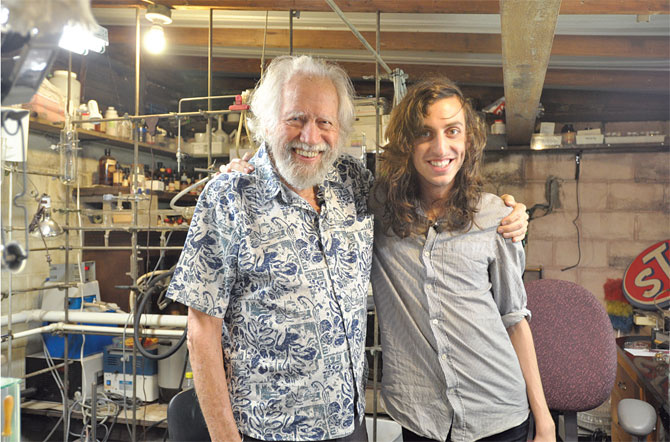
                      Alexander "Sasha" Shulgin, with fan Hamilton Morris, in Shulgin's 
                      home lab in Lafayette, CA. Photo probably by Ann Shulgin?


Fans of Robert Anton Wilson will be familiar with this idea of Reich's books being burned by the Unistat government less than 15 years after we supposedly fought a war against fascism, because, among other things, those fascists violated our basic ideas about freedom of information, and they burned books. (See RAW's Wilhelm Reich In Hell, for the uninitiated.)

Take a moment or two and ponder the AMA-FDA burning Reich's books, and Shulgin's recipes flying all over the world, to some exotic place where people are now tripping on some analogue of mescaline or DMT, or Ecstasy.

Also: those seeking to buy their own copies of PIHKAL and TIHKAL via online vendors: caveat emptor; the fascists no doubt are monitoring the movement of these books. I have them for my own "Walter Mitty" reasons I've discussed many times before here in blogspews about "dangerous" or "demonic" books. I somehow manage to screw up microwave dinners, so I'm a far cry from being able to understand, much less cook up something like Shulgin's underground favorite (or one of 'em), 2C-B:

"A solution of 100 g of 2,5-dimethoxybenzaldehyde in 220 g nitromethane was treated with 10 g anhydrous ammonium acetate, and heated on a steam bath for 2.5 h with occasional swirling. The deep-red reaction mixture was stripped of the excess nitromethane under vacuum, and the residue crystallized spontaneously. This crude nitrostyrene was purified by grinding under IPA, filtering and air-drying, to yield 85 g of 2,5-dimethoxy-(Greek beta letter)- nitrostyrene as a yellow-orange product of adequate purity for the next step..." (PIHKAL, p.503)

The text goes on to make the previous look like "heat on high for 4 minutes, remove, wrapper, let cool for one minute before eating." It gets way out there. It's like reading some experimental poetry to me: I don't get it at all, but the odd linguistic effects of reading it give a sort of Joycean thrill. Clearly, I want my future psychedelic bathtub chemists to have at least gotten an "A" in Organic Chemistry Lab. At a really good school.

Where's the buzz in having/reading the Shulgin cookbooks if you wouldn't know a methyl group if they ganged up on you behind the tennis courts? After all his abstruse chemical prose, there are always abrupt, jarring tonal shifts in prose: trip reports from his select group of elect psychonaut explorers of inner space, scattered around Berkeley, Oakland, and San Francisco (Shulgin's lab was on his property in nearby Lafayette, California). And now, one would guess, because of the dissemination of the two books all over the world, there are vast unpublished trip reports for such Shulgin drugs as AMT; 5-MEO-DMT; 5-MEO-DIPT, 4-Acecoxy-DiPT, and DOB.

Drugs That Alter Auditory Perception
A second little thing: about psychedelics and perception of sound: In my old copy of Lee and Shlain's Acid Dreams, I ran across a wild line about the CIA developing futuristic drugs, and there was one that "only alters auditory perception, under its influences all sounds become atonal, while other human faculties remain unaffected." (p.292) The authors give no citation, and when I first read about this, years ago, I thought they had to have been taken in by someone, if not some CIA person, then someone who had been reading a lot of William S. Burroughs. This sounds like a WSB-invented fiction. I would like to think the drug was called "Schoenberg," but I didn't really believe a drug could be that specific in the brain.


That is, until I read about Shulgin's DIPT, which supposedly makes people hear music one octave lower (or so) than its normal pitch. That reminded me of trying to learn blazing fast scale passages from my favorite guitarists by putting the record on at 16rpm rather than 33 1/3: a Randy Rhoads passage played high on the neck suddenly sounds like it's down around the 2nd fret, with Ozzy sounding truly evil and not like the carnival barker I believed him to be in so-called "real life." And then I read about Takao Hensch, a Harvard (those guys again?) professor of molecular and cellular biology, who took adult non-musicians and had them do musical ear-training tests on valproic acid, a mood-stabilizing drug. The subjects developed perfect pitch! I'd love to have perfect pitch, but with follow-up research I see Hensch's subject group was small. Even more irritating: what valproic acid does is potentiate the brain's neuroplasticity: your brain gets a re-set to the time when you were very young, and soaking up language and info like a vast sponge. We could all learn quantum field equations! and Swahili! and Chinese! and...how to do chemistry like Shulgin!? Ah, but the Big Caveat: the brain's neuroplasticity and our earlier "critical periods" for learning (before some neural window closed on us) seem very basic, and evolution probably did that for some good reason, which we won't want to tamper with. For right now, my main model to reason with this is If It Sounds Too Good To Be True, It Probably Is Too Good To Be True. So, we probably ought not tamper with this ancient system of learning.

But we will. Someone will, right? Stay...<ahem> "tuned." Maybe this will turn out to be Something Veddy Innaresting...

Cannabis Potency: A Law-Enforcement Myth That Even Most Pot Smokers Believe?
You've all heard this one: the pot you find now is 10 to 30 times stronger than the stuff the hippies were smoking in the late 1960s/early 1970s. I remember when we bought dime bags of Acapulco Gold and Panama Red: stringy, leafy, stems-and-seedy stuff we loved. Rarely anything that looked like an actual bud. And then rarely we'd find some guy who'd have Thai Stick (awesome!), or even more rarely, "Hawaiian," like Maui Wowie, which was the best stuff I'd ever had. Then, as recounted wonderfully in Michael Pollan's book, The Botany of Desire, Reagan got elected and started a campaign of spraying the Mexican pot crops with paraquat, an herbicide linked to Parkinson's Disease. And so, as Pollan writes, our best gardeners went underground, played with the genes of various strains of cannabis and came up with the most amazingly strong weed, which was grown in the Emerald Triangle of far northern California. And when "sensimilla" (without seeds: a truly utopian concept at the time) filtered into my suburb of Los Angeles, circa 1982: I took one hit and felt like I was on acid. So for awhile even I believed the stories about vastly increased potency.

But I had had conversations with renegade pot growers, guys who really knew their stuff, and they said that was all Cop Propaganda. I said, but what about all the amazing buds you guys have come up with, like Blue Cheese, Purple Urkel, Green Crack, and others? They said that stuff was always around, but I was too penurious to be able to afford it. Because it was scarce. Only the Beautiful (and rich) Dope Smokers were indulging in stuff like Dogshit Orgasm or Purple Kush...But still I was skeptical.

Then I read Ben Goldacre's book Bad Science. Goldacre is a tireless debunker of "woo" and at one point in the book smelled bullshit about the "it's 30 times more potent now...so...the children will all be KILLED!" shit the cops were playing. He uses math and stats and logic to debunk increased potency since 1970. (see Goldacre, pp.189-193) I was impressed by his zeal and rationality, but...I had access to all sorts of weed that was so potent, so...good I required more dissentual data about increased potency. It turns out if you look, you can find.  I read Brian Preston's Pot Planet: Adventures in the Global Marijuana Culture, which I remember liking a lot, but I don't remember much about <cough>. Preston quotes an expert who says it's not true that pot is way more potent than in the 1970s; it's just that the very potent stuff [17%-30%THC] is way easier to find now.

                Blueberry Afgoo, left. NYC Diesel bud on right. Photos by Erik Christiansen

I've started to come around. I think Goldacre and Preston's expert are probably right; Pollan is not wrong; he's inadvertently explaining (in his wonderfully written chapter in Botany of Desire about cannabis) why the Really Good Stuff is so omnipresent now. And some people still doubt Progress!

Flying on LSD: Literally
Who knows the deep story about Captain Trips? Who was Al Hubbard, anyway? We have reason to suspect he's telling the truth about growing up poor in Kentucky and getting rich in uranium. Why disbelieve his stories and documents about working for the OSS (and then the CIA?) Aldous Huxley found him charming. (Two more disparate personalities you'll rarely find in a friendship, by the way. Hubbard was a spy, a Cold Warrior, and not educated. Aldous was nothing if not ridiculously well-educated.) Hubbard had a mystical experience on LSD, seeing himself being conceived during his parents' sex act. He flew all over the world in his own plane, with his seemingly unlimited supply of great acid. He wanted to turn on the world. Was his motivation on the level? And his ties to the highest levels of the Unistat government made his "Johnny Acidseed" jaunts easy. He received a happy birthday card from Ronald Reagan just before he died. At a party at Oscar Janiger's house in 1979, Timothy Leary greeted Captain Al with "I owe everything to you!" (Acid Dreams, p.293)

Now: I haven't flown anywhere in a long time, largely because 1.) before 9/11 every time I took my bags to airport I got sidelined while everyone else went on with their business of passing through security, waiting for their flight, etc. But not me. I always had to wait for my "security" to be cleared. Sometimes this only took five minutes. Other times: 30 minutes or more. Why? Because, at some point in the 1970s - this is all I've ever been able to get from airport security people and researches online - some person in Canada hijacked a plane, and they used a false name. That name is my exact name. (You may have seen this on 60 Minutes many years ago.) The hijacker used one of the most common Unistat names there is: "Robert Johnson." The name on my birth certificate is this name, although I've always gone by my middle name: Michael. But then I asked, "How come you cleared me six months ago, this is the same airline, and you have to clear me again?" Just following orders. So, my name is on a list, totally undeservedly so, and yet no one can do anything about it? Later I found out I could pay some fee to...someone and it would make all that go away. But I thought this was just bullshit. I still do.

Then: 9/11 and the quasi-fascistic/quasi-Kafkaesque TSA of true "security theater" arrived. I'll do a blog on how profoundly worthless the entire TSA security theater show is some other day. Or, as Ring Lardner said, "You could look it up."

Anyway: when I did fly, it was always a tad sensory overload to me. Aside from the security issues and the waiting, flying was a rich source of stimuli, observation, and odd perspectives that I actually enjoyed. (I once flew 16 hours to Tokyo, which was grueling and not fun at all. Another story...) The idea of being on LSD while flying just seems like too much to me. But not to Timothy Leary. Here he is in 1969. The Supreme Court had set him loose from a 30 year charge for having half an ounce of weed. He was finally free, after four years, to leave the country:

"In mixing sacrament for the trip I had accidentally taken too much and sat primly in the Air Iberia waiting room at JFK, rushing, sorting out James Bond paranoias, hoping that Franco's agents would fail to penetrate my disguise. (I've been busted three times in airports.)"

Leary and his wife Rosemary get on the plane. "Two elderly men in uniform tottered by, painfully lugging briefcases, gold teeth flashing forlorn smiles. 'They look like retired generals from the Spanish Civil War,' I whispered. 'Hush,' said Rosemary. 'They are our pilots.'"

Leary starts to get telepathic signals from the other elderly Spanish passengers. He imagines them all as old, committed fascists under the Franco regime. He says to Rosemary, "What have we got ourselves into this trip? This plane is like the second-class bus from Malaga to Torremolinos. It will never make the Atlantic!

"Rosemary was pretending she didn't know me. 'How much did you drop? Really!'" Leary felt like it took "3 1/2 hours to wheeze down the runway and takeoff." He's convinced the steward is a secret police agent. Eventually two Spanish stewardesses approach Leary. We know who you are...do you mind if we ask you some questions? Leary, to himself: "Here we go!"

The stewardesses asked Leary if he had any dope on him. He denied it. You always deny it, he'd learned. The stewardesses were disappointed. "What a drag. Our friends in Madrid will be disappointed. Well, at least give us your autograph."

Leary, taken aback, asked, but what about Catholic Spain, Franco, the secret police?

"Young people are the same all over the world, Doctor Timothy. [...] Young people like to get high and feel good and make love." (Jail Notes, pp. 137-138)

                                  Michael Horowitz in 1972. Photo by Timothy Leary

It's July 1970 and Leary is back in California, in prison. Recently he'd made Michael Horowitz his official archivist. Horowitz writes, "I was no longer a hippie minding his own business; I was now a member of the entourage/support team of the High Priest, the Disgraced Harvard Professor, the Pied Piper, the Acid Martyr - the world's best advocate of 'better living through chemistry.'"

Leary was doing 10 years for possession of two roaches. Leary had asked Horowitz to visit him in prison. Michael's friend came to his Berkeley apartment to drive him to the airport. Michael decided to cut a hit of strong Windowpane acid in half, to share with Leary. His friend honked his horn, and impulsively, Horowitz swallowed his half and kept the other half hidden underneath his fingernail. "The desire to be tripping on acid while meeting the High Priest of LSD got the better of me, so I slipped the other half under my tongue."

In less than an hour Horowitz climbed into a Navaho Piper Cub to fly to the California Men's Colony at San Luis Obispo. Horowitz writes that he enjoyed flying while stoned, while I get a panic attack just reading about this...and typing it to you, Dear Reader. But just think: Horowitz was going to enter  the world of the Prison. As they approached, a sign said 20 years for bringing in "narcotics" or weapons. He became acutely aware of the "tiny thing under my thumbnail." Horowitz had a huge hippie 'fro, purple-tinted glasses, and a fringe-leather jacket with "Timothy Leary for Governor" on it, bell-bottom jeans. He felt all the guards were staring at him, and the paranoia, mounting, he wished the acid would quit coming on stronger and stronger. Hilariously, Horowitz writes, "What was I thinking? That this was something other than a fucking prison?"

"'Look at that freak visiting Leary!,' one of the guards hissed from across the room." As he's given multiple forms to fill out, using the writing hand that had the other half-hit of Windowpane under the nail, eight burly guards came up and surrounded him. He tried to read and fill out the forms, but the words swirled on the page. (If you've never done acid you have no idea how INSANE this scenario must have felt.)

When asked his purpose for the visit, Horowitz somehow blurted out "editorial and archival matters." One of the guards sneered, "What does that mean?" Michael answered.

He was directed to a gate. A guard said to another, "It looks like like he's on something, don't it?" And they laughed. Security doors, gates, drab prison dullness of walls, electronic security. Finally he meets Leary and they hug and Horowitz relaxes a little, buys them both a coffee and candy bars, feels less like "Joseph K visiting the Castle" and more like a fellow Merry Prankster. Finally, Leary realizes Horowitz is on acid.

"You're on acid? Shit! What do you think this is? Fillmore East? I'm looking at ten years! I desperately need your help - and you show up on acid!"

"I have some for you."

"Great. I just can't wait to trip in this place! Look around - it's the perfect set and setting, isn't it?"

"Sorry," I said, downcast, feeling I had totally blown it.

Leary perks up, tells Michael about the book he's writing on DNA and LSD and the stages of evolution and says, wait till the guard turns away before you slip me the hit of acid. Horowitz is elated: he gets to get high with Leary and hear him talk about his ideas. Then he looks down and notices the hit is gone: it's not on his fingernail.

"Um, Tim..."

Okay, so that was more about prison than flying. But when I first read this story (in Psychedelic Trips For the Mind, pp. 49-51), the flying in a Piper Cub to a prison was enough to give me an mild anxiety attack. What's all the fuss about whether we can explore parallel worlds as theorized by some High Priests of physics? We already have ways to explore parallel worlds. It's called literature.

Finally: Allen Ginsberg, while the Bard of the counterculture, had also, from an early age, believed in watching the watchers. He'd kept files and clippings and notes on the FBI, the CIA, police of all kinds, politicians, world leaders. (And you bet your ass they had a massive dossier on him, too.) He'd come to realize the CIA's role in disseminating LSD in Unistat, and it was always a hot topic of conversation with his friends.

From Ed Sanders's book The Poetry and Life of Allen Ginsberg:

                              October of '77
                              he was in the air on the way
                              to a symposium called LSD: A Generation Later
                                           at UC Santa Cruz

                              and dropped a hit on the plane
                                          thinking about the CIA and LSD.
                              Later at the symposium
                              he told what he'd done and asked
                     "Am I, Allen Ginsberg, the product of
                       one of the CIA's lamentable, ill-advised, or
                       triumphantly successful 
                                            experiments in mind control?"
                          (p. 129)

Other Writings Consulted
"SiHKAL: Shulgins I Have Known and Loved," by Hamilton Morris
Nomad Codes, Erik Davis, pp.207-211, wonderful writing on the impact of Shulgin
Visionary State, by Erik Davis. Contains two wonderful large, full-color photos of Shulgin's lab, taken by Michael Rauner.
Pharmako-Gnosis, by Dale Pendell. Stunning erudition throughout.
Storming Heaven, by Jay Stevens
"Why Harvest Opiates When You Can Get Yeast to Produce Them?"
Imagine Nation: The American Counterculture of the 1960s & '70s, pp. 17-40, "The Intoxicated State/Illegal Nation: Drugs in the Sixties Counterculture," by David Farber


                                            art by the wild Bobby Campbell
                               

Friday, February 20, 2015

Marina Abramovic's The Artist Is Present (Thoughts on "Performance Art")

Streaming on Netflix as I write this, this documentary about Abramovic's 90 days of sitting in a chair silent at NY's MOMA in 2010. The film also covers parts of her long career as a performance artist. I loved the film.

                          Marina Abramovic: Balkan Baroque: Dozing Consciousness (1997)

Definition of "Performance Art": Dicey at Best
The definition of "performance art" is famously contentious, and when I read the Wiki on it one of the further links is to an article "Classificatory Disputes About Art," and this very nebulousness is one of the things I most like about performance art. Read a few textbook-like articles that explain what performance art "is" and you will very likely run into a sentence or two that could easily apply to why people use psychedelic drugs. Some people really don't like the effects of performance art; it wigs them out. I'll return to this subject below.

(I wish the filmmakers in the Abramovic doc would've gotten responses from some of the people who were caught looking on quizzically and then turning away with a semi-disgusted look as Abramovic sat still and gazed into the eyes of fellow museum-goers, but maybe that's just me.) The eminent art critic Arthur Danto sees Abramovic's sitting a New Thing in the history of art, because it's well-known that most museum-goers spend about 30 seconds in front of the Mona Lisa, while lo!: they sit or stand all day watching Abramovic sit and gaze. Taking in The Artist Is Present makes Waiting For Godot look like a Jet Li flick...or Cirque du Soleil. (Only if you feel like it, no pressure: think about that?)

I found Abramovic's family background edifying vis a vis what she ended up doing with her life. Some writing on her suggests that performance art was a big deal in the Eastern Bloc because of its transitory nature, which makes sense to me.

One thing I think of immediately when someone says "performance art" is "nude bodies?" Indeed, there is a lot of Marina and others nude in the documentary. And in performance art in general. Why? Well, how else to make claims for a relatively new form of art? Shock people. How? Nudity, violence, blood, gross-outs, and outrageous speech acts, for starters. In my personal aesthetics, shock is rock-solid legit in Art. I want more shock from Art. (But is it all tapped out by now? As one young Abramovic-watcher at MOMA says, "Pretty soon you'll see someone shoot someone else in the face and they'll call it art." I paraphrase from memory. Let's hope Art doesn't go there. But: it has come pretty close.)

You Say All Performance Art Is Bullshit?
How close? In an early performance in Belgrade, 1974, Abramovic decks out tables with all sorts of implements, tools, gadgets. 72 items. The audience can do whatever they want with her. The audience can walk up to her and pick anything from the table and apply it to her body. She has her clothes ripped off rather quickly. Among the 72 items: feather duster, olive oil, whatever. Some cut her body with sharp instruments Abramovic has supplied. Someone else drinks some blood from her neck. She just takes it. The kicker: the audience is informed the pistol over there on the table is loaded. Someone puts it to her head but doesn't pull the trigger. Someone else pushed rose thorns into her stomach. There was always the chance some suitably deranged individual could have shot her. But they didn't. Many did do vicious things to her. She was tearful but elated (and laughs!) after the six hour piece because she wasn't shot or mutilated beyond repair, and she got her point across: a group of people can take on a nasty tone and do some fairly heinous acts to someone else's body, just because it seems it they have carte blanche to do so. I know people who think performance art is bullshit, but you have to admit: this seems compelling.

William S. Burroughs, in one of his apocalyptic moods, wrote about Art spilling off the pages, escaping the frames and filling the streets, becoming Writ Large. In a way, certain performance art is a step towards this, but it is still "framed" by the various notices and literature that performance art will take place at a certain venue, a certain time, admission is $16, parking can be found in a number of lots nearby at $20 for three hours and the subway is just around the block, etc.

As I write, Marina Abramovic has just arrived in Australia and is "like the Beatles," as a promoter waxes hyperbolic.

Zen Shit
But let's not be cynical. I love her work. But I also laugh at almost all of it, because she's able to carry it off. Someone once said that "Art is what you can get away with," and I have to agree. Abramovic also seems genuine to me. She's 68 as of last November and in the documentary, in an interview at age 63 she states her age and - yes, she's in makeup for the interview - but she's astonishingly gorgeous at 63. Now here's some cynicism on my part: would she have attracted as many followers if she didn't look like a Slavic Goddess archetype? (Maybe...)

Abramovic has done a few pieces in which nothing happens; she just sits there. One of the main reasons for doing this is to test the limits of her body. Indeed, much of it seems brutal, grueling. But she also hints there's a political component to these pieces: in the West, it's anathema to Do Nothing. Just sit there; it's provocative!

To prepare for these works, she does "zen shit." There's a sequence in the documentary where she takes thirty or so young artist-recruits to her house in upstate NewYork, where they prepare mentally and physically to perform some of Abramovic's past pieces at MOMA, along with performance pieces by other artists. It all looks like very zen-retreat-ish with a dash of surrealism to me. (Yea, maybe you wanna see the film.)

The Family Fang, by Kevin Wilson
Not long ago I read this novel and let me just say that if you're a performance art junkie who also likes to read novels, you might want to look into this one, which addresses serious items about the possible damages parents may cause their children, if the parent-artists take this sort of art too seriously. And I found it quite hilarious and entertaining too.

One of the ideas highlighted in this book is this: if you live with these sorts of artists - or actively seek out that which constantly challenges your ideas about what's "real" and who or what to trust, etc - often the most mundane situations you find yourself in can be fraught with High Weirdness. 'Cuz now you're on your toes, more than most people. About the whoopee cushions of "reality."

Toward a Taxonomy of Performance Art
Is a Marilyn Manson show "performance art"? I leave it to you. What about Christo's various monumental environmental installations? What about pranks? Guerrilla ontology? Hoaxes? Art "Actions"? Flash mobs? Fluxus performances? Interventions? Happenings? Neo-Dada? "Manouevres"? Circus freak shows? Yes, I take your point that hoaxes seem to be done for gain, and that generally the hope is that no one will catch on. And all of these things might fall under "guerrilla ontology" in that they hope to make the audience re-think what they thought was "real." Must the Work have an intended agenda or message? When, if ever, is a well-thought-out prank not performance art? (There are certain performance art aficionados who will not allow pranks in their club.) Sometimes those who take part don't know they're part of the Thing. To what degree is the audience necessary or complicit in the art-form? "Happenings" in the sense of Allan Kaprow's works seem to begin with a few parameters and then, like a scientific experiment, wonder how it will all turn out. In this sense they remind me of magickal workings. Does ceremonial magick belong somewhere in this taxonomy? Must there always be disruption? The possibility of danger? An overtly (or semi- ) political statement? Nudity? Profanity? (One would hope so for those last two...) One of the most pervasive ingredients in these things seem to be Indeterminacy, which has me buying it if only for that, because, ya know, life's too short.

Some of this stuff seems mostly to want to delight or entertain certain types of cognoscenti, and to piss off the philistines, which is all good to me. I've yet to see a very convincing taxonomy. Anyone got one?

Children
In an ideal world, children and other innocents would be spared exposure to violent ruptures in "reality" but we all know a few hearty kids who thrive on this material from the get-go. Clearly there were children entranced by Abramovic just sitting there. There were adults who looked outraged that this was A Thing. At some point in our lives, we can go on enjoying the shock or the surrealities of these things; others shut down. It's genes plus environment plus memory and experience plus a few other things I can't remember just now. Which brings me to...

Drugs and Performance Art
Abramovic is against drug use, and claims to have smoked a cigarette in the 1970s, because it was supposed to be cool. I think her work is about zen, the body, endurance, and facing fear and overcoming it. (Much of her earlier work with her lover Ulay seemed to be about incommensurability between men and women, too.) I see her work as having a drug-like effect. It works this way for me; it may not for you. What I want from any altered state is a novel perspective on some phenomena. I look at all art as a chance to enter into what the phenomenological sociologist Peter Berger calls a "finite province of meaning." I exercise a lot and enter a non-ordinary state. I meditate, smoke cannabis, read Finnegans Wake, listen to Bach/Stockhausen/Coltrane/Sun Ra/Vilayat Khan/Balinese Monkey Music/Pink Floyd, have sex, do math or logic puzzles, eat very spicy foods, sit in a hot bath in the dark with earplugs and eyeshades on, engage with sophisticated technology, watch films: voila!: non-ordinary states. I think this came with the Instruction Manual for the owner of a Mind. Many seem to have displaced their manual. Personally, I model all of these wonderful gimmicks as sorts of things and of a piece with the practice of magick. Your Mileage May Vary. To me, it's all Drugs. Try to stop me from doing my bathtub routine, DEA!

Some people do not like many (or all) of these sorts of things, and they should not be forced to engage with it, much less endure it. As with Timothy Leary's Two Commandments:

1.) Thou shalt not alter the consciousness of thy fellow men.
2.) Thou shalt not prevent thy fellow men from altering their own consciousness.

With the First Commandment and taking into consideration the somewhat fugitive nature of much of "performance art" in the wider senses of the term, sometimes we cannot help it. It could be the Times we're living in?

Other Perf-or-mances/Other Arty Mental States
A lot of the enjoyment of this - if enjoyed at all - seems idiosyncratic, a matter of taste. I have gotten my rocks off watching sword swallowers and gorgeous mostly-nude babes walking barefoot on a bed of broken glass at freak shows like the CIA in North Hollywood. Then again, I would return again and again to David Wilson's Museum of Jurassic Technology because I was never sure what was a put-on or what was legit, and it was all so incredibly well-done. (And I liked not knowing for sure what was a put-on or fancy; I love the indeterminacy.)

If extremes with the body is the subject, many artists come to mind. Like Bob Flanagan. Or Martha Graham stuff I've seen. Ever heard of Fakir Musafar? His stuff set a mind a-wonderin', aye.

Some of the best altered states I've been in were when I flew to Tokyo or London or Amsterdam or Lisbon or Kathmandu...and jet-lagged, I got out and walked aimlessly around those metropolises. This is not art, but it does seem linked to Abramovic's body-based work. Yet no one else can enjoy it but myself. And then I get back to my hotel room and collapse from sleepiness and the dreams extend that overall weirdness. The worst part of this is the actual flying part, hands down. What, in these scenarios, is the Art? I say to you: the cities and their inhabitants. It's yoga, a connection: my blitzed nervous system and the new city's overwhelming info-density and novelty.

I remember getting high off the hijinks of Andy Kaufman. I could rely on Andy to knock me into the finite province of wonder. There's a funny put-on/performance artist alive today (not saying you're not still alive, Andy!) named "Hennessy Youngman" who cracks me up. He seems like Sacha Baron Cohen ratcheted up a notch, and he makes Modern Art seem a lot more fun than some overly serious staid lecturer at Uni. I've seen lots of video of the robot anarchy from Survival Research Labs that really blew my balls to the far side of Eris. I recall when, around age 20, I read and delved like a madman into John Cage and Lamont Young, and felt a quite visceral thrill when I read that one of Nam June Paik's "serious" music performances consisted of coming out to applause, and, instead of sitting down at the piano, he took an axe and a chainsaw and cut the piano in half. Because...it had yet to be done?

As far as pranks go as a possible subset of performance art, here's one of my all-time favorites:
If you aren't familiar with this prank, please READ HERE. Effing genius.