Overweening Generalist

Showing posts with label Paul Feyerabend. Show all posts

Thursday, December 13, 2012

Free Radicals, by Michael Brooks

I never tire of contemplating how Copernicus and his co-conspirators gave us a convincing heliocentric view, and how that ricocheted and echoed down through time and changed the way individuals conceived of themselves in the cosmos. To knock the geocentric view out of the picture was quite the coup, eh? Then Darwin (and aye: Alfred Russell Wallace and scads of others) carries off an even bigger move: we're part of a long line of mammals; we're not God's Special Kids. Einstein and Hubble and many others made us understand that we're only part of a so-what solar system, one of quintillions (at least!) that exist. (Hubble space telescope sees a tribe of galaxies from the dawn of the universe.)

And yet some human egos need to resist these insults. To me, these new models constitute knowledges that are compliments to human ingenuity, having the added bonus of being "true."

Copernicus called nature "God's temple," and said we can know God through studying Nature...which got the Vatican to put his Copernicus's book on the Index. We do not know what, if any, drugs Copernicus took, but I do see him as a mystical weirdo, one of the guys on my team.


Darwin seemed very upset that he was upsetting the God-fearing. He had a lot of physical ailments, but he published his books anyway, and I continue to be staggered by his accomplishments. He followed up on some Wild Ideas put forth by thinkers in the immediate previous generations, ideas from disciplines not his own, like geology. And he persisted, despite sicknesses, as if possessed, because the Wild Ideas were interesting and might allow him to midwife some Wild Child of his own. One of my favorite sociologists of knowledge, Randall Collins, makes a very persuasive case that the most valuable thing an intellectual can do is to open up new spaces for other intellectuals to think in. And what a space Darwin opened up! Jaw-dropping...

                                                        Charles Darwin

Einstein seems sorta embarrassed by how he developed his world-shattering ideas: daydreaming, goofing off, tinkering around with images. He had mystical ideas about how Nature worked, but the his math wasn't up to snuff to prove them. As Michael Brooks writes in his recent book, Free Radicals: The Secret Anarchy of Science, "His papers are riddled with errors and convenient omissions - though they were lazy fudges rather than, as with Newton, deliberate frauds. Einstein repeatedly failed to take account of known facts when formulating his ideas." (p.7) Supposedly Einstein once said, "The secret to creativity is knowing how to hide your sources." His inspirations had no traceable source, hence Brooks's term for Einstein's animus: "mystical." It was clear to Einstein that working on the most interesting unsolved problems in physics could not be done logically, deductively, step-by-step: this would be beyond human capacity. No, he used Something Else...And one of the results was the ending of WWII.

Well, Brooks's book wonderfully extensionalizes/elaborates on Paul Feyerabend's main thesis: that "anything goes" in science. It's the best on this subject I've seen yet. I'd like to say that Feyerabend (mentioned in the book) would be pleased, but you never really know with Feyerabend.

Another Brief Riff on Perspective: Science as a "Brand," 1945-Now
Brooks says his book is about "the humanity of scientists - and what that really means." And he juxtaposes this with a narrative foisted upon almost all of us: the scientists are basically slightly less caricatured versions of Mr.Spock, from Star Trek. Brooks says this is a "cover-up" that's been wildly successful "because even the scientists haven't understood what has been going on."

Here's the Science brand after 1945: It's "logical, responsible, trustworthy, predictable, dependable, gentlemanly, straight, boring, unexciting, objective, rational. Not in thrall to passions or emotion. A safe pair of hands. In summary: inhuman." (p.2) Brooks elaborates on this at length, and it's a slam-dunk to me, an inveterate reader of dissentual data about this Science brand, which I smelled as bovine excreta at age 17. But it's the details and solid research, coupled with an investigative journalist's style - Brooks has a PhD in quantum physics - coupled with an enthusiasm to shine light on the cover-up, that makes the Brooks book so eminently readable.

Almost every fantastic breakthrough in science does not meet the "scientific method" narrative they still brainwash kids with in the schools.

To those interested in Buckminster Fuller's thesis about scientists as "Wizards" that the Machiavellian Owners of the World bought off: there's much here to build on Fuller's argument. (I'm mostly referring to Fuller's criminally underappreciated GRUNCH of Giants.) Brooks quotes Michael Schrage in referring to the bankers/corporations/energy moguls after WWII, when physicists were seen as the "Merlins of the Cold War...their wizardry could tip the balance of the superpowers in the twinkling of a quark."

Q: If the Scientist-as-Spock story is hooey, then what does go on?
A: Dreaming, cheating, mania, drugs, daring self-experimentation, pranks, and High Weirdness in general.

But let me return to perspective.

                                       "Earthrise," taken xmas eve, 1968, Apollo 8

Stewart Brand on LSD in San Francisco
In the mid-1960s, Brand, who paid attention to seemingly everything that would later change the world - was high on acid on a gravel-covered roof in the beatnik-y North Beach district of San Francisco. He was thinking about space flight and how astronauts had recently gotten glimpses of Earth from space: a new perspective. Then he remembered hearing Buckminster Fuller give a talk in which he thought a major flaw in humanity's assumption about itself that has led us to a possible brink was that, even though most of us "know" the world is round, we don't really conceptualize of our planet that way. We tend to conceive of the world as flat, and if we could only carry around with us the image of "a round ball, isolated in space, an island in an inhospitable cosmos, perspectives would change." And Brand, on LSD, became transfixed on allowing us all to see a picture, a photo of the Earth. He worked tirelessly, like a campaigner, writing NASA, getting college kids all riled up, writing the UN, the Soviets, members of Congress. He started in February of 1966, and by the end of 1967, photos of from Apollo 8 - one taken by William Anders, and called "the most influential environmental photograph ever taken,"by Galen Rowell in The 100 Greatest Photographs That Changed The World, was perfect for Brand's purposes. (Brooks, pp.15-17)

Carl Sagan's "Pale Blue Dot"
The words are from Sagan, watch this 3 1/2 minute video. Is this perspectival-feeling "olde news" to you? Or do you still feel it? Are we jaded? Does anything shift inside you? Or do you remember when it did, but now you're concerned with the multiverse or dark matter? Does this seem "cheesy"to you? Or does it make you melt, emotionally? What does it do to your sense of "self"?

Oh, now we can access via library DVDs, the science channels on TV, other amazing cosmological schtuff on You Tube...other planets, galaxies, taxonomies of galaxies, etc. But the pale blue dot was what Bucky Fuller wanted us to feel so we'd start to think we all live on this spaceship planet together, and do we really want to make it an armed madhouse? Michael Brooks makes a good argument that we  might never have gotten this perspective without radical, anarchic thinkers.

                                                        Dr. Lester Grinspoon

Carl Sagan was a bigtime pothead. He was good friends with Harvard MD Lester Grinspoon, who was a pioneer in medical pot. Brooks relates how Sagan liked the creative insights cannabis gave him, and tried to capture these by tape recording them so he'd be able to access them and take these ideas seriously the next day, when his buzz was gone and he needed to write. Dig this bit from Sagan via Brooks:

"If I find in the morning a message from myself the night before informing me that there is a world around us which we barely sense, or that we can become one with the universe, or even that certain politicians are desperately frightened men, I may tend to disbelieve; but when I'm high I know about this disbelief. And so I have a tape in which I exhort myself to take such remarks seriously. I say, 'Listen closely you sonofabitch in the morning! This stuff is real!'." (p.246)

Brooks's Free Radicals tells of the somewhat likelihood of Francis Crick's LSD use, and how it may have helped Watson and himself to discover the structure of DNA. Kary Mullis's LSD use is now-legendary, and he thinks it was a valuable asset in his discovery of the polymerase chain reaction technique, for which he won a Nobel Prize. Richard Feynman's pot smoking and LSD use is mentioned, as is William James's experiments with nitrous oxide.

But the true value of Brooks's wonderful little book is that he has quite thoroughly dismantled the "brand" of Science being done by slightly human Mr. Spock-types we were all taught; he gives a withering number of examples in a breezy prose that the business of making scientific breakthroughs is anything but clean and orderly and rational. It's thoroughly, gloriously, anarchic.

A 90-second bit with Michael Brooks:


Saturday, August 4, 2012

John P. Ioannidis and Reading the Latest Dispatches From the World of Science, Featuring Jonah Lehrer

In 1905 - stop me if you've heard this one - a young Swiss patent clerk published three papers that have shaken the world of physics ever since. We have not thought about little things like matter, space and time the same way since Einstein published in Annalen der Physic, in his Wunderjahr 1905, papers that proved to be paradigm-shattering and which addressed puzzling anomalies surrounding the photoelectric effect and Brownian Motion. Then Einstein added a little something called special relativity.

In 2005, an epidemiologist and medical statistician published two papers that had a similar effect in medical research. His name? John P. Ioannidis. (Say "yo-NEE-deez") He was a math prodigy and, after studying rare diseases, became interested in the problem of solid research that backed almost all of the taken-for-granted truths that your doctor and most medical researchers were working with. At first he thought he would take the rather paltry and shoddy studies that formed the basis of sound medical practice, then perform his speciality: a critical analysis of the founding papers, do a meta-analysis, and shore up and legitimize what had been a bit non-rigorous and sloppy for a body of practice that was so basic to our understandings of the best modes of treatment.

And...just...oh boy...

This was in the 1990s. Ioannidis, in his research, found that about 90% of what doctors believe and what they tell their patients, what drugs they prescribe, was seriously flawed. The research that supposedly legitimized the dogma in most of our doctors' heads was riddled with mistakes.

                             John P. Ioannidis, hero of this blog-spew, underrated thinker?

Brief Digression
I admit it: I read probably 100 articles a week on little scientific findings that sound..."interesting." I love Science Daily! There are about six or eight other science sites I read regularly, and I'm interested in  physics, chemistry, cosmology, medical findings, neurobiology, social psychology, genetics, archaeology, evolutionary studies, on and on, und so weiter. And I link to those in the OG, as for instance, earlier articles on the obesity problem, which is serious to me. But there's reason to believe, given what John P. Ioannidis has found, to read those studies with far more than a grain of salt. Rather read with something in mind between a dull news article about some crime that was committed...and fiction. Why? Read on.

Ioannidis and His Two Papers of 2005
One was published in PLoS and had a wonderfully provocative title: "Why Most Published Research Findings Are False," and was a rigorous mathematical proof that, summarized by David H. Freedman, who wrote the best journalistic piece I've seen on Ioannidis (HERE, and highly recommended you read it three times over the course of a year), as "Simply put, if you're attracted to ideas that have a good chance of being wrong, and if you're motivated to prove them right, and if you have a little wiggle room in how you assemble the evidence, you'll probably succeed in proving wrong theories right." This applies to medical research, but many researchers in other fields have taken note.

Another way of summarizing Ioannidis's meta-research here (the PLoS paper their most downloaded one ever, and heavily cited by others) could be like this:
1. Assume modest levels of researcher bias and add to that:
2. typically imperfect research techniques, and then add to that:
3. the human tendency (well-known) to focus on exciting rather than highly plausible theories, and it all adds up to:
4. VOILA!: researchers will come up with wrong findings most of the time

Isn't this sorta galling, freaky stuff? Or is it just me?

[I consider David H. Freedman one of our very best Expertologists, and I just now remembered that I wrote about him and his book HERE.]

Also in 2005, Ioannidis published, in Journal of the American Medical Association (JAMA), a paper that tested the idea that, sure, there's a lot of bad studies, but the larger social world of doctors and medical researchers will read these flawed studies and be able to identify them; the flawed stuff will get weeded out. As you may have guessed, this was not found to be true.

Ioannidis picked 49 of the most highly regarded research findings over the previous 13 years. These were the most widely cited articles in the best peer-reviewed journals. These papers had to do with hormone replacement therapy for menopausal women, vitamin E to stave off heart disease, the use of coronary stents, and daily low-dose aspirin for keeping the arteries unclogged, etc.

41% of these studies were shown to have major flaws. Physicians and researchers do not know how to see through dubious research findings. Or there's a herd mentality among medical professionals. Or some would rather not know. Or possibly all of the above and Something Else.

A Few Upshots From All of This
Ioannidis shows there are routinely problems at any and every step of the research process, and they have to do with conception and hypotheses, research techniques and other methodological problems, conclusions, conflicts of interest, the human desire to make a breakthrough, the human desire to publish to gain academic standing, the need to feel part of a larger research group by supporting their findings, and the politics of peer-review and how journals decide to accept or reject certain papers. Among other things. Like the common obsession of winning a big research grant, often from Big Pharma.

On top of all that, the field seems resistant to change what it already "knows." Sorta like the tuberculosis out there now, that's resistant to antibiotics because those antibiotics were too over-prescribed? (Hold on, that may be a Bad Analogy...)

Regarding obesity studies, Ioannidis says "ignore them all." Why? Because they're seriously flawed. Some studies found fat people live longer than expected, and were just as healthy as the non-fat. Why? The problem of bio-markers: they tell us something, but not the entire picture, and they don't take into account very many other interactions within the body. We may be spending far too much in the wrong places. What about using Vitamins A, D, and E? Forget those studies also, says Ioannidis. What about whether we should eat more fat or carbs? Forget it, says John P. Read the David Freedman article from The Atlantic that I linked to above for Ioannidis' reasons why these studies are to be ignored.

Then...then...then...if there's so much bad research done in the medical field, what about our health, as a society? Ioannidis answers: "That we're not routinely made seriously ill by this shortfall [of truly evidence-based medicine] he argues, is due largely to the fact that most medical interventions and advice don't address life-and-death situations, but rather aim to leave us marginally healthier or less healthy."

Ioannidis says bad ideas spread like an epidemic, "They're spreading it to other researchers through journals," says Ioannidis, who Freedman says looks "like Giancarlo Giannini with a bit of Mr. Bean."

How were Ioannidis's two bombshell papers received by the medical community? Very well. People seemed relieved. He was attacking general mistakes, and so every researcher could say to himself, maybe something like, "Yep, this stuff goes on a lot, and it's a problem. My colleagues need to be very careful..." It's not you who conducts bad research; it's other people.

Interestingly, in 1989, two Economists, Kevin Lang and Brad DeLong, published a meta-study of economic dogma and research and what they found was very much like what Ioannidis found: basic assumptions that formed the working models of almost all economists were found to be seriously flawed. However, the field of Economics has not embraced their research. There seems to be a profound lot of significance here about who we are, but I will leave that to my Dear Readers.

Here's Jonah Lehrer on video, for 30 seconds, explaining why he became a journalist:


Jonah Lehrer on This Stuff
Although I consider David H. Freedman's piece on Ioannidis most excellent journalism, Jonah Lehrer published a pretty terrific piece around the same time as Freedman, and about roughly similar problems in epistemology and scientific methodology, but for The New Yorker. It's HERE, and I was enchanted by the many examples of fascinating research Lehrer strings together. It's very entertaining, or at least I thought it was/is. Lehrer is trying to tease out a problem in science: that "the truth wears off," the name of his piece. The idea of verbal overshadowing and how it related to J.B. Rhine's studies in ESP was fascinating. One researcher's term, "cosmic habituation," reminded me of a fascinating outlaw biologist, Rupert Sheldrake, whose outre ideas about morphogenetic fields has not exactly been embraced by the larger Biology community.

Jonah quotes Ioannidis here, and many others. Irony-lovers: note the last paragraph of Lehrer's piece, where he writes, "Because these ideas seem true..." But I don't want to jump on Jonah here. He's gotta be reeling right now, the 31 year old fallen genius who fucked up royally. I am not one of those given to schadenfreude in this instance.

But read Lehrer's piece. Are you suspect of his research, now that you know he'd been outed as a fabricator of some sort? I find that I mostly believe what he's writing here. I particularly like what Jonah has to say about the "decline effect" in science, and I'll quote him here before giving Ioannidis the last say:

Jonah Lehrer: "The decline effect is troubling because it reminds us how difficult it is to prove anything. We like to pretend that our experiments define the truth for us. But that's often not the case. Just because an idea is true doesn't mean it can be proved. And just because an idea can be proved doesn't mean it's true. When experiments are done, we still have to choose what to believe."

Or, as Paul Feyerabend might've said, "Anything goes." Keep delving into the inner machinations of scientific research and it looks more and more like anarchy to us (well, I'll speak for myself and Feyerabend), and a lot less like the way Francis Bacon envisioned it.

I leave us with this quote from Ioannidis, which I find very poignant, hard-nosed, and revelatory of how rare and truly special the findings in any scientific field have been that have truly worked to provide major breakthroughs, research - like Einstein's - that led to a new paradigm:

"Science is a noble endeavor, but it's also a low-yield endeavor. I'm not sure that more than a small percentage of medical research is ever likely to lead to major improvements in clinical outcomes and quality of life. We should be comfortable with this fact."

Here's Jonah Lehrer on Charlie Rose, talking about Bob Dylan and creativity. 2 mins:

Here's a 15 minute video in response to Ioannidis's "Most Published Research Findings Are False," and I think it's pretty good in explaining the statistical methodology for determining good research. The narrator - who, to me, sounds very erudite and funny about this stuff - seems to want to stave off the possible reactionaries who already have problems with "science," or as he says, "on the road to science denialism." Sorry for taking so much of your time!


Friday, May 25, 2012

Imre Lakatos: Another Favored Hungarian

How does science work? In the long history of physics, from Aristotle to the string theorists of today, what precisely went on to bring about the change from one model or theory or mode of working to a newer way? How did similar things happen in math, chemistry, or other areas of knowledge that humans have sought to inquire into, to probe the inner workings of "reality"?

Perhaps the most influential High Culture text of the second part of the roaring 20th century was Thomas Kuhn's The Structure of Scientific Revolutions. Kuhn's creativity and rhetoric has proven very powerful. When your friends drop the word "paradigm," they may not know it, but they're probably borrowing from Kuhn at an nth removal. Kuhn said - of course this is far more complex than befits a single blog-post - but after a bunch of stabs in the dark, a new science gets going because some thinkers used metaphors that turned out to yield more satisfying corollaries. Eventually specialists working under the sway of a theory that seems to have won out cannot see any alternatives, or have been inculcated by their mentors in this theory that any rival theory or new idea must be wrong, or mistaken, or fraudulent. This is when a science is in its "normal" stage: scientists are working under such a powerful theory that it provides plenty of good problems to solve, and workers under this paradigm, while acknowledging that certain phenomena keep appearing that can't be accounted for in the theory, figure it's only a matter of time before someone working under this Great Theory will come along and figure it out. Meanwhile, anomalies keep piling up, and scientists keep putting them on the To Be Solved Later shelf. (Philosopher Ian Hacking's recent Q&A on the 50th anniversary of Kuhn's famous book, and how it's holding up.)

Eventually, a different way of thinking comes along. It is attacked by the dominant paradigm-workers; they have their whole lives invested in the reigning order. But the new paradigm starts to show that it can not only account for the older paradigm, but it starts to account satisfactorily for many of the anomalies the older paradigm couldn't solve; the older order and its adherents eventually die off, and the younger people with their new paradigm carry on, in their version of "normal science." A revolution has occurred.

Prior to Kuhn, possibly the most influential thinker in the philosophy of science was Karl Raimund Popper, who - and I'm leaving a woeful amount out here - said that a good theory must be "falsifiable" to be taken seriously. When tested, if falsified, great doubt is shed on the theory. If the theory is subjected to a thoroughgoing round of conjectures and is still found to fail, it should be abandoned for something better. (Popper's "Three Worlds" of knowledge idea.)

                                                    Imre Lakatos: One wily, funny,
                                                    rational cat!

Enter Imre Lakatos (say "EE moo ray LAK uh tosh"), who was born Imre Lipschitz, changed it to Imre Molnar to avoid Nazi persecution when they rolled into Hungary, then he later changed it to Lakatos (which means "locksmith" in Hungarian), possibly in honor of a Hungarian General who fought against Nazi rule in Hungary, but also maybe because his old shirts had "I.L." on them, so why not save money when it's scarce after WWII?

During WWII, Imre became a communist. He also attended the private seminars of Georgy Lukacs, the prime mover of the Frankfurt School. But eventually he had a difficult time dogmatically toeing the Communist party line (It's Imre Lakatos! Of course he couldn't help but question the Authorities!), and they threw him in prison for the crime of "revisionism." Imre spent 1950-53 in prison, then went back to academic life, radicalized and allied with at least one group that furthered the march toward the disastrous 1956 Hungarian Revolution.

And here we have that same old story, of political strife in Hungary driving its geniuses out of the country, where they usually flourished in England or especially Unistat. Imre found his home at the London School of Economics (LSE), where he met Karl Popper and a host of high-powered thinkers, became a very popular professor until Imre's untimely death in 1974, his lectures crowded with excited young intellectuals. Imre was never boring and told many jokes. As the philosopher Ernest Gellner said of Imre's talks: "He lectured on a difficult, abstract subject riddled with technicalities: the philosophy of mathematics and science; but he did so in a way that made it intelligible, fascinating, dramatic, and above all, conspicuously amusing even for the non-specialists."


He developed his method of doing the philosophy of science by first developing a method of dialogue surrounding a theorem in mathematics, showing that, if one questioned every attempted conjecture, a counterexample was almost always found. How did conjectures and counterexamples arise in the first place? One might be tempted to say they were arrived by well-educated thinkers using creativity on the problem, or even by something like Charles Saunders Peirce's "abduction" in logic.

Lakatos said a form of "thought experiment" was used, and, being the Hungarian sort of mathematical mind and seeming to fetishize "rationality" above all (more on this below), he admitted that thought experiments that led to tests of a theorem qualified as "quasi-empiricism." This mode of thought was very important and indeed, heuristic: it helped to generate auxiliary hypotheses, kernels of thought that, Hegelian-like (Lakatos was heavily influenced by Hegel) and with refutations and counterexamples...led to to the growth of knowledge. Moving on...

Lakatos wanted to find a middle way between Popper and Kuhn. At the LSE he became heavily influenced by Popper, but Kuhn's book (first edition published in 1962) had to be criticized and accounted for, and justified with Popper's falsifiability idea. Over the years, Lakatos often spoke of Popper1 and Popper2. The former was the Popper that is misread by his readers, or the Popper represented by bad readings of Popper; the latter represents the close, insightful readings of Popper, but many critics have said that Popper2 is really Lakatos himself.

Popper had said something along the lines that, scientists propose hypotheses, and these are tested. If the tests show the hypotheses did not work as thought, then this was Nature saying "No!" Think of something better. Here's Imre's rejoinder to that: "It is not that we propose a theory and Nature may shout 'No!'; rather we propose a maze of theories and nature may shout 'Inconsistent!'" - p.130, Criticism and the Growth of Knowledge. There's something telling here: in Imre's very complex epistemic formulations, we do not criticize individuals, we criticize the methodology being done within a certain research program. As his pioneering work in mathematics - in which he argued via imaginative reconstructions of actual different mathematicians' attempts to prove a conjecture, arriving at the idea that no theorem in informal math is "true" and "final," only that no counterexample had arrived yet - this was also how scientific knowledge should be worked upon. Highly mathematized, too rationalistic, too Idealistic? Maybe...

Imre thought that, because Kuhn rejected Popper's falsification and justification ideas, he'd fallen back on "mysticism" and, because Kuhn had not demonstrated a logic of scientific discovery other than something resembling a political revolution - or even plate tectonics - that his ideas were tantamount to irrationality and "mob rule." (See Imre in this passage from 1970's Criticism and the Growth of Knowledge) Speaking from my current state of confusion and ignorance, I think Imre wanted people to be as Hungarianly rationalistic as he was; however, they are not. I'm not sure they ever were. Rarely have groups of humans - even scientists! - behaved rationally in the way that Imre idealized. Scientists are humans too, with emotional stakes, cutthroat competitiveness, and adhering to party-line dogmas like Churchmen.

But now we're getting to why I think Imre Lakatos is such a fascinating thinker on the human stage. (He died of a brain hemorrhage suddenly at the age of 51.)

Eventually, Lakatos struck up a friendship with the anarchist-epistemologist and philosopher of science, Paul Feyerabend. Feyerabend, an Austrian, had fought for the Nazis, as he details in his wonderfully readable autobiography, Killing Time, eventually ending up with a professorship in Berkeley. Imre's mother and grandmother had died in Auschwitz. But Imre's and Paul's intense intellectual interests led to very heated and civil exchanges, and very many letters, all of Imre's to Paul lost, because of Feyerabend's carelessness. He said he tacked some to his walls in Berkeley to keep the rain out, if memory serves. Imre, meanwhile, dutifully filed every letter from Paul, and you can read Paul's letters to Imre in the delightful For and Against Method: Imre Lakatos/Paul Feyerabend, edited magnificently by Matteo Motterlini.

(John Kadvany's photos of Imre, Popper, Feyerabend, and Imre's Hungarian milieux.)

Despite Imre's intensely rationalistic mind, and his deep desire to take Popper's thought further, Feyerabend, a very close reader of Imre, Popper, Kuhn, and many others, repeatedly failed to see a difference between Imre's implied historical "logic" used in scientific discovery, and Feyerabend's own, "anything goes," best seen in the third edition of Feyerabend's, in my view vastly underrated Against Method. Throughout their correspondence, Feyerabend, playing Socrates tinged with Pyrrho, points up again and again that, when followed to its conclusion, Lakatos's "method" is virtually the same as his: anarchistic!

How could two seemingly polar temperaments be friends at all? First, both were deeply in love with intellectual thought, and especially dialogue. It was Imre who cornered Feyerabend at a party in 1970 and said, "Paul, you have such strange ideas. Why don't you write them down? I shall write a reply, we publish the whole thing, and I promise you - we shall have lots of fun." Paul's Against Method was his side; Imre died too soon to write his reply. Nevertheless, we can read the book of letters, and Imre's books and come to our own conjectures.

The second reason these two men were such good friends was humor. Imre's students knew that, no matter how difficult the subject of a lecture, some jokes would be forthcoming to retain levity. Feyerabend, a fascinating, irascible, complex character who I think qualifies as one of the great guerrilla ontologists of the 20th century, wrote in a letter to Imre dated 16 April, 1971:

"Criterion for being a lefty: you lose your sense of humour and become a self-righteous bastard (or bitch, as the case may be). In this, of course, you do homage to an age old American tradition: Puritanism. Now, I am un-American to the extent that I despise Puritanism, whether it comes from the right, left, or centre. 'But what about the truth?,' people ask. The truth, whatever it is, be damned. What we need is laughter. You have got the gift for laughter, even where your own position is concerned, so, as far as I am concerned, you are a good guy (and you are 'good' even theoretically, for your theory is equivalent to mine, as I have said above and in chapter 25 of my magnificent AM."

There is very much more to be said of Imre Lakatos, thinker extraordinaire, but I have gone on too long once again. I will leave by exhorting readers of Robert Anton Wilson, who are interested in his epistemology and his ontology, to maybe check out Lakatos and Feyerabend. Popper and Kuhn are far more well-known, but Imre and Paul should go a long way toward further mindcopulae, and I'm thinking especially of readers of RAW's The New Inquisition: Irrational Rationalism and the Citadel of Science. Also, as per Imre's inner working from within the logic of scientific discovery: when an idea within a research program is being tested via creative criticism and the dialectical sparks that occur therein, a progressive program will yield startling innovations. Nick Herbert talks about a couple instances of conjecture and refutation that led to innovation or new ideas that he was involved with, in quantum theory, here.

Wednesday, September 14, 2011

There Is No "Scientific Method"

Or at least that's what the anarchist academic epistemologist/ontologist Paul Feyerabend argued, in his classic Against Method, which first arrived in 1975 and was amended significantly over the next two editions, the third coming out in 1993, a year before Feyerabend died of a brain tumor at age 68. There exists a 4th edition as of 2010, but I have not perused it yet and so will stifle the urge to comment on it.
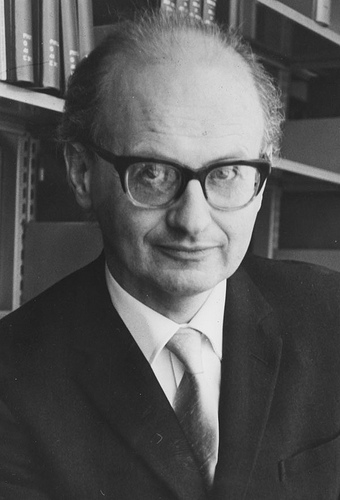
                                  The pugnacious Feyerabend, ready to spar intellectually with all-comers.

He was officially a Professor at Berkeley from 1958 to 1989, when he left Unistat with a woman who'd seen him give a talk; both had been rattled by the 1989 San Francisco earthquake and it was time to leave.

A brief bracketed tangent on sources and "facts":
[The seemingly requisite Wiki article (I include links to Wikipedia because, while hit and miss, the entries are sometimes detailed and quite fine, and, if not, they at least give a few stats and links.) is here.]

[The always top-notch Stanford Encyclopedia of Philosophy entry, should you choose to accept reading it, is here. If you happen to read Wiki and/or Stanford or some other linked source and something is at odds with what I say in the blog, so much the better, as one of my aims is to impart some learned cognitive dissonance and spur you to your own exertions. That's what I want from my reading; I will assume my Ideal Reader as being somewhat akin to myself. - the OG]

Among a handful of books (less than 15 but more than 7) that I regularly delve into that are about the sociology of knowledge, Feyerabend's Against Method is one. What a bold and entertaining intellectual!

                            Imre Lakatos, Hungarian Popperian whose sense of humor Feyerabend greatly appreciated

It was supposed to be called For and Against Method, a collaborative work with his equally brilliant and dear friend Imre Lakatos (say "LAK-uh-tosh"), who was a disciple of Sir Karl Raimund Popper, and had developed Popper's ideas about rationality in science in novel ways. Feyerabend says that Lakatos told him, "You have such strange ideas. Why don't you write them down?," and Feyerabend suggested they pit each other's ideas about the scientific method (which Paul thought was a fiction) against one another in a book, possibly as an exchange of letters. But Imre died in 1974, shortly before the first edition of Paul's writings on the topic came out.

Basically: Feyerabend said that, contrary to secondary school stories, in fact scientists have tinkered and bumbled and stumbled and used innumerable quirky methods in order to make their breakthroughs. And after tinkering enough, happy accidents occur. The Francis Bacon story about empiricism just doesn't really fly. Science as an endeavor is far messier than the textbooks make it out. Are there many scientists who themselves buy into the mythos of "the scientific method" and try to work along those lines? Yes, there are: but the results seem pretty sketchy. At best the narrative of "the" method cashes out at a lot less than you'd think. And different sciences have different approaches. And it's far, far, far more of a social endeavor than ever. And the sophisticated gadgetry and measuring devices increasingly lead to computer modeling and statistical analysis. And...well, you get the picture.

For enthusiasts of the sociology of knowledge, the sociology of science, and maverick anarchistic ideas in philosophy, I consider Against Method a must-read, and I'll try to highlight a few reasons why...

Oh, but first: I wrote on David Kaiser's recent book How The Hippies Saved Physics here. And Kaiser's cogent ideas about the structural reasons for physicists' unemployment in the 1970s should hold sway, but I would like to point out that Feyerabend was one powerful thinker around Berkeley throughout this period, and he had some ideas that may have gotten into the air and then the minds of the Berkeley hippie physicists. In his 1987 preface to the 3rd edition of Against Method, he says:

"None of the ideas that underlie my argument is new. My interpretation of scientific knowledge, for example, was a triviality for physicists like Mach, Boltzmann, Einstein and Bohr. But the ideas of these great thinkers were distorted beyond recognition by the rodents of neopositivism and the competing rodents of the church of critical rationalism. Lakatos was, after Kuhn, one of the few thinkers who noticed the discrepancy and tried to eliminate it by means of a complex and very interesting theory of rationality. I don't think he has succeeded in this. But the attempt was worth the effort; it has led to interesting results in the history of science and to new insights into the limits of reason."

Feyerabend was always against the "shut up and do your math" mantra with which physicists were inculcated during and after WWII in Unistat. (He also became friends with David Bohm, who influenced his thinking on quantum mechanics. Bohm also influenced the Berkeley hippie physicists.)
-----------------------------------------
Feyerabend noted that Thomas Kuhn had become duly famous and influential, but was preceded by John Stuart Mill and Niels Bohr in his line of thought. For Mill, see the passage on p.31 of the 3rd ed; Feyerabend quotes from Mill's Autobiography and it reads like proto-Kuhn...from a book published in 1873!
----------------------------------------
He does something I like a lot, a throwback: he includes an "Analytical Index" at he beginning of his book, which summarizes the basic argument in every chapter. I've seen this in many olde pre-20th century books and always found this rhetorical flourish charming. For Chapter 3, we read this statement, which is one the first hooks he got into me:

"There is no idea, however ancient and absurd, that is not capable of improving our knowledge. The whole history of thought is absorbed into science and is used for improving every single theory. Nor is political interference rejected. It may be needed to overcome the chauvinism of science that resists alternatives to the status quo." And then he elaborates in the chapter. This seems like a world turned upside down to many of us in Unistat in 2011: we would rather political ideas stay out of science, as the State-Military-Industrial-Corporate-Entertainment Complex seems to be doing us in, slowly.

But Feyerabend has, ultimately, a longue duree in mind. He agrees in the separation of Church (in this he considers not only the Churches, but rationalists, secular humanists and Marxist ideologies as "religious" and interfering!) and State, but he also - and this blew me away when I first encountered it - thinks "democratic societies must be protected from science." Dig this epistemological wildness and weirdness:

"This does not mean scientists cannot profit from a philosophical education and that humanity has not and never will profit from the sciences. However, the profits should not be imposed; they should be examined and freely accepted by the parties of the exchange. In a democracy scientific institutions, research programmes, and suggestions must therefore be subject to public control [NB: recent concerns over nanoparticles, not to mention animal testing and those little things called "nuclear weapons" - the OG], there must be a separation between state and science just as there is a separation between state and religious institutions, and science should be taught as one view among many and not the one and only road to truth and reality. There is nothing in the nature of science that excludes such institutional arrangements or shows that they are liable to lead to disaster."

Oh wow! I've already gone on too long, but you must read him to understand where he's coming from here, especially with that bombshell of a statement of "one view among many." To quote Mr. X from the movie JFK, "You may think you know what's going on..." (Oh wait: wasn't that Noah Cross in Chinatown?)
---------------------------------------------------------
Feyerabend, who grew up in Nazi-controlled Vienna and fought for the Germans in WWII, wrote a surpassingly readable autobiography just before he died. Even though it's written by a philosopher of science, it's the sort of under-300 page book that any intelligent person can read for fun, and contains frank passages on his very active sex life (even though he was shot during the war, the bullet lodging near his spine, leaving him impotent for the rest of his life...he married four times and had many affairs!) and lurid anecdotes about Popper, Lakatos, and even the eminent philosophy professor John Searle, a longtime colleague at Berkeley. It's title is Killing Time, and is a play on Feyerabend's name, which in German means "work-free time" or "after work."
---------------------------------------------------------
Finally, Paul was much-misunderstood - after reading his autobiography I'm not sure if he understood himself, emotionally, all that well - and he fed into this by his frequent changes of mind (any intelligent being "flip-flops" when they encounter new knowledge; it's part of a survival mechanism, something the Republican Party in Unistat seems to know NOTHING about), and Paul liked to say provocative things. But some seem to deliberately misread him. Here's an article from the National Catholic Register that seeks to defend Pope "Rats" Ratzinger in his "science ain't everything" screed of not long ago. Yes, "Rats" and Paul were both concerned about science run amok, but Feyerabend would vehemently distance himself from such an Authoritarian schmuck as the mitered infallible Pope-man, He who wears a dress and speaks on behalf of Gee Oh Dee. Oh, well...
---------------------------------------------------
While I don't agree with Feyerabend on everything - far from it - he was, to me, an overwhelmingly interesting thinker and personality. Sombunall readers of Robert Anton Wilson's book The New Inquisition: Irrational Rationalism and the Citadel of Science might find they generate an abundance of dialectical sparks when they rub that book against Against Method. Just sayin'.