Overweening Generalist

Showing posts with label CIA. Show all posts

Friday, July 15, 2016

Gary Webb, Philip Marlowe, Robert Anton Wilson and Chapel Perilous

Investigative Journalists
I finally caught, on Netflix, Spotlight, this generation's All The President's Men. I had coincidentally been thinking a lot about investigative journalism and journalists and was moved by the story. And how could one not be?

The "Spotlight" group of investigative reporters at the Boston Globe were in the belly of the beast of Catholicism in Unistat. Their footwork, tenacity and courage has seemed to actuate some real change in what seems like an endless run of pedophile priests, with cover-ups going all the way to the Vatican.

The Film Noir Detective Hero
But they were a team, backed by a major metropolitan daily. Woodward and Bernstein: two guys backed by the Washington Post. Still: when I look at ballsy investigative reporting, I keep thinking of some of my favorite characters in my favorite film style: film noir, which flourished in Unistat from 1941-1959, but has never gone away. Some of those films feature the lone private detective who gets hired to do a seemingly simple seedy gig, like finding out if a spouse is cheating. But one thing leads to another, and the detective (Chandler's Philip Marlowe is the best example) finds himself up to his ears in a bigger mystery. Things are not what he thought they were, and he's in great danger.

He's not being paid to solve this big conspiracy - much less report on it for a major newspaper - but he can't help himself: he's the Lone Knight in search of the truth. He takes risks, travels in the labyrinth of The City from the poorest neighborhood to the wealthiest enclaves, trying to piece things together.  Everyone, it seems, is lying to him. But why? He needs to know. He will eventually get knocked out, shot at, drugged, and punched in the solar plexus by hulking meathead gangsters.

He will come out alive, but with the gnosis. The myth of the private detective in films noir: he's a free agent, not well-off, lives by his wits and instinct and street-smart intellect and knows how to talk his way out of a jam and into more knowledge of the situation.

The noir detective drinks, loves beautiful women, and is obviously flawed, and he's no hypocrite. He seems like a profane character, but he's a mostly a man of honor who hates bullshit, who cares about justice in a world that only pays lip service to the idea. In a hopelessly corrupt metropolis, he keeps his integrity. And observes.

It's been noted many times that the Marlowe-type detective harkens back to the Knights of the Grail legends. Which brings us to Chapel Perilous.


Chapel Perilous
I had come across this term when I first tried reading T.S. Eliot's The Wasteland in my early twenties. I didn't follow up on the footnote in the section "What the Thunder said," which tells us to consult "Miss Weston's book." I have since made a study of Jessie Weston's 1919 work of brilliant scholarship, From Ritual to Romance, which studies the Grail legends from primary sources. There are very many variations on Chapel Perilous, with interpolations by later writers. Weston's penultimate chapter covers a few of the versions that involve Chapel Perilous, with Sir Lancelot starring, or sometimes Sir Gawain, and even King Arthur appears.

A generic version of Chapel Perilous: the Knight is riding alone in the forest when a violent storm hits. He finds a chapel in a clearing, often near a cemetery. He'll take refuge from the storm there. He goes in and no one is there, except for a dead knight on the altar, with one long candle lit nearby. There is a window behind and above the altar. Suddenly a Black Hand extinguishes the candle and chapel-shakingly loud haunting voices are heard. The Black Hand looks evil and hideous. Maybe the Knight engages the Black Hand with his sword, and barely makes it out alive.

My favorite version in Weston: King Arthur has fallen off his game: he's a slob and is at risk of losing all fame and prestige he once had. His wife urges him to trek out to the Chapel of St. Austin, which is a very dangerous journey, but may be just the thing to restore Arthur's reputation. He will take with him a young squire, son of (get this) Yvain the Bastard. The squire's name is Chaus. Chaus is like myself: if I have a very exciting and unusual thing to do the next day, I sleep fitfully in anticipatory anxiety.

Chaus decides to sleep in his clothes in the hall, to be ready to roll at daybreak with Arthur. He doesn't want to screw this up. He falls asleep, and then it appears King Arthur has already wakened and left on the journey without him. He immediately jumps up and rushes to his horse, trying to follow the tracks of Arthur's horse. Chaus happens upon a chapel in a glade, near a churchyard. He enters the chapel, but there's no one there, only a dead knight on the altar. There are golden candlesticks burning at the dead knight's head and foot. He takes one of the candlesticks and jams it into one pant-leg, mounts his horse, and goes off searching for Arthur.

Chaus then meets on the road a dark, foul man with a double-edged knife. Chaus asks him, "Have you seen Arthur?" The man says no, but I've met you and you're a thief! You stole that golden candlestick! You're also a traitor. Give me the candlestick! Chaus refuses and the dark man stabs Chaus in the side. Chaus cries out...and then awakens: he'd been asleep in the hall the whole time, yet he has the candlestick and he's been stabbed! Chaus, bleeding out, tells his story, confesses, receives the last rites, and dies.

Weston, after relating many variations of this story, asks what could it all mean? And she's convinced that it is "The story of an initiation (or perhaps it would be more correct to say the test of fitness for an initiation) carried out on the astral plane, and reacting with fatal results upon the physical." (italics in original, pp. 171-172 of the Dover ed.)

Robert Anton Wilson and Chapel Perilous
Robert Anton Wilson uses "Chapel Perilous" as an unforgettable metaphor in his autobiographical book, Cosmic Trigger vol 1 (1977). RAW told Sander Wolff in an interview in 1990 that the "whole book is an account of self-induced brain change." Self-experimentalists and Quantified Self-ies: are you aware that the heritage of your endeavor(s) is brimming with a history of daring, intrepid self-experimentalists like RAW? (I also find Scott Michaelson's take on RAW's self-experimentation compelling: that it was a synthesis of Aleister Crowley and modern neuroscience.) (See Portable Darkness, jacket sleeve, inside cover.)

As I write, there is a group reading of Cosmic Trigger vol 1 going on over at RAWIllumination.net, and if you're reading this at a later date, look for the archives of the reading and the scads of insightful comments and leave your own comments from your reading there, as I sense this is a case in which a "mere blog" will offer up many a nugget for future researchers...

Back to Wilson's take on Chapel Perilous as metaphor:

When researching occult conspiracies, one eventually faces a crossroad of mythic proportions (called Chapel Perilous in the trade). You come out the other side either a stone paranoid or an agnostic; there is no third way. (p. 6, CT1) Wilson describes Chapel Perilous as a mind-state that, while undetectable by any instruments, certainly seems all-too real to the person who finds herself in it. Comparing Chapel Perilous to the human Ego, "once you're inside it, there doesn't seem to be any way to get out again, until you suddenly discover that it has been brought into existence by thought and does not exist outside thought." (p.6)

In reading of Wilson's determination to push his nervous system as far as it can go before it breaks (delving into ceremonial magick, psychedelic drugs, various forms of yoga, a deep research into conspiracy theories, even some investigative reporting on his own, etc, etc, etc...) he finds himself the psychologically functional equivalent of the Knight, alone in the isolated Chapel, with a dead knight before him on the altar, and then the otherworldly Black Hand appears...

What does he do? Read the book!

                                                Gary Webb, investigative reporter

Gary Webb
If you don't know who the reporters/investigators I'm talking about here, you really ought to look into their cases for yourself. (See Michael Hastings and Danny Casolaro too?) There are far too many (luminous) details and I suspect at least half of my readers are familiar with these figures anyway. So I'll try to make it brief: Gary Webb got a line on how the CIA was allowing crack cocaine to flood the streets of Los Angeles, in order to fund their covert war against the socialist Sandinista government in Nicaragua. Few believed him, but he was smart, with boundless energy, and he produced a series of reports for the small San Jose Mercury-News that made national headlines. Then, the CIA, with a deplorable amount of help from the Washington Post, New York Times, and Los Angeles Times - the reasons seem complicated: they resented being scooped by a relatively small-town paper and some liked the access the CIA allowed them? - Webb quickly went from award-winner to having his own editor and staff gutlessly retract most of Webb's work. There is much to be learned here, my friends, and it's not for the faint of heart.

Perhaps "mendacious" is too strong a word for these big-time journalists and editors, who, taking the CIA's idea an running with it, decided that Webb's work was shoddy and stoked the fears of an already "conspiracy-theory"- minded African American readership. Webb's own paper took him off the investigation beat and he eventually quit, pursued the story alone, but ended up dead in his hotel room eight years after his breakthrough reporting, with two bullet holes in his head from a .38

I read a lot of the full-frontal assault on Webb in the Big Newspapers. One thing that really troubles me (to this day) is that, apparently, we're not supposed to know that the CIA has been involved with gangsters and thugs and drug smuggling since...before they were even called the CIA! Don't reporters go to the library and read the astonishingly well-documented Politics of Heroin in Southeast Asia, by Alfred McCoy? How did you miss not reading about the OSS/CIA and their deal with Lucky Luciano and the Mob, the democratic elections in Italy, and the French Connection that flooded the streets of major Unistat cities with heroin?

Another galling thing: many of the "reporters" on the big-city dailies who attacked Webb for stoking conspiracy theories in black communities? Many of them were black themselves. I tracked down a handful and emailed them, politely asking if they've changed their mind about Gary Webb (who turns out to have been right about almost everything, of course). Only one wrote back: Donna Britt, who wrote in the WA Post that the whole CIA/crack cocaine-contra connection "just may not have happened." But still, paranoid cases will go on thinking their conspiracy thoughts. "They know the truth, or one truth anyway: It doesn't matter whether [Webb's "Dark Alliance" series - OG] claims are 'proved' true. To some folks - graduates of Watergate, Iran-Contra, and FBI harassment of Malcolm X and Martin Luther King Jr - they feel so true that even if they're refuted, they'll still be fact to them." (Donna Britt, Washington Post "Finding the Truest Truth," Oct 4, 1996)

Here's what she said in her email to me:

Thanks for your note. The fact is that I honestly don't recall what I wrote about him. That was a long time ago! Sorry to disappoint.....


The boundaries are imaginary. The rules are made up. The limits don't exist....


Apparently she's a book-author now. HERE is her website.

When I think of Gary Webb, I think of his own Chapel Perilous. But: was it brought into existence by thought alone? I think there was more to his. I think Webb's Chapel Perilous somehow has something to do with us.

Other Sources Consulted:
Kill The Messenger: How the CIA's Crack-Cocaine Controversy Destroyed Gary Webb, Nick Schou.

Kill The Messenger (2014 film starring Jeremy Renner as Webb: trailer)

Dark Alliance: The CIA, the Contras, and the Crack-Cocaine Explosion, by Gary Webb

"Managing a Nightmare: How the CIA Watched Over the Destruction of Gary Webb," by Ryan Devereaux, The Intercept

Censored 2016: chapter 7, "Dark Alliance: The Controversy and the Legacy, Twenty Years On," by Brian Covert, pp.227-253

Murder, My Sweet (1944 Edward Dmytryk) with Dick Powell as Marlowe
The Big Sleep (1946 Howard Hawks) with Humphrey Bogart as Marlowe
Lady in the Lake (1947 Robert Montgomery) with Montgomery as Marlowe
Long Goodbye (1973 Robert Altman) with Elliot Gould as Marlowe
Farewell, My Lovely (1975 Dick Richards) with Robert Mitchum as Marlowe
Chinatown (1974 Roman Polanski) with Jack Nicholson as Jake Gittes


                                           I personally posed for this photo. The book was
                                           artist Bob Campbell's idea. In reality, the number
                                           of arms is slightly exaggerated.


Friday, May 27, 2016

On Hillary Clinton's UFOlogy

Since last December I've noted that Hillary Rodham Clinton (henceforth: HRC) has been openly talking about how she'd like to "get to the bottom" of what the Unistat gummint knows about UFOs/aliens.

Call me cynical (What? In this election cycle? Golly!), but I immediately thought of the neo-Machiavellian political theories of guys like Alastair Smith and Bruce Bueno de Mesquita, and their Dictator's Handbook: Why Bad Behavior Is Almost Always Good Politics from 2012: even in a democracy you need enough coalitions of support from the "selectorate" in order to win; you may be yanking other coalition's chains, but you need as many voting blocs of special interests as possible. The ones with money who helped you get elected matter most to you, and if you yank their chains the wrong way, you're cooked.

I thought, "Well, she's going for the X-Files-obsessed vote here." Cynical! (Of me and/or HRC.)


Then I continued to follow HRC and her UFO talk, and I went back and researched a bit to see how phony HRC might be on this subject. It gets complicated. Which is how I like it.

While Donald Trump trots out around one conspiracy theory per day lately: Vincent Foster was killed by the Clintons; Obama may still be a secret Muslim; Scalia was murdered and it was covered up; vaccines cause autism; many thousands of muslims were seen celebrating in New Jersey on 9/11/01; Ted Cruz's father had a hand in the JFK hit; Bill Clinton has sexually "assaulted" several women, etc...he's clearly going for the Nutjob vote, which I think he already had sewn up a long time ago.

I'd say, "Maybe time to dial it back a bit, Donny," but he'd probably have his goons haul me out of the room, telling said goons to "Knock the crap out of him. I'll pay your legal fees." (Ladies and germs: the future President of Unistat!)

I figured HRC needed to tap into the quasi-religious and conspiracist idea that the Unistat gov still has classified files about aliens. That's probably a sizable voting bloc, eh? (The voters, not the aliens.)

It turns out she seems to have been genuinely interested in UFOs (she corrected Jimmy Kimmel on his show earlier this year: the scientific, evidence-based community prefer UAPs [Unidentified Aerial Phenomena]), which greatly - apparently? - impressed the ardent UFO-philes out there. HRC met with Laurence Rockefeller  in 1995, at his Wyoming ranch. She was photographed with serious physicist Paul Davies's book Are We Alone?

(Coincidentally, Davies very recently wrote an article for Scientific American that posits maybe life in the universe is exceedingly rare, afterall...assumptions that there must be life seeded all over this universe - the one you're probably in right now - seem unwarranted...is Davies trying to distance himself from HRC? Wheels within wheels...)

Longtime Clinton operative John Podesta is an X-Files aficionado and has talked about getting the files declassified, asserting recently that "There are still classified files that could be declassified." (Maybe it depends on what the term "are" means?)

Kimmel told HRC that he'd asked her husband and Obama about the UFOs and they didn't find anything. Hillary: "Well I'm going to do it again." Great, because it's not like the economy needs fixing or anything. Go for it, Hills-y baby! (Obama has treated questions about UFOs as a joke.)

So, while Bill was Prez 1993-2000, they weren't able to "get to the bottom of it"? Why? Maybe lots of stuff has happened since then? Who knows...Let's try to keep an open mind here. Let's keep digging...


I stumbled on to an article about former Prez Gerald Ford, who, as a Michigan Congressman in 1966, responded to UFO sightings over Michigan by calling for a Congressional Hearing. He didn't get the hearing, and seems to have taken his constituents' fears seriously (this was only five years after the Cuban Missile Crisis, Cold War in full swing, UFOs not the humorous Thing they are now), but Ford did get a long report on UFO sightings from the U. of Colorado and Project Blue Book, which ran from 1947-1969. This report considered 12,618 UFO sightings, all explained as weather balloons, atmospheric phenomena, or classified test flights, and a few other things. 701 sightings were still inconclusive.

The conspiracy-minded will want me to mention that Ford was on the Warren Commission. Done. Anyway...

Oh yea: Project Blue Book? Recently, the CIA tweeted that all those UFO sightings in the 1950s and '60s? It was them! I mean...not THEM-them, but the CIA. Which is "them" enough for me. Yea, verily the CIA asserts they were covering up their very high-flying U-2 Program, 1954-74. So, a branch of the Unistat government withheld evidence from a future US President and anyone else who might be interested in what the hell was going on with odd things in the sky. The cads! Those...bounders have done it again!

'Cuz, "national security," of course. If you read the article, professional "skeptic" and debunker Robert Sheaffer is calling bullshit on the CIA here. O! sooo rich! So meaty! Sheaffer once accused Robert Anton Wilson of "malicious, misguided fanaticism." (Personally, I prefer the properly "guided" fanaticism, but that's just me.) Sheaffer is long-suffering. In 1990, he charged the novelist Wilson as one who "attacks language and thought" the way a "terrorist attacks"...and to add insult, Wilson seems to have enjoyed a hearty belly-laugh over what he did as a writer of satire. Horrible!

To be honest, why are you even reading what some dipshit blogger like the OG thinks about these ideas? Clearly: Robert Sheaffer is the go-to Grand Poo-Bah of all things honest and capital tee Truth. What does Sheaffer think of HRC wanting to get to the bottom of the UFO/aliens thing?

HRC and her UFOlogy Sancho Panza, Podesta, just want transparency, evidence-based science, and the destigmatization of those who are interested in whether or not We Are Not Alone. The UFO/alien cohort (Sorry! Very snarky of me: the UAP/alien cohort) is an estimable one too: Stephen Bassett, who spends his time lobbying Congress on extraterrestrial/UFO issues? His organization has 2.5 million Twitter followers. That could put you over the top. (In November.)

December, 2015: HRC tells a New Hampshire reporter, "We may have been visited already." (Yes, and you may have already won the Publisher's Clearinghouse Sweepstakes of one million dollars cash!)

I like this line from HRC: "There's enough stories out there that I don't think everybody is just sitting in their kitchen making them up." Point well taken. They could be in the bathroom, or out by the swing-set near the wading pool. The possibilities seem well-nigh endless.

In 1996, Bob Woodward's book The Choice made fun of HRC (what a meanie!), seeming to ridicule her for having conversations with dead heroes of hers, like Gandhi and Eleanor Roosevelt.

In delving in some archives (Okay: I read about six short articles published in the last year) and re-visiting the Wm Jefferson Clinton years in Office, I was reminded that, indeed, the X-Files seemed to run alongside his term. And Independence Day did boffo box office. And HRC openly complained about a "vast right wing conspiracy" out to get her and Bill. (I think she had something tangible with that last bit of conspiracy thinking, but this was all pre 9/11/01; it was practically Leave It To Beaver time compared to what we're looking at now.)

And you know what? Even though I confess I'm not a HRC fan - not by a longshot - I do think she has some good points about her UFOlogizing. But it sounds better coming from the mouth of a higher-up who may as well be anonymous to me: a luminary named Christopher Mellon, a former Senate Intelligence Committee guy, former intel at the Dept of Defense: "It shouldn't be a source of embarrassment to discuss it. [UFOs/UAPs/aliens- OG] We should be humble in terms of recognizing the extreme limits of our own understanding of physics and the universe."

Amen to that, Mellon. (Can I borrow a $50-spot?)

So: I've rambled fairly incoherently through this blogspew, and I have no excuse save for I'm stoned on some uber-dank OG Fire and trying to laff my way into November. I've considered my alternatives, and laffing seems the best.

Two more tangential points to make, and then I promise I'll be more sober for the next installment of the OG:

1. Blogger Justin Raimondo thinks Trump is a "false flag" candidate. Or at least as of last July Raimondo thought this. He says that just before Trump got into the Republican race he was trying to help his friend, Hillary Rodham Clinton. How else do you describe the sheer INSANITY of Trump's gambits so far? (Note the date Raimondo wrote this. What does he think now? No seriously: what does he think? Anyone know? I'm too stoned to Bing it.) And what do YOU think of this idea? I mean: consider the implications. Have you read Baudrillard on the Simulacrum? Is it time to resume your studies of the deep structure in The Matrix films?

Which leads me to Noam Chomsky, who recently said a Trump Prez is basically a "death warrant" for humanity and the planet. Noam the Subtle. (I confess I'd rather he was wrong on this one, if for no other reason than my overweening bias towards humanity not dying on a burned-up, uninhabitable planet.) So yea...

2. In Chomsky's 2007 book, What We Say Goes: Conversations on US Power in a Changing World: Interviews With David Barsamian, Noam says this:

A couple of years ago I came across a Pentagon document that was about declassification procedures. Among other things, it proposed that the government should periodically declassify information about the Kennedy assassination. Let people trace whether Kennedy was killed by the mafia, so activists will go off on a wild goose chase instead of pursuing real problems or getting organized. It wouldn't shock me if thirty years from now we discover in a declassified record that the 9/11 industry was also being fed by the administration. -pp.39-40

So, I end with epistemology down the rabbit hole: Chomsky bristles when you say he's a "conspiracy theorist." He does "institutional analysis." (He does it really well, methinks.) BUT: If the JFK hit is the great conspiracy - or at least in your Top Five - Chomsky seems to be saying here that the government has been engaged in a conspiracy to mislead people into thinking that the government conspires to mislead people.

Let this sink in.

Or not.

Does Chomsky make a valid point here? A sound one?

See you on the Other Side of the Looking Glass.

Some Other Reading I Did Before I Bloviated; Lots of the Quoted Material Is Found Here:
"Hillary Clinton Is Serious About UFOs," by AJ Vicens, Mother Jones, 25 March, 2016

"Hillary Clinton Gives UFO Buffs Hope She Will Open the X-Files," by Amy Chozick, New York Times, 10 May 2016

"What Hillary Clinton Says About Aliens Is Totally Misguided," by Natalie Drake, National Geographic, 11 May 2016

"A Guide to the Many Conspiracy Theories Donald Trump Has Embraced," by Brett Neely, NPR, 24 May 2016

"Welsh Government Uses Klingon to Respond to Serious UFO Questions," by Sebastian Anthony, Ars Technica, 12 July 2015

"The Government Tested a Flying Saucer in 1956. Here's the Full Report," by Rebecca Onion, Slate, 11 July 2013

June 1962 issue of Paul Krassner's The Realist: Krassner reported that UFOs were really diaphragms dropped by nuns on their ascent to heaven.

"NASA Preps Real Flying Saucer For Takeoff," by Amanda Kooser, CNET, 19 May 2014

"US Secretly Run by Nazi Space Aliens, Says Iranian News Agency"

"Alien Nation: Have Humans Been Abducted By Extraterrestials?," by Ralph Blumenthal, Vanity Fair, 10 May 2013 (Robert Redford planned a film about heretic Harvard psychologist John Mack)

OG here: Just a thought: why worry about possible Extraterrestrial Intelligence "visiting" us, when we already have yellow slime-mold intelligence, a jellyfish takeover in the making, and thousands of asteroids that can wipe us out?  And nota quite bene I'm not even mentioning the antibiotic apocalypse, runaway global warming, AI singularity Worst Case scenarios, or the Trump Presidency.

Have a fine day!


                                           אמנות על ידי בוב קמפבל

Friday, April 29, 2016

World Book Day/Night 2016

[Apparently World Book Night came again this year, and I was busy doing other things, totally oblivious. Yesterday I logged on to "surf the Net" - which fogies like me still say, by the way - and kept noticing all these new articles about Shakespeare and wondered, "wha?" Then it hit me: World Book Day/Night was April 23rd, so here I am, a mere six days late. - OG]

Fore-Words: Set the Tone
Here's part of a dialogue between Bill Moyers and Joseph Campbell:

Moyers: Who interprets the divinity inherent in nature for us today? Who are our shamans? Who interprets unseen things for us?

Campbell: It is the function of the artist to do this. The artist is the one who communicates myth for today. But he has to be an artist who understands mythology and humanity and isn't simply a sociologist with a program for you.

Moyers: What about those others who are ordinary, those who are not poets or artists, or who have not had a transcendent ecstasy? How do we know of these things?

Campbell: I'll tell you a way, a very nice way. Sit in a room and read - and read and read. And read the right books by the right people. Your mind is brought onto that level, and you have a nice, mild, slow-burning rapture all the time. This realization of life can be a constant realization in your living. When you find an author who really grabs you, read everything he has done. Don't say, "Oh, I want to know what So-and-so did" - and don't bother at all with the best-seller list. Just read what this one author has to give you. And then you can go read what he had read. And the world opens up in a way that is consistent with a certain point of view. -  The Power of Myth, p.99
=====================================


Short Note on Books and Revolutions
My writing on the visceral thrill I get from reading "forbidden" or "dangerous" books, books with some purported "demonic" power, books linked to infamous crimes, etcetera, has appeared at this blog and in other places. Currently I've been reading in books about other books on the topic of what books can/might/did "do" to certain readers, and, oh, all kinds of fallout in human history. For those who want to look at some choice academic research quite readable about books and revolutions, two that I've recently found of surpassing interest are Robert Darnton's The Forbidden Best-Sellers of Pre-Revolutionary France, and John V. Fleming's The Anti-Communist Manifestos: Four Books That Shaped the Cold War.

Darnton - one of the great scholars of books in our time - breaks down the forbidden best-sellers during the 20 year period before the ancien regime turned to guillotine-time (a much different time than the time Joseph Campbell warned us about; I tend to agree with Campbell about best-sellers under the current dispensation); Darnton's sleuthing is marvelous, teasing out the many "underground" forbidden books from roughly 1769 or so to 1789. These books get classified into three categories: 1.) "Philosophical Pornography"; 2.) Utopian Fantasy; and 3.) Political Slander. Darnton writes a chapter on each. Later, Section 3 of Darnton is titled, "Do Books Cause Revolutions?" and this section constitutes a marvelous contribution to the sociology of knowledge.

Fleming writes at length about four books that influenced the Cold War: Koestler's Darkness At Noon (1940), which was the only one of the four I'd been familiar with. The others are Out of the Night (1941, but really only a few weeks after Koestler's book came out), by "Jan Valtin" AKA Richard Krebs, a supposed autobiography and the best-seller in Unistat by the end of the year; I Chose Freedom, by Victor Kravchenko (1944). The last anti-commie book for Fleming was one I'd known of, but that was the extent: Whittaker Chambers's Witness (1952), which Fleming calls "perhaps the greatest American masterpiece of literary anti-Communism," and a book which greatly benefited by the Cold War being then in full swing, and even more so by Chambers's nailing of Alger Hiss. At the end of last year I read a cracking good just-off-the-presses book about the history of today's Unistat right wing, Right Out of California, by UC Davis History professor Kathryn Olmstead. That book - which argues persuasively that the origin of the Unistat Right began in Depression Era California, where the migrant farmworkers were not considered under The New Deal, because FDR needed the South - foreshadowed a lot of the information in Fleming's book, and extended the boundaries of my own historical imagination vis a vis the refinement of propaganda techniques by Unistat spy agencies and the military/industrial/entertainment complex. Juxtaposing Fleming's book on mid-20th century political books that the State "likes" vs. the underground sales of books forbidden by the State in Darnton made me feel like 1789 was more like 500 years ago.

Darnton and Fleming and Olmstead (oh my!) also reminded me of Frances Stonor Saunders's must-read, The Cultural Cold War. Get a load of this:

"'Books differ from all other propaganda media,' wrote a chief of the CIA's Covert Action Staff, 'primarily because one single book can significantly change the reader's attitude and action to an extent unmatched by the impact of any other single medium [such as to] make books the most important weapon of strategic (long-range) propaganda.' The CIA's clandestine books programme was run, according to the same source, with the following aims in mind: 'Get books published or distributed abroad without revealing any US influence, by covertly subsidizing foreign publications or booksellers. Get books published which should not be 'contaminated' by any overt tie-in with the US government, especially if the position of the author is 'delicate.' Get books published for operational reasons, regardless of commercial viability. Initiate and subsidize indigenous national or international organizations for book publishing or distributing purposes. Stimulate the writing of politically significant books by unknown foreign authors - either by directly subsidizing the author, if covert contact is feasible, or indirectly, through literary agents or publishers." -p.245, Saunders, who is quoting from the Final Report of the Church Committee, 1976. Saunders quotes a NYT article published on Christmas Day, 1977, about the investigations into the CIA's history: "The New York Times alleged in 1977 that the CIA had been involved in the publication of at least a thousand books."

When I first read Saunders, I noted a CIA-backed book I had read that no one I personally knew had read. And I'd liked the book: The New Class, by Milovan Djilas. E. Howard Hunt, working for the CIA admitted he helped get that book published. Was I a dupe? I guess any one of us who reads books at this level will be reading "propaganda" at some point, unwittingly, or possibly quasi-wittingly. Chomsky has written many times that the intellectual class is most subject to this sort of thing, simply because they read so damned much...So there's another reason to embrace those rebel writers you love, the outre and declasse ones that never get reviewed by the New York intellectuals?

To return to our Big Q: do books cause revolutions? I'd like to think so. My oblivious reading of Djilas's CIA-backed book led me to read a wonderful book by the renegade "outlaw Marxist" Alvin Gouldner, and his The Future of Intellectuals and the Rise of the New Class. Gouldner turned Socrates and interrogated Marxism from within, walking the perimeter of "the dark side of the Dialectic," which I still find thrilling. I find the intellectual stimulation so bracing I return to this slim volume every few years. In it, Gouldner says that Marxism is a product of bookstores and libraries.
========================================


Thirdly, and really a bald non-sequitur, I will state a personal strong esthetic preference for reading "dead tree" books over reading them on any digital gadget, and that replacing paper books with e-books is - and I'm not the first to float this analogy - like replacing real cut flowers with plastic ones.

Dead Tree Books, Despite the Peril of Paper
Oh, okay yes: the "real" cut flowers will wither in a week or so, while your plastic flowers look the same year after year, so there's gotta be something wrong with this analogy. But I will throw in a monkeywrench and say that with cannabis and hemp legalization more publishers will probably want to use hemp for paper because it last many, many, many times longer than pulped paper.

And our diminishing world forests get a break. Lousy quality paper: have you ever picked up an old paperback novel produced in the 1950s at a yard or library sale? I've bought ones where the paper is increasingly sort of brownish-rusty near the edges, the paper itself has a rough fuzzy feel to it, and the pages are likely to break if you bend them. Lamentable books like this - even if you read 'em and they're great - are not the ones you'd give to someone else, "You've got to read this! It's fantastic!" Then you hand them the book and a couple of pages fall out, having detached from the spine during the apparently rough drive over, when you hit that pothole. Sad. What an overall lugubrious-evoking state of affairs, indeed.

40 years after a book rolls off the presses ready for the bookstore, it's literally disintegrating in your hands! (I first noted these books in the 1990s.)

In the bargain basement pulp paper era (BBPPE), which lasted into the 1980s, according to one source I probably just made up, publishers of paperbacks sought to save money by buying the cheapest pulp paper they could find, then "extend" this pulp by throwing in some acid.

No, that's cutting corners. It's more like this: when you use wood to make paper there's this stuff called lignin, which went into making the cell walls of wood and bark and helped make up the vascular structures of a plant. This is odorless, mostly colorless, and I imagine fairly tasteless. (Ever get one of those old crappy paperbacks that actually have a big fleck of wood embedded in a page? This I count as one of those Things That Ought Not Be in my world.)

You get rid of the lignin when you're making the paper by adding acid, particularly something called peroxycetic acid. It's more complex than this (of course!), but adding the acid is part of the delignification process. We worry about old Ray Bradbury paperbacks - or at least I think we should -  but documents and artworks, if not delignified, will break down and deteriorate, and even faster if exposed to light and heat. And don't we do some of our best reading under light, with adequate heat? To get the pH level of your pulp back to something closer to the 7 of alkaline/acid balance, you need to go through another process or two, but that costs money. Just take the acid-riddled pulp and print that dimestore novel on that. Take the money and run...

To cut to a less technical aspect of this spiel, hemp has lower lignin content. If treated just right, it's fairly inexpensive to produce paper for books from hemp that will last 500 to 1000 years before it noticeably starts to deteriorate. Robert Anton Wilson cited an article in a February, 1938 issue of Popular Mechanics about a hemp harvesting machine that would make farmers rich and allow us all to have the most fantastic paper in our books, no cutting down forests either. The male (you don't get high off it) cannabis plant: hemp. Easy to grow. Here's RAW's bit:

"Well, kiddies, the wonderful invention was a device that made it possible to harvest hemp more cheaply than ever before. Hemp was the chief ingredient in paper throughout most of history (our Declaration of Independence was written on it, for instance) and paper made of hemp lasted a good long time compared to paper made of wood pulp. Ever notice how 19th or 18th century books, or even 17th century books like the original folio of Shakespeare's plays, printed on hemp, are still around, while modern books printed on wood pulp fall apart in only decades?"
-p.178, "Deforestation," Email To The Universe

Wilson then goes on to link this to the War on Drugs, including pot. The Unistat gummint found out people were getting high, so sorry: millions of lives must be ruined, forests chopped down, and books must fall apart. I wish I believed in "hell" so I could imagine someone like Harry Anslinger paying for his part in all this, but he's probably just food for worms.

The Good News: we have good reason to believe we'll get lots of hemp in our paper in our books, soon, the cultural winds finally having shifted. And I'm sorry, but we cannot extend the life of our cut flowers indefinitely, and I'm sure someone's working on it. (Then where will the florists be? Uber drivers? Oy!)

I love the story about Ts'ai Lun, who made paper out of hemp and mulberry bark and tried to convince the Chinese bureaucracy to adopt his invention, paper, in 105 CE. The stuffed shirts wouldn't give Ts'ai a decent hearing, so he pulled the old shamanic stunt of burying himself alive and then returning to the living. He used a hollow reed to breathe, and his friends burned a bunch of his hemp-paper over his grave, which caused Ts'ai Lun to miraculously come back to life. Quite a trick! The bureaucrats were impressed (jeez, the shit The Suits put you through before they'll listen to a new idea!), and his paper was adopted, and Ts'ai became a palace favorite. But political winds shifted after a spell, and Ts'ai faced a trial, which he wasn't up for. So, as Dale Pendell writes, Ts'ai Lun "dressed in his best robes and drank poison." - PharmakoPoeia, p.183

Coda: A Future?
So, we're all used to the print/dead tree/dead hemp plant "codex" book vs. the book read on some electronic gadget argument. Well, Google is working on a combination of the two, but as I read about it, I had mind's eye trouble: an "augmented reality" pop-up book that adds sound, lighting elements, and video projection? And it interacts with other personal information you had stored on your other e-gizmos? You can add content? I'm not sure if I understand what these visionaries want to do, but I guess there are some areas in all our lives and - I'll speak for myself here - I think I already add that stuff to my reading of the plain old paper-bound book. I do it in exercising my imagination. For what the wizards at Google and Apple want to do, I'll just watch a fucking movie, your mileage may vary. See the article I'm getting all reactionary over HERE. What am I missing?

On second thought: this could become the next great art medium, and you know what? I hope it does...

Adieu
I wish you all a Joseph Campbell-ian "nice, mild, slow-burning rapture all the time" in your reading, chums.

                                          fantasztikus grafikus Bob Campbell


Thursday, July 23, 2015

Sirius A, B and Maybe Even C Has Influenced Pop Culture...

...and some of us hope it will continue to. They have their ways.

There was a very strange musician from Europe who claimed to be from Sirius. He influenced Miles Davis, Jefferson Airplane, Frank Zappa, Grateful Dead, Kraftwerk, and many others. The Beatles were influenced by him. Look at your copy of Sgt Pepper's Lonely Hearts Club Band; he's on the cover, top row, fifth from the left, between Lenny Bruce and W.C. Fields. His name was Karlheinz Stockhausen. If you listen to his music (try THIS?), you may start to believe he really did emanate from the Dog Star system.

Clearly, the Airplane took what Sirius-born Stockhausen had to say in lectures at UC Davis...in some other way.

------------------------------------------------------

I just got through re-reading Carl Sagan's piece "White Dwarfs and Little Green Men," collected in his book Broca's Brain, and originally in August 1979 issue of Omni. Sagan was a marvelous popularizer of science and wrote with verve. I recommend the essay, because he tries to refute claims made by Robert K.G. Temple in his book The Sirius Mystery. The Dogon people of West Africa told anthropologists Griaule and Dieterlen scientifically factual things about Sirius that they could not possibly know, given their level of technology. Sagan does a fairly good job of persuading us that the Dogon had been "contaminated"with European scientific knowledge before Griaule and Dieterlen talked to them, and my favorite rhetorical ploy Sagan used in that essay (I wish I could find it online for you; you'll have to obtain the book) was anecdotes about other anthropologists who'd been taken in (for a spell) by remote tribesmen.

But I'm not entirely convinced by Sagan's debunking. See Temple's answers and refutations of Sagan's debunkery HERE.

I'm not convinced the Dogon were told, or had information passed down to them, by ancient fish-men-like astronauts, either. Maybe the 1893 French expedition to Central West Africa to witness the total eclipse of the sun on April 16th seeded the Dogon with some Sirius knowledge. Noah Brosch in Sirius Matters think this may be the case. But still, it seemed the Dogon knew too much. I remain agnostic, but very interested.

--------------------------------------------------

Temple's work is audacious and has kept the debunkers awake ever since his book appeared in 1976. Temple tried to link Sir Philip Sydney, the Knights Templars, Dr. John Dee, and Giordano Bruno together within an occult tradition that carries on to today. Temple got the Sirius idea to write a book because he'd been working with the helicopter inventor and scientific mystic Arthur Young, who may have hinted he'd been in contact with Higher Intelligence from Sirius. I don't know what to say about this, but Robert Anton Wilson's dear friend and co-writer of the Illuminatus! trilogy, Robert Shea, told Neal Wilgus that "It frequently helps an artist to imagine that the work he is creating has a separate life of its own and is being transmitted to him..." Shea then cited Stravinsky, Nabokov, Keats and Charles Rycroft. (Shea interview with Neal Wilgus, c. 1980, collected in Seven By Seven, a 1996 book, pp.43-44)

Robert Anton Wilson, Shea's friend, co-writer and co-conspirator, knew of RAW's exceedingly odd experience with (maybe) communication from Sirius, which started on July 23rd, 1973. As Wilson puts it, after many years of intense experimentation with yoga, psychedelic drugs, Crowleyan ceremonial magickal techniques, intense study of books dense, difficult and erudite, depth psychologies, non-Aristotelian logics, and a continued study of Alfred Korzybski's General Semantics, "The outstanding result was that I entered a belief system, from July 1973 until around October 1974, in which I was receiving telepathic messages from entities residing on a a planet of the double star Sirius." (Cosmic Trigger vol 1, p.8.)

As RAWphiles know, his previous grounding in scientific methods of doubt, Buddhistic doubt, Korzybskian linguistic doubt, and Niels Bohr's Copenhagen Interpretation of the quantum theory - among other systems of thought and practice - led him to posit many models of what had happened to him. Maybe he was being contacted telepathically by beings from near Sirius. But maybe he'd pushed his nervous system in a way few humans have, and this is the sort of oddness that happens. Maybe he'd reached a level of neurologic status which you just have to chalk up to cosmic hilarity. The key word here is maybe. 

-------------------------------------------------------------


At around this same period, fellow Californian science fiction writer Philip K. Dick began to have contact with an intelligent entity he called VALIS, an acronym for Vast Active Living Intelligence System. He too developed a welter of multi-perspectivalisms to explain this extreme weirdness. The scientist John Lilly seems to have had an equally uncanny experience - or series of them - around this time. His metaphors for superintelligent entities were the ECCO (Earth Coincidence Control Office) and SSI (Solid State Intelligence). Lilly's SSI reminds me a lot of VALIS, but there are differences, of course.


In 1971, the brothers McKenna had an experience so weird, so unheimlich that you really have to read about it for yourself - it involves intelligence from UFOs, among other Things - as chronicled in Terence McKenna's book True Hallucinations.

---------------------------------------------------------------

"World's Oldest Temple Built to Worship the Dog Star", from August 14, 2013 issue of New Scientist. Read it and make of it what you will.

--------------------------------------------------------------

The Great UFO Wave of 1973: "Well before Patty Hearst became the poster child for Stockholm Syndrome, hundreds of ordinary Americans were already experiencing their own versions of this syndrome in connection with visitations from outer space. In what became known as the Great UFO Wave of 1973, a series of sightings began in late summer and climaxed in October, ushering in a new era of official and public interest in UFOs, later commemorated by Steven Spielberg's 1977 film Close Encounters of the Third Kind." - 1973 Nervous Breakdown, Andreas Killen, p.133. Killen then cites "debunkers" who pointed out how bad things were going for Unistatians socially at the time: war broke out in the middle east (Israel-Palestine), and Kissinger put the nation on nuclear alert because the Soviets threatened to send troops to the conflict. Many in the press thought Nixon had gone mad. Then OPEC caused an artificial gas shortage, veep Agnew resigned over tax evasion charges, and talks about Nixon being impeached ramped up. "Arguing that people 'see things' as a reaction to social stress, several prominent psychologists suggested that the UFO wave was a predictable response to a month of particularly bad news." - ibid, p.134

Okay, so I think social stress may have an effect on human visual perception, but who reading this in 2015 (or later) thinks this is mostly yet another example of "experts" who are full of crap? Was there a massive wave of UFO sightings after 9/11? I don't think so. Anyway...
------------------------------------------

One reason why we might use the word "gnostic" to describe Stockhausen:

Five fingers. Four limbs. Two eyes. A brain. And a name, too: homo bipedus, sapiens, loquens. It is easy to describe man with the detachment of an inhabitant of Sirius. But the Gnostics did have this feeling that they came from Sirius, or rather from a world that was even farther away, stranger and still more puzzling, a world beyond Sirius. Perhaps this explains the alien and, above all, contemptuous view they took from our hominoform appearance, our anthropoid conformation, our condition as foetuses dropped prematurely into the deserts of the world, and therefore crying out unceasingly with the same howl of anguish that announced our arrival on earth. - The Gnostics, Jacques Lacarriere, p.34 in my hardcopy, but p.25 in the PDF linked to here)

-------------------------------------------

NB: Lilly, PKD, and the McKennas do not cite Sirius as the main deal. Also note: these writers, along with Robert Anton Wilson, are/were all imaginative people, steeped in science fiction, the hard sciences, logic, math, linguistics, and neuroscience, in addition to the history of esoteric thought. They all also used psychedelic drugs (and other drugs) in order to probe the deeper recesses of Mind.

Wilson wrote about LSD and the possibility that it opened up "noise" into the human nervous system. Writing in what appears to be pre-July 1973, he says that John Lilly thought he had been contacted by alien intelligences and that Wilson knew of other LSD users who'd had the same experience. (See Sex, Drugs and Magick, p.214) All I urge Dear Reader to do here is note the profusion of metaphors for odd experience. Noise, mathematically, is information that had been previously unintelligible to a given human nervous system. Noise represents something that was unexpected, and once it interfers with a person's ontology, it must be dealt with; interpretations must be made. As an analogy, in effort to illustrate this, The Reader is urged to obtain a copy of James Joyce's book Finnegans Wake and try to read it. It may seem very "noisy" but, with experience trying to make sense of it (reading it aloud, making notes about the phenomenology of the experience of reading it, using secondary sources, reading it in a group, etc), you may notice that what was previously noise now seems understandable and even psychedelic.

In the early 1970s, while all this was going on, Timothy Leary was in prison and developing his ideas for Starseed, which involved contact with Higher Intelligence.

                                      section of a Stockhausen score
--------------------------------------------------------

The OG has been using the term Higher Intelligence, but there might be other semantic senses of this term. I have seen very many articles and books that assert, like the true conspiracy of the CIA's MK-ULTRA program, that clandestine intelligence groups have been involved in this High Weirdness. (See for example, The Stargate Conspiracy, pp.282-287, esp. writer Lyall Watson's very bizarre experience in 1973 that supposedly came from some sort of Higher Intelligence of Black PsyOps, pp.218-219)

Indeed, Wilson knew all too well about these sorts of things, and was even accused by some counterculturalists as being a CIA man himself. Paranoia feeds on itself, and its ravenous hunger seemingly knows no bounds. RAW was circumspect enough to wonder if he had been what the CIA calls a "useful idiot."

RKG Temple himself has claimed that after he publication of The Sirius Mystery he'd been hounded by multiple governmental intelligence agencies. The skeptic here, Jason Colavito, says he has found no proof of Temple's assertion, but that intelligence agencies have investigated a more popular - and less scholarly - "ancient astronaut" writer, Erich Von Daniken.

Maybe Colavito is right. What's far more interesting to me is his book, The Cult of Alien Gods: H.P. Lovecraft and Extraterrestrial Pop Culture, published in 2005. I have not yet read this book, but the reviews look promising. RAW, PKD, the McKennas all had read Lovecraft.

Could it be that intelligence agencies followed anyone who proclaimed some metaphysical relationship with Sirius because that's what mystic/Christian fascist/all-time weirdo William Dudley Pelley had done? Just throwin' it out there...

------------------------------------------------------

In his "historical grammar of poetic myth," Robert Graves unpacks myth after myth, digging deeper and deeper and making us feel weirder and weirder. Graves's book The White Goddess has proven to function as a strange wind, blowing many minds, mine included.

There is an ancient story that includes a male roe deer called a roebuck, a short-billed bird called a lapwing, and...a dog. And various heroes. See if we can follow Graves here:

But why Dog? Why Roebuck? Why Lapwing?
The Dog with which Aesculapius is pictured, like the dog Anubis, the companion of Egyptian Thoth, and the dog which always attended Melkarth the Phoenician Hercules, is a symbol of the Underworld; also of the dog-priests, called Enariae, who attended the Great Goddess of the Eastern Mediterranean and indulged in sodomitic frenzies in the Dog days at the rising of the Dog-star, Sirius. But the poetic meaning of the Dog in the Cad Goddeu legend, as in all similar legends, is "Guard the Secret," the prime secret on which the sovereignty of a sacred king depended. Evidently Amathaon had seduced some priest of Bran - whether it was a homosexual priesthood I do not pretend to know - and won from him a secret which enabled Gwyndion to guess Bran's name correctly. Hercules overcame the Dog Cerberus by a narcotic cake which relaxed its vigilance; what means Anathaon used is not recorded.
-p.40

Okay, so Graves is fucking my mind here. There is much wild knowledge and obscure names of gods and goddesses and symbols that lead up to this paragraph, and lead onto many similar, that I confess pixillates me somewhat. Still: dog symbols guarding a secret? Sodomy and proto-Bill Cosby-like drug cakes are a fun addition. The erudition is staggering, the style bewitching. But the SECRETS!

Notice Thoth, the messenger-god of the Egyptians. He also gave them other little things, such as writing. Hermes is the Greek version. More than a couple Lovecraft scholars have identified Lovecraft's own Nyarlathotep in his Cthulhu mythos with those other two messenger gods.

What "is" the message?

I don't know. Neither did Robert Anton Wilson, but if you obtain a copy of Cosmic Trigger, vol 1 and study very very VERY closely pages 13-16, I think you might be onto the Final Secret of The Illuminati.

I said "might." Which seems a close cousin to "maybe."

Tuesday, June 30, 2015

Drug Report: LSD and Flying; Future Drugs; Cannabis Potency, etc.

First off: tidbits of drug news I've found interesting: Science Inches Closer To Home Brew Heroin. While I don't think smart guys with a few flasks, some re-agent, a Bunsen Burner and a worn out copy of Principles of Organic Chemistry, 31st edition, will be making this stuff soon, let's face it: it's only a matter of time before we will all be able to make our own heroin, or maybe even Dave Nichols and Sasha Shulgin-level psychedelics. The costs of hardware are falling precipitously.  Others are doing it right now. But can you trust them? NB the Doctor who says to consider illicit drugs a disease that we've been treating with antibiotics for 50 years. Wouldn't we expect the drugs (and their users?) to become antibiotic-resistant after 50 years?

Speaking of Shulgin: he's only been dead for 13 months and he seems bigger than ever, if my Internet reading is an accurate indicator. No doubt the main reason is that he published two fat books on psychedelic chemistry - PIHKAL and TIHKAL - despite the DEA telling him they'd rather he not. In a conversation Shulgin had with Martin Torgoff, author of Can't Find My Way Home: America In the Great Stoned Age, 1945-2000, Torgoff writes, "His reason for publishing this remarkable collection of how-to recipes was twofold. The first explanation was philosophical. 'Every drug, legal or illegal, provides some reward,' he wrote. 'Every drug presents some risk. And every drug can be abused. Ultimately, in my opinion, it is up to each of us to measure the reward against the risk and decide which outweighs the other...My philosophy can be distilled in four words: be informed, then choose.' The other reason had to do with Shulgin's passionate belief in the freedom of information. As he explained it, 'You know where all of Wilhelm Reich's notes and his manuscripts  and writings went after he died? the FDA burned them. I felt the same thing could have happened to my work, which is why I wanted to get the stuff scattered as widely as I could.'" (p.393)

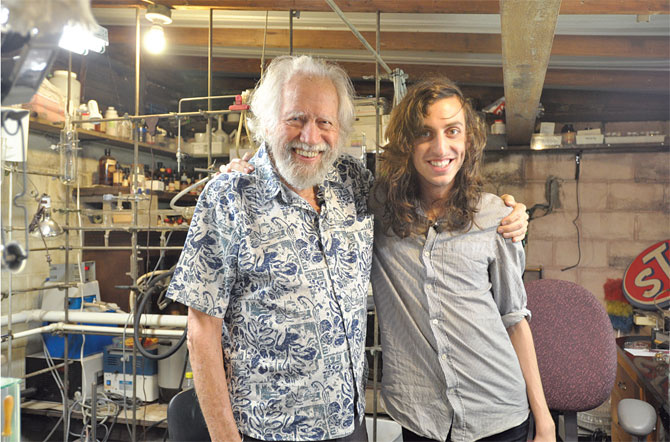
                      Alexander "Sasha" Shulgin, with fan Hamilton Morris, in Shulgin's 
                      home lab in Lafayette, CA. Photo probably by Ann Shulgin?


Fans of Robert Anton Wilson will be familiar with this idea of Reich's books being burned by the Unistat government less than 15 years after we supposedly fought a war against fascism, because, among other things, those fascists violated our basic ideas about freedom of information, and they burned books. (See RAW's Wilhelm Reich In Hell, for the uninitiated.)

Take a moment or two and ponder the AMA-FDA burning Reich's books, and Shulgin's recipes flying all over the world, to some exotic place where people are now tripping on some analogue of mescaline or DMT, or Ecstasy.

Also: those seeking to buy their own copies of PIHKAL and TIHKAL via online vendors: caveat emptor; the fascists no doubt are monitoring the movement of these books. I have them for my own "Walter Mitty" reasons I've discussed many times before here in blogspews about "dangerous" or "demonic" books. I somehow manage to screw up microwave dinners, so I'm a far cry from being able to understand, much less cook up something like Shulgin's underground favorite (or one of 'em), 2C-B:

"A solution of 100 g of 2,5-dimethoxybenzaldehyde in 220 g nitromethane was treated with 10 g anhydrous ammonium acetate, and heated on a steam bath for 2.5 h with occasional swirling. The deep-red reaction mixture was stripped of the excess nitromethane under vacuum, and the residue crystallized spontaneously. This crude nitrostyrene was purified by grinding under IPA, filtering and air-drying, to yield 85 g of 2,5-dimethoxy-(Greek beta letter)- nitrostyrene as a yellow-orange product of adequate purity for the next step..." (PIHKAL, p.503)

The text goes on to make the previous look like "heat on high for 4 minutes, remove, wrapper, let cool for one minute before eating." It gets way out there. It's like reading some experimental poetry to me: I don't get it at all, but the odd linguistic effects of reading it give a sort of Joycean thrill. Clearly, I want my future psychedelic bathtub chemists to have at least gotten an "A" in Organic Chemistry Lab. At a really good school.

Where's the buzz in having/reading the Shulgin cookbooks if you wouldn't know a methyl group if they ganged up on you behind the tennis courts? After all his abstruse chemical prose, there are always abrupt, jarring tonal shifts in prose: trip reports from his select group of elect psychonaut explorers of inner space, scattered around Berkeley, Oakland, and San Francisco (Shulgin's lab was on his property in nearby Lafayette, California). And now, one would guess, because of the dissemination of the two books all over the world, there are vast unpublished trip reports for such Shulgin drugs as AMT; 5-MEO-DMT; 5-MEO-DIPT, 4-Acecoxy-DiPT, and DOB.

Drugs That Alter Auditory Perception
A second little thing: about psychedelics and perception of sound: In my old copy of Lee and Shlain's Acid Dreams, I ran across a wild line about the CIA developing futuristic drugs, and there was one that "only alters auditory perception, under its influences all sounds become atonal, while other human faculties remain unaffected." (p.292) The authors give no citation, and when I first read about this, years ago, I thought they had to have been taken in by someone, if not some CIA person, then someone who had been reading a lot of William S. Burroughs. This sounds like a WSB-invented fiction. I would like to think the drug was called "Schoenberg," but I didn't really believe a drug could be that specific in the brain.


That is, until I read about Shulgin's DIPT, which supposedly makes people hear music one octave lower (or so) than its normal pitch. That reminded me of trying to learn blazing fast scale passages from my favorite guitarists by putting the record on at 16rpm rather than 33 1/3: a Randy Rhoads passage played high on the neck suddenly sounds like it's down around the 2nd fret, with Ozzy sounding truly evil and not like the carnival barker I believed him to be in so-called "real life." And then I read about Takao Hensch, a Harvard (those guys again?) professor of molecular and cellular biology, who took adult non-musicians and had them do musical ear-training tests on valproic acid, a mood-stabilizing drug. The subjects developed perfect pitch! I'd love to have perfect pitch, but with follow-up research I see Hensch's subject group was small. Even more irritating: what valproic acid does is potentiate the brain's neuroplasticity: your brain gets a re-set to the time when you were very young, and soaking up language and info like a vast sponge. We could all learn quantum field equations! and Swahili! and Chinese! and...how to do chemistry like Shulgin!? Ah, but the Big Caveat: the brain's neuroplasticity and our earlier "critical periods" for learning (before some neural window closed on us) seem very basic, and evolution probably did that for some good reason, which we won't want to tamper with. For right now, my main model to reason with this is If It Sounds Too Good To Be True, It Probably Is Too Good To Be True. So, we probably ought not tamper with this ancient system of learning.

But we will. Someone will, right? Stay...<ahem> "tuned." Maybe this will turn out to be Something Veddy Innaresting...

Cannabis Potency: A Law-Enforcement Myth That Even Most Pot Smokers Believe?
You've all heard this one: the pot you find now is 10 to 30 times stronger than the stuff the hippies were smoking in the late 1960s/early 1970s. I remember when we bought dime bags of Acapulco Gold and Panama Red: stringy, leafy, stems-and-seedy stuff we loved. Rarely anything that looked like an actual bud. And then rarely we'd find some guy who'd have Thai Stick (awesome!), or even more rarely, "Hawaiian," like Maui Wowie, which was the best stuff I'd ever had. Then, as recounted wonderfully in Michael Pollan's book, The Botany of Desire, Reagan got elected and started a campaign of spraying the Mexican pot crops with paraquat, an herbicide linked to Parkinson's Disease. And so, as Pollan writes, our best gardeners went underground, played with the genes of various strains of cannabis and came up with the most amazingly strong weed, which was grown in the Emerald Triangle of far northern California. And when "sensimilla" (without seeds: a truly utopian concept at the time) filtered into my suburb of Los Angeles, circa 1982: I took one hit and felt like I was on acid. So for awhile even I believed the stories about vastly increased potency.

But I had had conversations with renegade pot growers, guys who really knew their stuff, and they said that was all Cop Propaganda. I said, but what about all the amazing buds you guys have come up with, like Blue Cheese, Purple Urkel, Green Crack, and others? They said that stuff was always around, but I was too penurious to be able to afford it. Because it was scarce. Only the Beautiful (and rich) Dope Smokers were indulging in stuff like Dogshit Orgasm or Purple Kush...But still I was skeptical.

Then I read Ben Goldacre's book Bad Science. Goldacre is a tireless debunker of "woo" and at one point in the book smelled bullshit about the "it's 30 times more potent now...so...the children will all be KILLED!" shit the cops were playing. He uses math and stats and logic to debunk increased potency since 1970. (see Goldacre, pp.189-193) I was impressed by his zeal and rationality, but...I had access to all sorts of weed that was so potent, so...good I required more dissentual data about increased potency. It turns out if you look, you can find.  I read Brian Preston's Pot Planet: Adventures in the Global Marijuana Culture, which I remember liking a lot, but I don't remember much about <cough>. Preston quotes an expert who says it's not true that pot is way more potent than in the 1970s; it's just that the very potent stuff [17%-30%THC] is way easier to find now.

                Blueberry Afgoo, left. NYC Diesel bud on right. Photos by Erik Christiansen

I've started to come around. I think Goldacre and Preston's expert are probably right; Pollan is not wrong; he's inadvertently explaining (in his wonderfully written chapter in Botany of Desire about cannabis) why the Really Good Stuff is so omnipresent now. And some people still doubt Progress!

Flying on LSD: Literally
Who knows the deep story about Captain Trips? Who was Al Hubbard, anyway? We have reason to suspect he's telling the truth about growing up poor in Kentucky and getting rich in uranium. Why disbelieve his stories and documents about working for the OSS (and then the CIA?) Aldous Huxley found him charming. (Two more disparate personalities you'll rarely find in a friendship, by the way. Hubbard was a spy, a Cold Warrior, and not educated. Aldous was nothing if not ridiculously well-educated.) Hubbard had a mystical experience on LSD, seeing himself being conceived during his parents' sex act. He flew all over the world in his own plane, with his seemingly unlimited supply of great acid. He wanted to turn on the world. Was his motivation on the level? And his ties to the highest levels of the Unistat government made his "Johnny Acidseed" jaunts easy. He received a happy birthday card from Ronald Reagan just before he died. At a party at Oscar Janiger's house in 1979, Timothy Leary greeted Captain Al with "I owe everything to you!" (Acid Dreams, p.293)

Now: I haven't flown anywhere in a long time, largely because 1.) before 9/11 every time I took my bags to airport I got sidelined while everyone else went on with their business of passing through security, waiting for their flight, etc. But not me. I always had to wait for my "security" to be cleared. Sometimes this only took five minutes. Other times: 30 minutes or more. Why? Because, at some point in the 1970s - this is all I've ever been able to get from airport security people and researches online - some person in Canada hijacked a plane, and they used a false name. That name is my exact name. (You may have seen this on 60 Minutes many years ago.) The hijacker used one of the most common Unistat names there is: "Robert Johnson." The name on my birth certificate is this name, although I've always gone by my middle name: Michael. But then I asked, "How come you cleared me six months ago, this is the same airline, and you have to clear me again?" Just following orders. So, my name is on a list, totally undeservedly so, and yet no one can do anything about it? Later I found out I could pay some fee to...someone and it would make all that go away. But I thought this was just bullshit. I still do.

Then: 9/11 and the quasi-fascistic/quasi-Kafkaesque TSA of true "security theater" arrived. I'll do a blog on how profoundly worthless the entire TSA security theater show is some other day. Or, as Ring Lardner said, "You could look it up."

Anyway: when I did fly, it was always a tad sensory overload to me. Aside from the security issues and the waiting, flying was a rich source of stimuli, observation, and odd perspectives that I actually enjoyed. (I once flew 16 hours to Tokyo, which was grueling and not fun at all. Another story...) The idea of being on LSD while flying just seems like too much to me. But not to Timothy Leary. Here he is in 1969. The Supreme Court had set him loose from a 30 year charge for having half an ounce of weed. He was finally free, after four years, to leave the country:

"In mixing sacrament for the trip I had accidentally taken too much and sat primly in the Air Iberia waiting room at JFK, rushing, sorting out James Bond paranoias, hoping that Franco's agents would fail to penetrate my disguise. (I've been busted three times in airports.)"

Leary and his wife Rosemary get on the plane. "Two elderly men in uniform tottered by, painfully lugging briefcases, gold teeth flashing forlorn smiles. 'They look like retired generals from the Spanish Civil War,' I whispered. 'Hush,' said Rosemary. 'They are our pilots.'"

Leary starts to get telepathic signals from the other elderly Spanish passengers. He imagines them all as old, committed fascists under the Franco regime. He says to Rosemary, "What have we got ourselves into this trip? This plane is like the second-class bus from Malaga to Torremolinos. It will never make the Atlantic!

"Rosemary was pretending she didn't know me. 'How much did you drop? Really!'" Leary felt like it took "3 1/2 hours to wheeze down the runway and takeoff." He's convinced the steward is a secret police agent. Eventually two Spanish stewardesses approach Leary. We know who you are...do you mind if we ask you some questions? Leary, to himself: "Here we go!"

The stewardesses asked Leary if he had any dope on him. He denied it. You always deny it, he'd learned. The stewardesses were disappointed. "What a drag. Our friends in Madrid will be disappointed. Well, at least give us your autograph."

Leary, taken aback, asked, but what about Catholic Spain, Franco, the secret police?

"Young people are the same all over the world, Doctor Timothy. [...] Young people like to get high and feel good and make love." (Jail Notes, pp. 137-138)

                                  Michael Horowitz in 1972. Photo by Timothy Leary

It's July 1970 and Leary is back in California, in prison. Recently he'd made Michael Horowitz his official archivist. Horowitz writes, "I was no longer a hippie minding his own business; I was now a member of the entourage/support team of the High Priest, the Disgraced Harvard Professor, the Pied Piper, the Acid Martyr - the world's best advocate of 'better living through chemistry.'"

Leary was doing 10 years for possession of two roaches. Leary had asked Horowitz to visit him in prison. Michael's friend came to his Berkeley apartment to drive him to the airport. Michael decided to cut a hit of strong Windowpane acid in half, to share with Leary. His friend honked his horn, and impulsively, Horowitz swallowed his half and kept the other half hidden underneath his fingernail. "The desire to be tripping on acid while meeting the High Priest of LSD got the better of me, so I slipped the other half under my tongue."

In less than an hour Horowitz climbed into a Navaho Piper Cub to fly to the California Men's Colony at San Luis Obispo. Horowitz writes that he enjoyed flying while stoned, while I get a panic attack just reading about this...and typing it to you, Dear Reader. But just think: Horowitz was going to enter  the world of the Prison. As they approached, a sign said 20 years for bringing in "narcotics" or weapons. He became acutely aware of the "tiny thing under my thumbnail." Horowitz had a huge hippie 'fro, purple-tinted glasses, and a fringe-leather jacket with "Timothy Leary for Governor" on it, bell-bottom jeans. He felt all the guards were staring at him, and the paranoia, mounting, he wished the acid would quit coming on stronger and stronger. Hilariously, Horowitz writes, "What was I thinking? That this was something other than a fucking prison?"

"'Look at that freak visiting Leary!,' one of the guards hissed from across the room." As he's given multiple forms to fill out, using the writing hand that had the other half-hit of Windowpane under the nail, eight burly guards came up and surrounded him. He tried to read and fill out the forms, but the words swirled on the page. (If you've never done acid you have no idea how INSANE this scenario must have felt.)

When asked his purpose for the visit, Horowitz somehow blurted out "editorial and archival matters." One of the guards sneered, "What does that mean?" Michael answered.

He was directed to a gate. A guard said to another, "It looks like like he's on something, don't it?" And they laughed. Security doors, gates, drab prison dullness of walls, electronic security. Finally he meets Leary and they hug and Horowitz relaxes a little, buys them both a coffee and candy bars, feels less like "Joseph K visiting the Castle" and more like a fellow Merry Prankster. Finally, Leary realizes Horowitz is on acid.

"You're on acid? Shit! What do you think this is? Fillmore East? I'm looking at ten years! I desperately need your help - and you show up on acid!"

"I have some for you."

"Great. I just can't wait to trip in this place! Look around - it's the perfect set and setting, isn't it?"

"Sorry," I said, downcast, feeling I had totally blown it.

Leary perks up, tells Michael about the book he's writing on DNA and LSD and the stages of evolution and says, wait till the guard turns away before you slip me the hit of acid. Horowitz is elated: he gets to get high with Leary and hear him talk about his ideas. Then he looks down and notices the hit is gone: it's not on his fingernail.

"Um, Tim..."

Okay, so that was more about prison than flying. But when I first read this story (in Psychedelic Trips For the Mind, pp. 49-51), the flying in a Piper Cub to a prison was enough to give me an mild anxiety attack. What's all the fuss about whether we can explore parallel worlds as theorized by some High Priests of physics? We already have ways to explore parallel worlds. It's called literature.

Finally: Allen Ginsberg, while the Bard of the counterculture, had also, from an early age, believed in watching the watchers. He'd kept files and clippings and notes on the FBI, the CIA, police of all kinds, politicians, world leaders. (And you bet your ass they had a massive dossier on him, too.) He'd come to realize the CIA's role in disseminating LSD in Unistat, and it was always a hot topic of conversation with his friends.

From Ed Sanders's book The Poetry and Life of Allen Ginsberg:

                              October of '77
                              he was in the air on the way
                              to a symposium called LSD: A Generation Later
                                           at UC Santa Cruz

                              and dropped a hit on the plane
                                          thinking about the CIA and LSD.
                              Later at the symposium
                              he told what he'd done and asked
                     "Am I, Allen Ginsberg, the product of
                       one of the CIA's lamentable, ill-advised, or
                       triumphantly successful 
                                            experiments in mind control?"
                          (p. 129)

Other Writings Consulted
"SiHKAL: Shulgins I Have Known and Loved," by Hamilton Morris
Nomad Codes, Erik Davis, pp.207-211, wonderful writing on the impact of Shulgin
Visionary State, by Erik Davis. Contains two wonderful large, full-color photos of Shulgin's lab, taken by Michael Rauner.
Pharmako-Gnosis, by Dale Pendell. Stunning erudition throughout.
Storming Heaven, by Jay Stevens
"Why Harvest Opiates When You Can Get Yeast to Produce Them?"
Imagine Nation: The American Counterculture of the 1960s & '70s, pp. 17-40, "The Intoxicated State/Illegal Nation: Drugs in the Sixties Counterculture," by David Farber


                                            art by the wild Bobby Campbell